
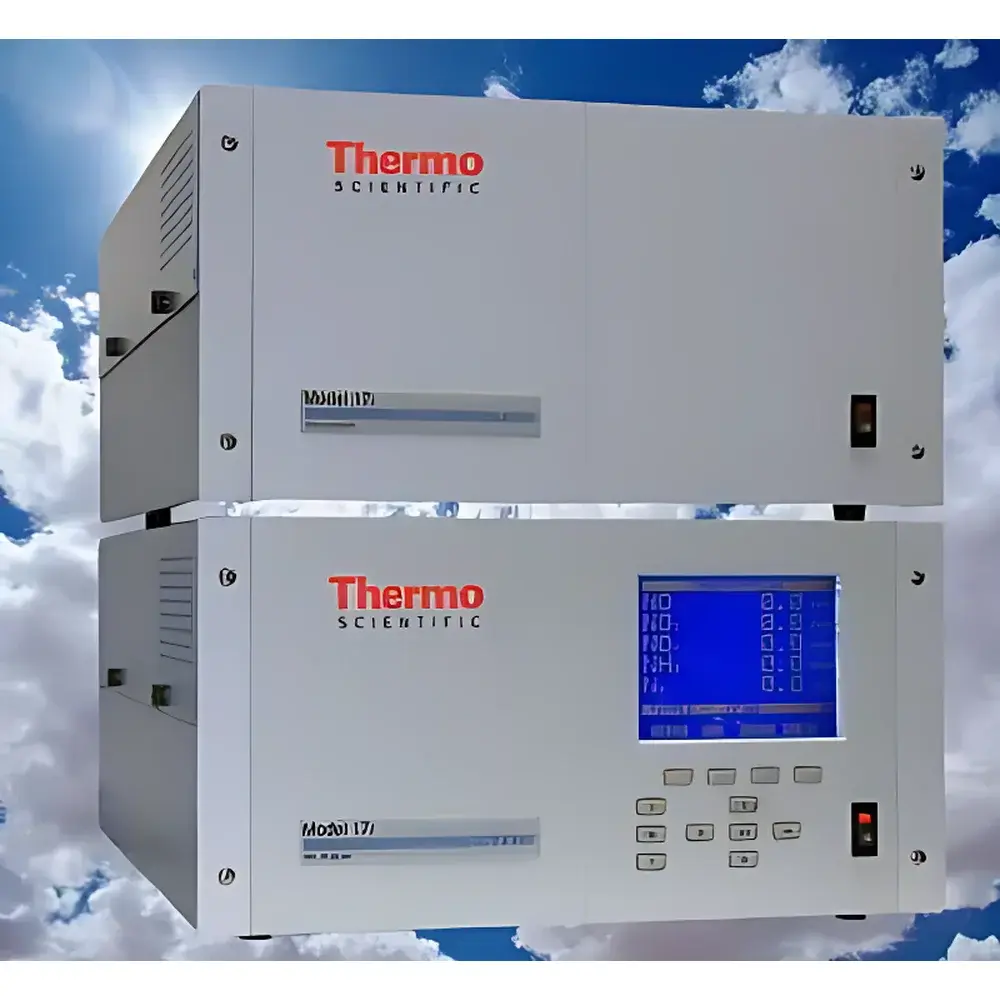
Thermo Fisher Scientific 17i Ammonia (NH₃) Analyzer
| Brand | Thermo Fisher Scientific |
|---|---|
| Origin | USA |
| Manufacturer Type | Original Equipment Manufacturer (OEM) |
| Origin Category | Imported |
| Model | 17i |
| Instrument Type | Online Gas Analyzer |
| Detection Principle | Chemiluminescence (NO + O₃ → NO₂* + hν) with Catalytic Conversion for NH₃ and NO₂ |
| Measurement Modes | NO, NOₓ, Nₜ |
| Output Signals | Analog (0–10 V / 4–20 mA), Digital (Ethernet), RS-232/RS-485 |
| Range Options | 0–50 to 0–20,000 ppb |
| Zero Noise | 0.5 ppb RMS (120 s averaging) |
| LOD | 1 ppb |
| Zero Drift (24 h) | ≤1 ppb |
| Span Drift (30 days) | ≤1% FS |
Overview
The Thermo Fisher Scientific 17i Ammonia (NH₃) Analyzer is a high-performance, online chemiluminescence-based gas analyzer engineered for continuous, real-time measurement of ammonia in ambient air, stack emissions, and industrial process streams. It operates on the well-established principle of nitrogen monoxide (NO) chemiluminescence: gaseous NO reacts quantitatively with ozone (O₃) in a reaction chamber to produce electronically excited nitrogen dioxide (NO₂*), which emits characteristic near-infrared photons upon relaxation. The intensity of this chemiluminescent signal is linearly proportional to the NO concentration. To extend detection to NH₃ and NO₂, the 17i integrates two thermally controlled catalytic converters—first a molybdenum (Mo) converter for NO₂-to-NO reduction, and second a stainless-steel (SS) converter capable of simultaneously converting both NO₂ and NH₃ to NO. By sequentially operating in NO, NOₓ (NO + NO₂), and Nₜ (NO + NO₂ + NH₃) modes, the instrument enables precise, interference-free derivation of NH₃ concentration via differential calculation (Nₜ − NOₓ). This architecture eliminates cross-sensitivity from common interferents such as water vapor, CO₂, and hydrocarbons, delivering exceptional selectivity essential for regulatory-grade environmental monitoring.
Key Features
- Triple-mode chemiluminescence architecture (NO, NOₓ, Nₜ) enabling simultaneous, trace-level quantification of NH₃, NO, NO₂, NOₓ, and total reactive nitrogen (Nₜ)
- Dual interchangeable catalytic converters: Mo-based for NO₂ conversion; high-efficiency stainless-steel converter optimized for quantitative NH₃-to-NO conversion at elevated temperatures (≥650 °C)
- Sub-part-per-trillion detection capability: <1 ppb limit of detection (LOD) and 0.5 ppb RMS zero noise (120 s averaging), meeting stringent requirements for background air quality networks (e.g., EPA SLAMS, EMEP)
- Modular hardware design with field-replaceable optical bench, ozone generator, and reaction chamber—minimizing downtime and supporting long-term operational stability
- Integrated Ethernet interface compliant with TCP/IP v4, enabling remote configuration, real-time data streaming, and firmware updates over local area networks or secure VPN connections
- Onboard flash memory (≥2 GB) supporting >1 year of high-resolution (1 Hz) data logging with timestamped audit trails, fully compliant with EPA Method 205 and ISO 14956 data integrity requirements
- Configurable time constants (0.1–30 s), user-defined alarm thresholds, and programmable soft keys for rapid method switching in multi-pollutant monitoring applications
Sample Compatibility & Compliance
The 17i is designed for continuous sampling of ambient air, flue gas (diluted or conditioned), and clean process streams. Sample inlet accepts standard ¼″ OD PTFE or stainless-steel tubing; optional heated sample lines (up to 180 °C) prevent NH₃ adsorption and condensation artifacts. All wetted materials—including the SS converter, reaction chamber, and flow path—are passivated to minimize surface-catalyzed losses. The analyzer meets key international performance standards: EPA Performance Specification 18 (PS-18) for NH₃ analyzers, EN 14625:2012 for chemiluminescence NOₓ/NH₃ instruments, and ISO 15714:2021 for ambient air quality—nitrogen compounds. Its firmware supports 21 CFR Part 11-compliant electronic signatures, audit trails, and role-based access control—making it suitable for GLP, GMP, and regulated emissions reporting environments.
Software & Data Management
Instrument operation and data handling are managed via Thermo Fisher’s iSeries Control Software (v4.2+), a Windows-based application supporting local and remote deployment. The software provides full parameter configuration—including converter temperature profiles, calibration schedules, and mode sequencing logic—as well as automated zero/span validation logs. All measurements are stored with embedded metadata (instrument ID, operator, calibration status, ambient T/P). Raw and processed data export formats include CSV, NetCDF, and EPA-compatible .DAT files. Remote access is enabled through HTTP/HTTPS APIs and Modbus TCP, facilitating integration into SCADA, EMS, and central data acquisition systems. Audit logs record all user actions, configuration changes, and calibration events with immutable timestamps—ensuring full traceability per ISO/IEC 17025 and EU 2017/1463 requirements.
Applications
- Ambient air quality monitoring networks (AQN) for compliance with WHO guidelines and EU Directive 2008/50/EC on NH₃ exposure limits
- Industrial fence-line monitoring at fertilizer plants, livestock facilities, and wastewater treatment centers
- Stack emission testing for NH₃ slip in selective catalytic reduction (SCR) systems used in power generation and cement manufacturing
- Research-grade flux measurements using eddy covariance setups requiring fast-response, low-drift NH₃ detection
- Calibration reference for portable sensors and diffusion tube networks via dynamic dilution systems
FAQ
How does the 17i distinguish NH₃ from NO₂ in the same sample stream?
The 17i uses sequential catalytic conversion: first, the Mo converter reduces NO₂ to NO (measuring NOₓ); then, the stainless-steel converter reduces both NO₂ and NH₃ to NO (measuring Nₜ). NH₃ concentration is derived mathematically as Nₜ − NOₓ.
Is the stainless-steel NH₃ converter certified for quantitative conversion efficiency?
Yes—the converter is validated per ASTM D6348-18 Annex A4, demonstrating ≥98.5% NH₃-to-NO conversion efficiency across 0–10,000 ppb at 675 °C, with <±1.5% inter-converter variability.
Can the 17i be integrated into an existing EPA-certified CEMS?
Yes—it complies with 40 CFR Part 60 Appendix B PS-18 and supports QAL2/QAL3 verification protocols required for CEMS certification under EU IED and US NSPS.
What maintenance intervals are recommended for routine operation?
Ozone generator: 6 months; optical window cleaning: quarterly; catalytic converters: 12–18 months depending on sample matrix; full system calibration: semi-annually or per QA/QC schedule.
Does the 17i support automatic zero/span correction during unattended operation?
Yes—integrated solenoid valves enable scheduled zero air and span gas injections; all events are logged with validation metrics (e.g., % recovery, drift rate) for regulatory reporting.







