
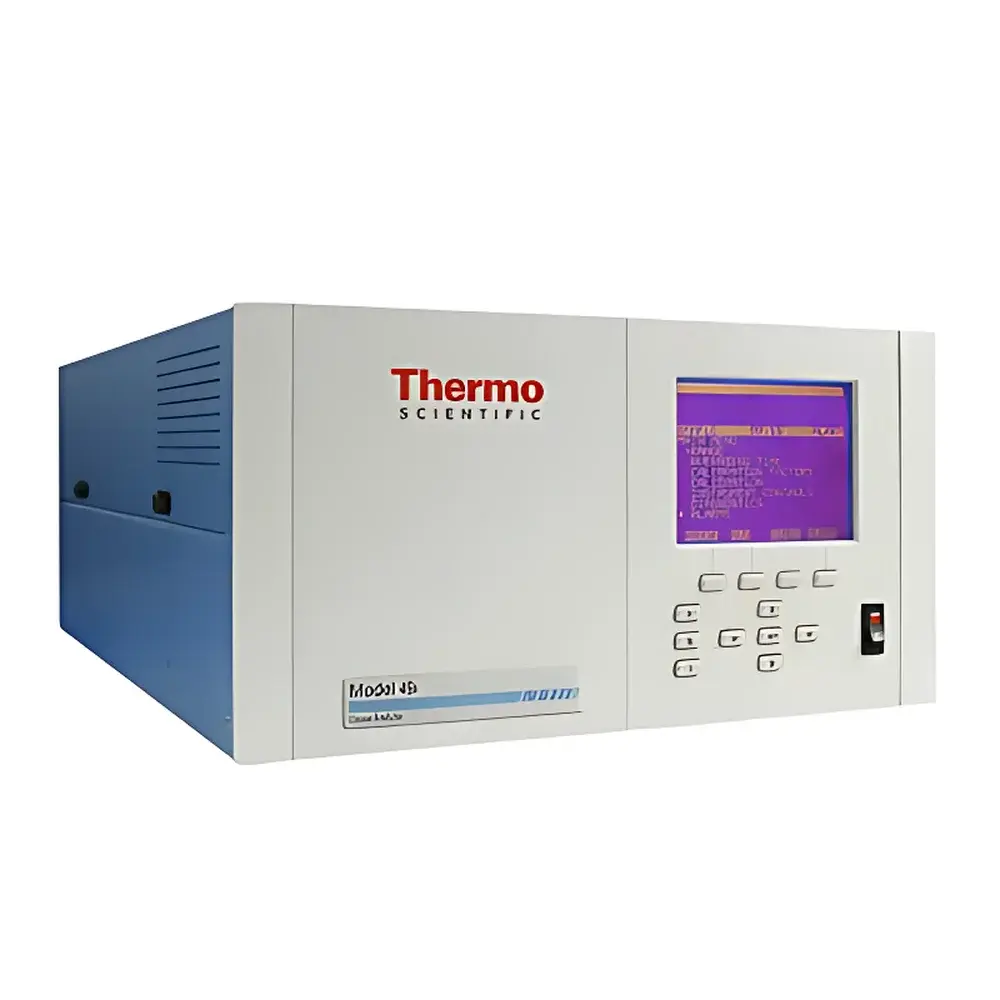
Thermo Fisher Scientific 49i Ozone (O₃) Analyzer
| Brand | Thermo Fisher Scientific |
|---|---|
| Origin | USA |
| Manufacturer Type | Original Equipment Manufacturer (OEM) |
| Product Category | Imported Instrument |
| Model | 49i |
| Instrument Type | Online Continuous Monitor |
| Measurement Range | 0–0.05, 0.1, 0.2, 0.5, 1, 2, 5, 10, 20, 50, 100, 200 ppm |
| Lower Detection Limit | 0.5 ppb |
| Response Time (T₉₀) | 20 s |
| Zero Drift (24 h) | <1.0 ppb |
| Span Drift (30 days) | <1% of full scale |
| Resolution | 1.0 ppb |
| Zero Noise | 0.25 ppb RMS (60-s averaging) |
Overview
The Thermo Fisher Scientific 49i Ozone (O₃) Analyzer is a high-precision, continuous online monitoring instrument engineered for regulatory-grade ambient air quality measurement and industrial process control applications. It operates on the principle of ultraviolet (UV) photometry at 254 nm, leveraging the strong and selective absorption characteristics of ozone in the UV-C spectral region. This well-established, NIST-traceable methodology ensures compliance with U.S. EPA Reference Method EQOA-0808-193 and equivalent international standards including ISO 13964 and EN 14625. The analyzer features dual-beam optical architecture with temperature-stabilized UV lamps and precision interference filters to minimize drift and enhance long-term stability. Its robust design supports unattended operation in demanding environmental monitoring stations, urban air quality networks, cleanroom environments, and ozone generator output verification systems.
Key Features
- UV photometric detection at 254 nm with dual-beam optical path for inherent compensation of lamp intensity fluctuations and window fouling
- Twelve user-selectable concentration ranges (0–0.05 to 0–200 ppm), automatically configurable via front-panel interface or remote command
- Sub-part-per-trillion baseline noise performance: 0.25 ppb RMS (60-second average), enabling reliable quantification near background levels
- Fast T90 response time of ≤20 seconds—critical for capturing transient ozone events in photochemical smog studies
- Zero drift <1.0 ppb over 24 hours and span drift <1% of full scale per month—meeting stringent QA/QC requirements for regulatory reporting
- Integrated flash memory (≥16 MB) supporting local storage of calibrated analog outputs, diagnostic logs, and event-triggered data snapshots
- Large backlit LCD display with customizable soft keys for intuitive navigation, real-time diagnostics, and parameter configuration without external software
- Modular internal layout with tool-less access to optical cell, lamp assembly, and electronics—reducing mean time to repair (MTTR) during field maintenance
Sample Compatibility & Compliance
The 49i is designed for continuous analysis of ambient air, stack emissions, and controlled process streams. Sample inlet accepts standard 1/4″ OD PTFE or stainless-steel tubing; optional heated sample lines and particulate filters are available for high-humidity or aerosol-laden environments. All wetted materials—including flow path, valves, and optical cell—are chemically inert (e.g., electropolished 316L SS, fused silica, PTFE) to prevent catalytic decomposition of ozone. The analyzer conforms to U.S. EPA Performance Specification PS-2 for ozone analyzers and satisfies data integrity requirements under 40 CFR Part 58 Appendix A. Its firmware architecture supports audit trails, electronic signatures, and secure user-level access control—facilitating compliance with FDA 21 CFR Part 11 and GLP/GMP environments where traceability is mandated.
Software & Data Management
Remote operation and data retrieval are supported via built-in RS-232/RS-485 serial interfaces and optional Ethernet module (Model 49i-E). The instrument communicates using ASCII-based command protocol compatible with SCADA, DAQ, and Telemetry systems. Thermo’s proprietary Instrument Manager software (Windows-based) enables firmware updates, calibration scheduling, trend visualization, and automated report generation in PDF/CSV formats. All calibration events—including zero/span checks, multi-point linearity verifications, and sensor diagnostics—are timestamped and stored with operator ID and reason-for-change metadata. Data export supports UTC-synchronized timestamps and includes raw absorbance values, temperature/pressure-corrected concentrations, and system health flags—ensuring full transparency for regulatory audits.
Applications
- Ambient air quality monitoring networks (e.g., U.S. AirNow, EU Air Quality Directive reporting)
- Photochemical assessment in urban and rural atmospheric research campaigns
- Verification and feedback control of ozone generators used in water treatment, semiconductor fabrication, and surface sterilization
- Indoor air quality (IAQ) monitoring in healthcare facilities and laboratories subject to ASHRAE Standard 62.1
- Calibration transfer standards for secondary ozone monitors and portable sensors
- Long-term trend analysis in climate and tropospheric chemistry studies requiring sub-ppb stability
FAQ
What UV wavelength does the 49i use for ozone detection?
The 49i employs a low-pressure mercury vapor lamp emitting at 254 nm—the peak absorption wavelength for ozone in the Hartley band.
Is the 49i compliant with U.S. EPA reference method requirements?
Yes. It meets EPA Reference Method EQOA-0808-193 and has been designated as an Equivalent Method (EQ) under 40 CFR Part 53.
Can the 49i operate in high-humidity environments?
It is rated for operation up to 95% RH non-condensing; optional Nafion® dryer or heated inlet accessories are recommended for sustained >80% RH exposure.
How often does the instrument require zero and span calibration?
Per EPA guidance, automatic zero/span checks are recommended every 24 hours; full multi-point calibration is advised quarterly or after maintenance.
Does the 49i support analog output for integration with existing PLC or DCS systems?
Yes—standard 4–20 mA and 0–10 VDC outputs are configurable for any selected range, with isolated current loops and NIST-traceable scaling.
Related Products







