
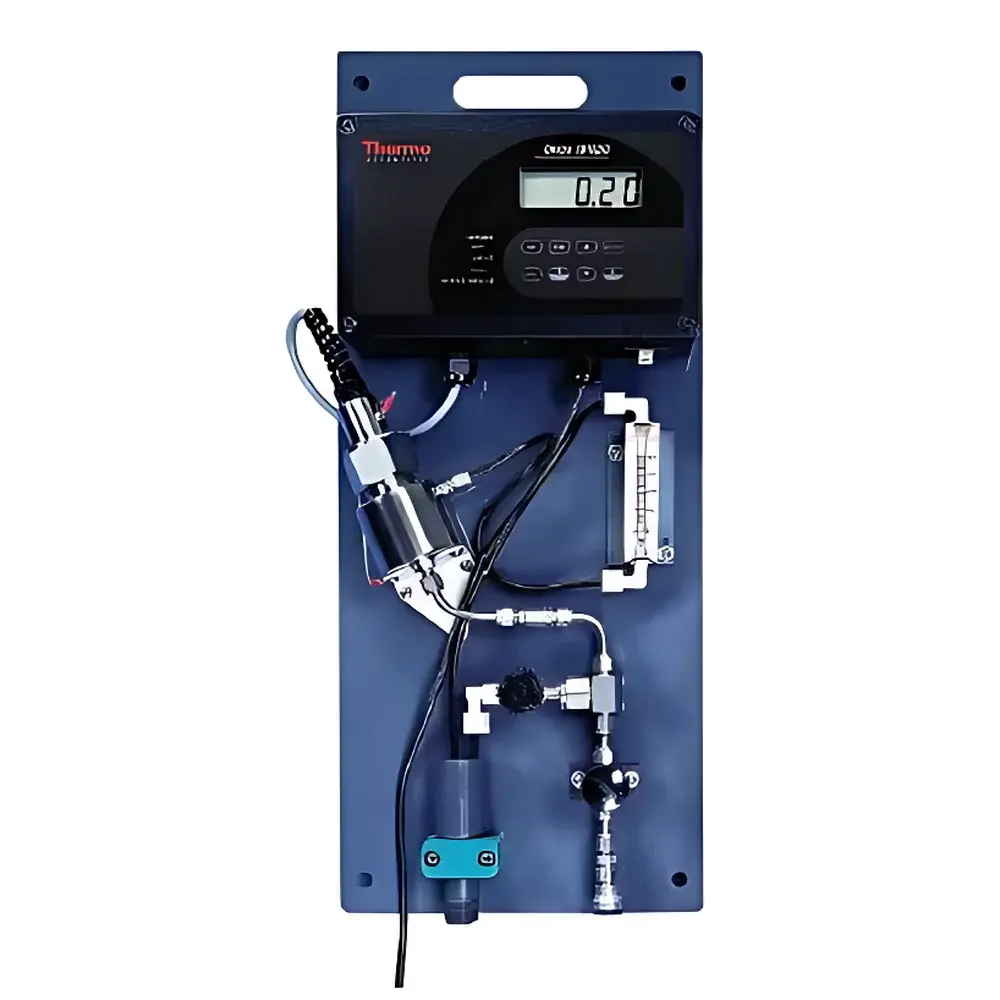
Thermo Scientific 1816DO Dissolved Oxygen Analyzer
| Brand | Thermo Fisher |
|---|---|
| Origin | USA |
| Manufacturer | Thermo Fisher Scientific |
| Product Category | Imported Instrument |
| Model | Thermo Scientific 1816DO |
| Pricing | Available Upon Request |
Overview
The Thermo Scientific 1816DO Dissolved Oxygen Analyzer is a high-precision, galvanic cell-based online instrument engineered for continuous, ultra-low-level dissolved oxygen (DO) measurement in ultrapure water systems. Designed specifically for critical steam-cycle and power generation applications, it employs a self-powered galvanic electrochemical sensor—eliminating the need for external polarization voltage and delivering inherent stability and long-term drift resistance. Its measurement principle relies on the diffusion-controlled reduction of molecular oxygen at a noble metal cathode within an electrolyte-filled cell, generating a current proportional to the partial pressure of dissolved O₂. With a detection limit of 0.1 ppb and sub-ppb repeatability, the 1816DO meets stringent requirements for boiler feedwater, condensate, and deaerator outlet monitoring where oxygen ingress must be quantified at trace levels to prevent corrosion-induced failure in high-pressure thermal systems.
Key Features
- Galvanic sensor architecture with zero-power operation—no external bias required, ensuring intrinsic signal stability and extended electrode service life.
- True “absolute zero” reference capability, achieved through rigorous factory calibration and internal temperature-compensated electronics—enabling reliable baseline verification without manual zero-gas exposure.
- Patented guard-ring electrode design that actively suppresses parasitic oxygen diffusion from the electrolyte reservoir, enabling rapid recovery (<60 s) from high-to-low DO transitions—a critical requirement for dynamic process upsets.
- Integrated membrane-covered sensor with standardized replacement protocol; routine maintenance limited to monthly automated calibration, completed in under 5 minutes with no system shutdown.
- Stainless steel flow-through cell with dual-layer barrier construction—mechanically isolates the sensing zone from ambient air ingress while minimizing boundary-layer effects and pressure-induced artifacts.
- Onboard data logging capacity for 1000 timestamped measurements, supporting local trend analysis, alarm correlation, and basic diagnostics without external SCADA dependency.
Sample Compatibility & Compliance
The 1816DO is validated for use with ultrapure water (UPW) streams meeting ASTM D5127, ISO 3696 Grade 1, and SEMI F63 specifications. It operates continuously across a temperature range of 5–50 °C and pressures up to 10 bar (gauge), with full compensation for temperature, pressure, and salinity (0–100 µS/cm conductivity). The analyzer complies with IEC 61508 SIL 2 functional safety requirements for safety-related instrumentation and supports audit-ready operation per FDA 21 CFR Part 11 when integrated with compliant DCS or historian systems. Its mechanical design conforms to ASME B31.1 Power Piping Code for installation in boiler feedwater circuits and satisfies EPRI TR-102342 guidelines for online DO monitoring in fossil and nuclear power plants.
Software & Data Management
The 1816DO features a built-in RS-485 Modbus RTU interface and optional 4–20 mA analog output with HART 7 protocol support. Configuration, calibration history, and diagnostic logs are accessible via front-panel keypad or remote web interface (when paired with Thermo Scientific Process Analytics Gateway). All calibration events—including date, operator ID (if entered), span/zero values, and sensor impedance—are time-stamped and stored with write-protected integrity. Data export is supported in CSV format for integration into LIMS or enterprise asset management (EAM) platforms. Audit trails meet GLP/GMP documentation standards, including user action logging and change tracking for all configuration parameters.
Applications
- Boiler feedwater monitoring in fossil-fueled and combined-cycle power plants to ensure compliance with <5 ppb DO limits per EPRI guidelines.
- Condensate polishing loop surveillance in nuclear power facilities, supporting ALARA (As Low As Reasonably Achievable) oxygen control objectives.
- Ultrapure water distribution systems in semiconductor fabrication fabs—verifying DO <1 ppb at point-of-use for wet bench process stability.
- Deaerator outlet verification in pulp & paper mills, where residual oxygen must be minimized prior to high-pressure steam injection.
- Pharmaceutical purified water (PW) and water-for-injection (WFI) systems, supporting USP and Annex 1 risk-based monitoring strategies.
FAQ
What is the minimum detectable dissolved oxygen concentration?
The 1816DO achieves a lower detection limit of 0.1 ppb (parts per quadrillion) under optimized flow and temperature conditions.
Does the analyzer require daily manual calibration?
No—automatic zero and span calibration is scheduled monthly; manual intervention is only required during sensor replacement or after major maintenance events.
Can the 1816DO be installed in pressurized UPW loops without sample conditioning?
Yes—the stainless steel flow cell is rated for direct in-line installation at operating pressures up to 10 bar (gauge), with no external pressure regulators or bypass lines needed.
Is the galvanic sensor compatible with hydrogen-saturated calibration gas?
No—galvanic sensors do not require zero-gas calibration; the “absolute zero” is established electrochemically and verified using certified low-oxygen standards (e.g., nitrogen-sparged UPW).
How is sensor drift monitored over time?
Drift is tracked via periodic impedance checks and calibration deviation logs; the analyzer flags deviations exceeding ±0.2 ppb from historical baselines and triggers configurable alarms.







