
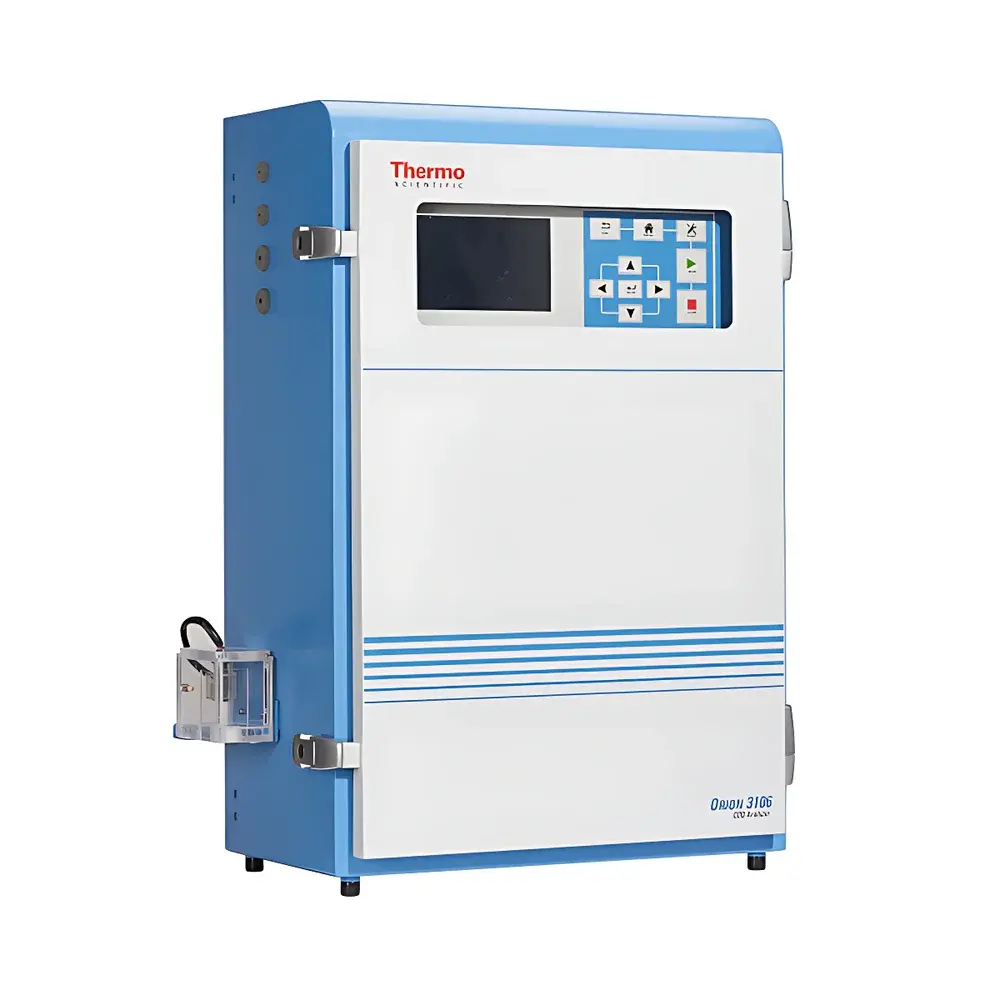
Thermo Fisher Orion™ 3106 Online Chemical Oxygen Demand (COD) Analyzer
| Brand | Thermo Fisher |
|---|---|
| Origin | Shanghai, China |
| Manufacturer Type | Original Equipment Manufacturer (OEM) |
| Product Origin | Domestic (China) |
| Model | Orion™ 3106 COD |
| Instrument Type | Online Analyzer |
| Measurement Principle | Potassium Dichromate Oxidation Digestion (Online Mode) |
| Detection Wavelength | 450 nm |
| Measurement Ranges | 20–200–800–2000 mg/L (auto-ranging) |
| Accuracy | ±5 mg/L (for values <50 mg/L) or ±10% (for values >50 mg/L) |
| Repeatability | ≤5% RSD |
| Limit of Detection (LOD) | 4 mg/L |
| Cycle Time | 40 minutes per sample |
| Sample Throughput | Up to 500 samples per batch |
Overview
The Thermo Fisher Orion™ 3106 Online Chemical Oxygen Demand (COD) Analyzer is an industrial-grade, fully automated water quality monitoring system engineered for continuous, unattended operation in municipal wastewater treatment plants, industrial effluent discharge points, and environmental compliance monitoring stations. It implements the standardized potassium dichromate oxidation digestion method—aligned with HJ 353–2019, HJ 354–2019, HJ 355–2019, and HJ 356–2019 (China’s Technical Specifications for Automatic Wastewater Monitoring Systems)—to quantify the oxygen demand exerted by oxidizable substances, including organic compounds, nitrites, ferrous ions, sulfides, and other reducing agents. Unlike laboratory-based COD analyzers, the Orion™ 3106 integrates digestion, colorimetric detection, and fluidic control into a single ruggedized platform designed for 24/7 deployment under variable ambient conditions. Its optical architecture employs a stable 450 nm LED light source (rated lifetime ≥30,000 hours), ensuring long-term photometric consistency without lamp replacement or recalibration drift.
Key Features
- Auto-ranging measurement capability across four dynamic ranges (20, 200, 800, and 2000 mg/L COD), with seamless range switching performed without manual intervention or revalidation of calibration coefficients;
- Integrated digestion module operating at controlled temperature and time (optimized per HJ 353–2019), enabling complete oxidation of refractory organics while minimizing chloride interference through matrix-matched digestion protocols;
- Self-diagnostic routines including automatic zero/span verification using certified reference standards, scheduled tubing flushing, and flow-path integrity checks to ensure data continuity and reduce unscheduled downtime;
- IP66-rated enclosure constructed from corrosion-resistant stainless steel and UV-stabilized polycarbonate, qualified for outdoor installation in high-humidity, dusty, or chemically aggressive environments;
- Embedded touchscreen HMI with intuitive navigation, multilingual support (English, Chinese, Spanish), and real-time visualization of digestion status, absorbance signals, and QC flagging;
- Onboard data logger with non-volatile memory supporting ≥2 years of 15-minute interval records (including raw absorbance, calculated COD, calibration logs, and maintenance events); data export via USB 2.0 interface in CSV format compliant with LIMS ingestion protocols.
Sample Compatibility & Compliance
The Orion™ 3106 accepts raw influent, secondary effluent, and tertiary treated wastewater without pre-filtration (inlet particle size tolerance ≤1 mm). It accommodates total suspended solids (TSS) up to 500 mg/L and chloride concentrations up to 2000 mg/L—within the operational envelope defined by HJ 353–2019 for routine monitoring applications. All analytical outputs are traceable to NIST-traceable potassium hydrogen phthalate (KHP) standards. The instrument carries CCEP (China Environmental Protection Product Certification), CE marking (per Directive 2014/30/EU on EMC and 2014/35/EU on LVD), CMC (China Metrology Accreditation), and conforms to ISO/IEC 17025:2017 requirements for testing laboratories when operated under documented QA/QC procedures. It supports audit-ready electronic records meeting GLP principles and aligns with data integrity expectations outlined in FDA 21 CFR Part 11 for regulated environments where trend analysis informs process control decisions.
Software & Data Management
Firmware v3.2+ includes embedded data validation logic that flags outliers based on ICH Q2(R2)-informed robustness thresholds (e.g., absorbance stability during measurement window, digestion temperature deviation >±2°C). Remote configuration and firmware updates are supported via secure HTTPS-enabled web interface (TLS 1.2+), with role-based access control (admin/operator/viewer). Historical datasets include full audit trails: timestamped operator actions, calibration history with standard lot numbers, and system error codes mapped to diagnostic resolution guides. Exported files contain embedded metadata (instrument ID, firmware version, method ID, analyst ID if logged in) to satisfy chain-of-custody documentation needs in regulatory reporting workflows.
Applications
- Real-time compliance monitoring at municipal wastewater treatment plant discharge outfalls per HJ 356–2019;
- Process optimization in industrial sectors including pulp & paper, pharmaceutical manufacturing, food & beverage, and petrochemical refining;
- Early-warning detection of shock loads (e.g., accidental chemical spills or upstream bypass events) in combined sewer systems;
- Long-term trend analysis for environmental impact assessments and permit renewal submissions;
- Integration with SCADA and DCS platforms via Modbus TCP or 4–20 mA analog output (isolated, HART-enabled optional).
FAQ
Does the Orion™ 3106 require daily manual maintenance?
No—routine maintenance intervals are extended to 30 days for reagent replacement and 90 days for full system cleaning, enabled by its self-flushing manifold and low-reagent-consumption digestion protocol.
Can it operate reliably in high-chloride wastewater streams?
Yes; the analyzer applies a chloride compensation algorithm validated against spiked reference matrices up to 2000 mg/L Cl⁻, consistent with HJ 353–2019 Annex B.
Is remote diagnostics supported?
Yes—embedded SNMPv3 agent enables network-level health monitoring (CPU load, memory usage, communication latency), and diagnostic logs can be retrieved via secure FTP or email alert on critical fault conditions.
How is calibration traceability ensured?
All factory calibrations use KHP standards certified to ISO/IEC 17025-accredited reference laboratories; field calibrations require only NIST-traceable liquid standards with documented uncertainty budgets.
What cybersecurity measures are implemented?
Firmware enforces TLS 1.2+ for all remote interfaces, disables unused services (e.g., Telnet, FTP), and supports certificate-based authentication for administrative access—aligned with IEC 62443-3-3 SL2 requirements for industrial control systems.
Related Products







