
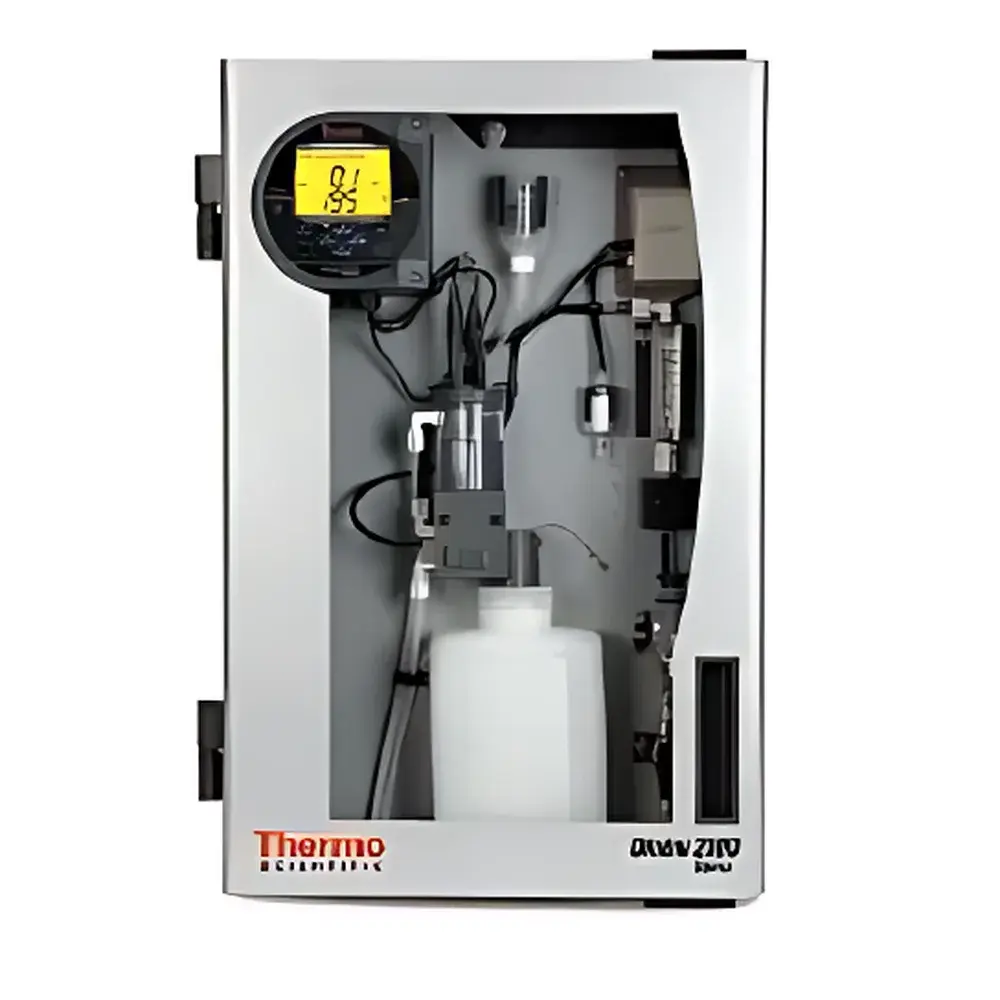
Thermo Scientific 2117HL High-Level Chloride Analyzer
| Brand | Thermo Fisher |
|---|---|
| Origin | USA |
| Manufacturer | Thermo Fisher Scientific |
| Product Category | Imported Instrument |
| Model | Thermo Scientific 2117HL |
| Pricing | Available Upon Request |
Overview
The Thermo Scientific 2117HL High-Level Chloride Analyzer is a robust, maintenance-optimized online analyzer engineered for continuous, reagent-free measurement of chloride concentration in industrial process and reclaimed water streams. It operates on the principle of potentiometric ion-selective electrode (ISE) detection, utilizing a proprietary solid-state chloride-selective membrane electrode that delivers stable, drift-resistant response across high-concentration ranges. Unlike colorimetric or titrimetric methods, the 2117HL eliminates chemical reagents, liquid handling systems, and optical components—reducing failure points and long-term cost of ownership. Designed specifically for applications where chloride monitoring directly impacts system integrity (e.g., reverse osmosis concentrate streams, cooling tower blowdown, or boiler feedwater recirculation), it provides real-time insight into concentration ratios critical for water reuse optimization and corrosion risk mitigation.
Key Features
- Reagent-free operation: No consumable reagents, pumps, or tubing—eliminates calibration drift from reagent degradation and reduces total cost of ownership.
- High-range chloride measurement: Engineered for reliable quantification from 75 ppm to 1000 ppm Cl⁻, optimized for concentrated process streams where conventional low-range analyzers saturate or require dilution.
- Dual-point known-addition (DKA) calibration: A traceable, user-guided calibration protocol that compensates for electrode slope deviation and junction potential without reference standards—enabling rapid return to measurement mode with documented audit trail.
- Industrial-grade electrode architecture: Solid-contact, polymer-based chloride ISE with integrated temperature compensation; designed for >18-month operational stability under continuous flow conditions.
- Backlit graphical LCD display: 128 × 64 pixel monochrome display with intuitive menu navigation, supporting simultaneous viewing of live concentration, temperature, electrode mV output, and diagnostic status.
- Minimal mechanical complexity: Zero moving parts, no peristaltic pumps, no valves, and no sample filtration modules—maximizing uptime and reducing scheduled maintenance intervals.
- Fast response and stabilization: Achieves <90% step response in ≤45 seconds and reaches electrochemical equilibrium within 2 minutes under typical flow rates (100–300 mL/min).
Sample Compatibility & Compliance
The 2117HL is validated for use with clarified, non-oily aqueous streams exhibiting pH 4.5–8.5 and suspended solids <10 mg/L. It is compatible with stainless steel (316 SS) and PVC sample housings and supports standard ¼" NPT or compression fittings. The analyzer meets IP65 enclosure rating for panel-mounted installation in industrial environments. While not certified as SIL2 or ATEX-compliant out-of-the-box, its analog 4–20 mA and Modbus RTU outputs are compatible with third-party safety instrumented systems (SIS). Data logging and configuration changes comply with GLP principles when used with optional Thermo Scientific Orion StarLink software, supporting time-stamped event records and operator ID tagging for FDA 21 CFR Part 11 readiness.
Software & Data Management
The 2117HL integrates seamlessly with Thermo Scientific’s Orion StarLink™ Suite (v3.2+), enabling remote configuration, historical trend analysis, alarm management, and electronic calibration log export (CSV/PDF). All calibration events—including DKA parameters, electrode offset, and slope—are stored with timestamps, user IDs, and pass/fail flags. Audit trails are exportable for internal QA review or regulatory submission. The device supports configurable alarm thresholds (high/low, rate-of-change), hysteresis settings, and hold-on-alarm behavior to prevent nuisance tripping in fluctuating processes. Data retention includes 30 days of 1-minute interval measurements onboard, expandable via external SCADA integration.
Applications
- Monitoring concentration ratio in municipal and industrial greywater/industrial wastewater reuse circuits—enabling dynamic control of blowdown volume and antiscalant dosing.
- Chloride surveillance in power plant condensate polishing loops and feedwater systems to prevent stress corrosion cracking in austenitic alloys.
- Process water quality assurance in semiconductor fab ultrapure water (UPW) pretreatment stages, particularly post-RO concentrate monitoring.
- Real-time chloride tracking in food & beverage CIP rinse water recovery loops to ensure compliance with NSF/ANSI Standard 151.
- Agricultural irrigation water assessment where chloride accumulation threatens soil permeability and crop yield—deployed at district-level distribution nodes.
FAQ
Does the 2117HL require daily calibration?
No. Under stable process conditions, DKA calibration is recommended every 7–14 days. Electrode performance validation (via mV check against known standard) can be performed weekly without full calibration.
Can it be installed in an outdoor cabinet exposed to ambient temperature swings?
Yes—provided the cabinet maintains internal temperature between 5 °C and 45 °C and relative humidity <85% non-condensing. Optional thermostatically controlled enclosures are available for extreme climates.
Is the electrode compatible with high-turbidity or high-organic-content samples?
It requires pre-filtration for samples with >10 mg/L suspended solids or >5 mg/L dissolved organic carbon (DOC) to prevent membrane fouling. Inline 5-µm cartridge filters are recommended upstream.
How is data security handled during remote access?
StarLink communication uses TLS 1.2 encryption for cloud-based sessions; local network access employs password-protected HTTP/S with role-based permissions (Operator, Technician, Administrator).
What is the expected electrode service life under continuous operation?
Typical field service life exceeds 18 months in clean, non-abrasive streams; replacement intervals are tracked automatically and reported via the diagnostics screen and StarLink alerts.







