
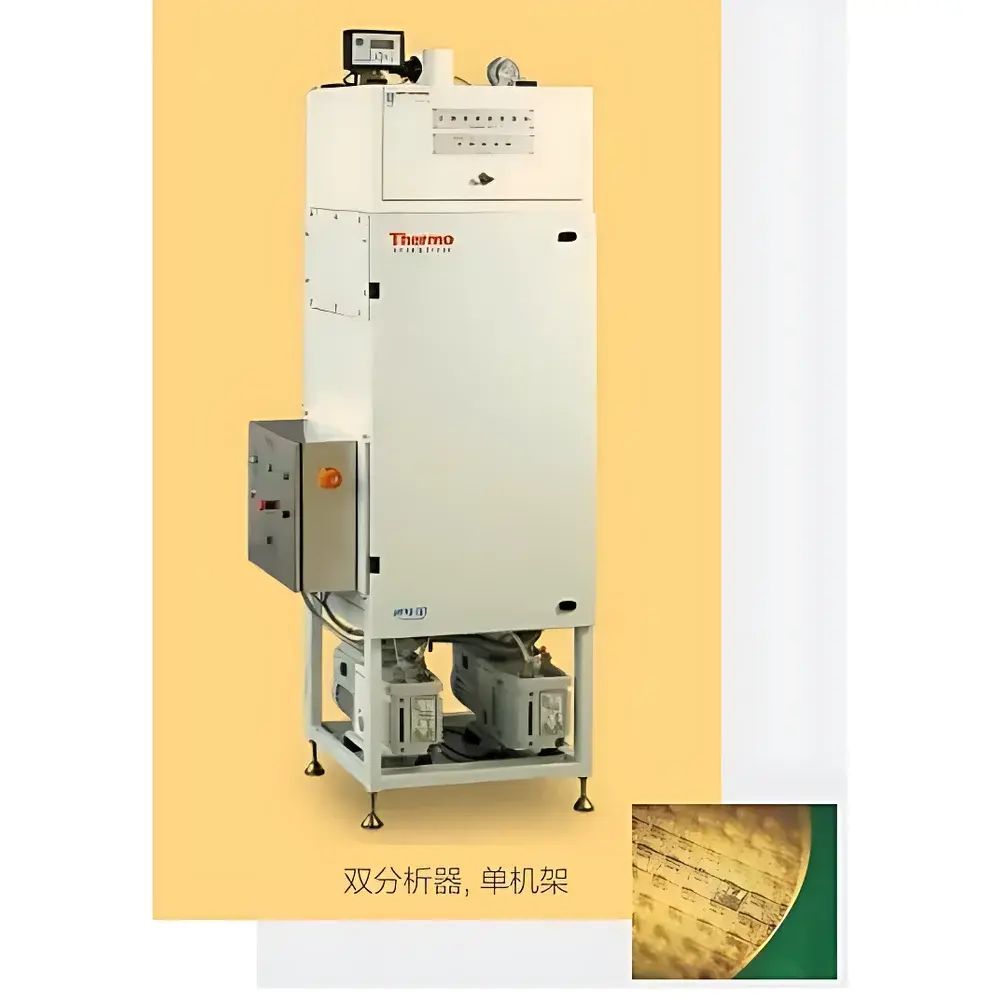
Thermo Scientific APIX Ultra-High-Purity Electronic Gas Mass Spectrometer
| Brand | Thermo Fisher |
|---|---|
| Origin | USA |
| Manufacturer Type | Original Equipment Manufacturer (OEM) |
| Origin Category | Imported |
| Model | APIX |
| Detection Targets | Conventional + Specialty Gas Trace Impurities |
| Detection Method | Atmospheric Pressure Ionization Mass Spectrometry (API-MS) |
| Mass Range | 1–300 AMU |
| Ion Source | Atmospheric Pressure Ionization (API) |
| Background Level | <1 ppt |
| Detector | 100 MHz Pulse-Counting Electron Multiplier |
| Noise Floor | 10 counts per 10⁶ pulses |
| LOD | <10 ppt (compound-dependent) |
| Analysis Time per Component | <1 s |
| Typical Cycle Time | <5 s |
| Flow Path Switching Time | <15 min (to sub-ppb stability) |
| Compatible Bulk Gases | UHP H₂, N₂, Ar, He |
| Dimensions (δQ) | 1.9 m (H) × 0.7 m (W) × 0.65 m (D) |
| Dimensions (Quattro) | 1.9 m (H) × 2.1 m (W) × 0.65 m (D) |
| Communication Protocols | OPC UA, Modbus TCP/RTU, PROFIBUS DP, Siemens 3964R, DDE, EtherNet/IP |
| Software Platform | Thermo Scientific GasWorks® v5.x |
| Compliance | Designed for ISO 9001-certified manufacturing |
Overview
The Thermo Scientific APIX Ultra-High-Purity Electronic Gas Mass Spectrometer is an industrial-grade, atmospheric pressure ionization mass spectrometry (API-MS) system engineered for continuous, real-time trace impurity monitoring in ultra-high-purity (UHP) bulk gases used across semiconductor fabrication, flat-panel display manufacturing, and advanced packaging facilities. Unlike vacuum-based electron impact (EI) or chemical ionization (CI) mass spectrometers, the APIX platform operates with sample introduction at ambient or slightly elevated pressure—eliminating complex differential pumping stages and enabling direct coupling to gas distribution systems. Its core measurement principle relies on soft, charge-transfer ionization induced by corona discharge in a high-pressure ion source chamber. This mechanism selectively ionizes trace contaminants—including H₂O, CO, CO₂, O₂, CH₄, Kr, Xe, and other volatile species—at efficiencies up to three orders of magnitude higher than conventional vacuum-source MS systems. As a result, the APIX achieves detection limits consistently below 10 parts-per-trillion (ppt) for critical impurities, meeting the stringent requirements of 300 mm wafer production lines and next-generation logic/memory nodes where gas purity specifications have tightened to sub-ppt levels.
Key Features
- Real-time multi-component analysis with cycle times under 5 seconds per gas stream—enabling immediate response to supply fluctuations and rapid process fault detection.
- Dual-platform architecture: APIX δQ (single-triple quadrupole API-MS) for dedicated single-stream monitoring; APIX Quattro (four independent triple-quadrupole API-MS analyzers) for concurrent analysis of up to four bulk gas lines with full redundancy.
- Atmospheric pressure ion source with corona discharge ionization—optimized for selectivity toward low-ionization-potential impurities while minimizing fragmentation of major matrix gases (N₂, H₂, Ar, He).
- Modular mechanical design featuring slide-out analyzer modules, front-access service panels, and integrated hydrogen safety interlock—ensuring minimal downtime during preventive maintenance or component replacement.
- Embedded real-time operating system (RTOS) with dual-processor redundancy, flash-based firmware storage, and battery-backed diagnostics—allowing fully autonomous operation without external PC dependency.
- Factory-integrated Air Liquide gas handling unit for automated ppb- to ppt-level calibration using permeation tubes and certified standard mixtures—reducing manual intervention and calibration drift.
Sample Compatibility & Compliance
The APIX system is validated for continuous analysis of ultra-high-purity nitrogen (UHP N₂), argon (UHP Ar), helium (UHP He), and hydrogen (UHP H₂) at delivery pressures ranging from 1 to 10 bar(g). It detects and quantifies over 20 trace species—including but not limited to H₂O, CO, CO₂, O₂, CH₄, Kr, Xe, NO, NH₃, and hydrocarbons—with mass resolution sufficient to resolve isotopic interferences (e.g., ⁴⁰Ar⁺ vs. ⁴⁰Ca⁺). All hardware and software components are manufactured under Thermo Fisher’s ISO 9001:2015 certified quality management system. The GasWorks® software platform supports configurable electronic signatures, time-stamped audit trails, and role-based access control—facilitating compliance with FDA 21 CFR Part 11 when deployed in regulated environments. System architecture adheres to SEMI S2/S8 safety standards and includes Class I, Division 1-rated hydrogen leak detection and automatic shutoff functionality.
Software & Data Management
Thermo Scientific GasWorks® software serves as the unified interface for instrument configuration, method development, real-time visualization, alarm management, and historical data export. Built on a modular, object-oriented framework, it supports both local workstation deployment and centralized server-based operation via secure TLS-encrypted Ethernet connections. Each APIX analyzer hosts an embedded OPC UA server compliant with IEC 62541, enabling seamless integration into DCS, SCADA, and MES platforms without middleware. Diagnostic telemetry—including detector gain stability, ion source voltage drift, vacuum gauge status, and flow path integrity—is continuously logged and accessible via RESTful API endpoints. Raw spectral data, processed concentration values, and system health metrics are stored in vendor-agnostic HDF5 format, supporting third-party analytics tools and statistical process control (SPC) engines. Remote firmware updates and configuration rollbacks are supported through authenticated HTTPS channels with SHA-256 signature verification.
Applications
- Semiconductor front-end manufacturing: In-line monitoring of bulk gas cabinets (BGCs), point-of-use (POU) purifiers, and gas delivery manifolds for 300 mm and 450 mm wafer fabs.
- Advanced packaging and MEMS production: Quantification of moisture and oxygen ingress in inert glovebox environments and plasma etch tool gas supplies.
- Flat-panel display (FPD) and OLED manufacturing: Detection of carbonaceous contaminants affecting thin-film uniformity during CVD and PECVD processes.
- Photovoltaic cell production: Verification of purge gas purity prior to deposition of perovskite or tandem-layer stacks.
- High-purity gas cylinder certification labs: Reference-grade validation of UHP gas specifications per ASTM D7541 and ISO 8573-8.
FAQ
What detection limit can the APIX achieve for water vapor in ultra-high-purity nitrogen?
Typical detection limit for H₂O in UHP N₂ is ≤5 ppt (v/v) under optimized operating conditions, verified using NIST-traceable moisture standards and validated per ISO 10156 Annex B.
Does the APIX require liquid nitrogen or mechanical cryo-pumping?
No. The APIX operates exclusively with ambient-temperature, non-cryogenic ion optics and does not utilize cryogenic cooling or liquid nitrogen traps—reducing operational complexity and consumables cost.
Can the APIX Quattro analyze four different gases simultaneously without cross-contamination?
Yes. Each of the four triple-quadrupole modules features physically isolated sample inlets, dedicated gas handling paths, and independent vacuum manifolds—preventing carryover between streams even during rapid switching.
Is GasWorks® software qualified for use in FDA-regulated pharmaceutical manufacturing?
GasWorks® supports 21 CFR Part 11 compliance when deployed with optional electronic signature modules, audit trail logging, and system validation documentation packages—subject to site-specific IQ/OQ/PQ execution.
What maintenance intervals are recommended for the atmospheric pressure ion source?
Source cleaning is recommended every 6 months under continuous operation; full recalibration is advised annually or after any hardware replacement affecting ion transmission efficiency.







