
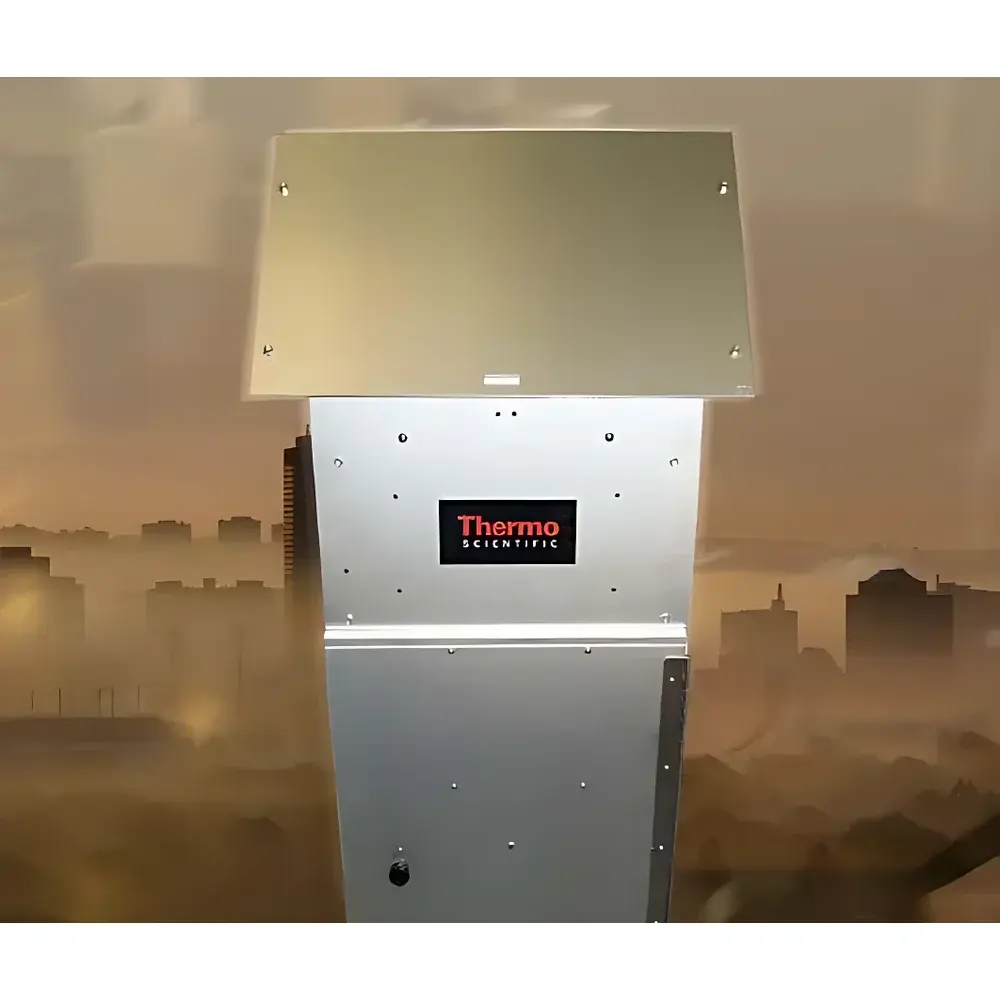
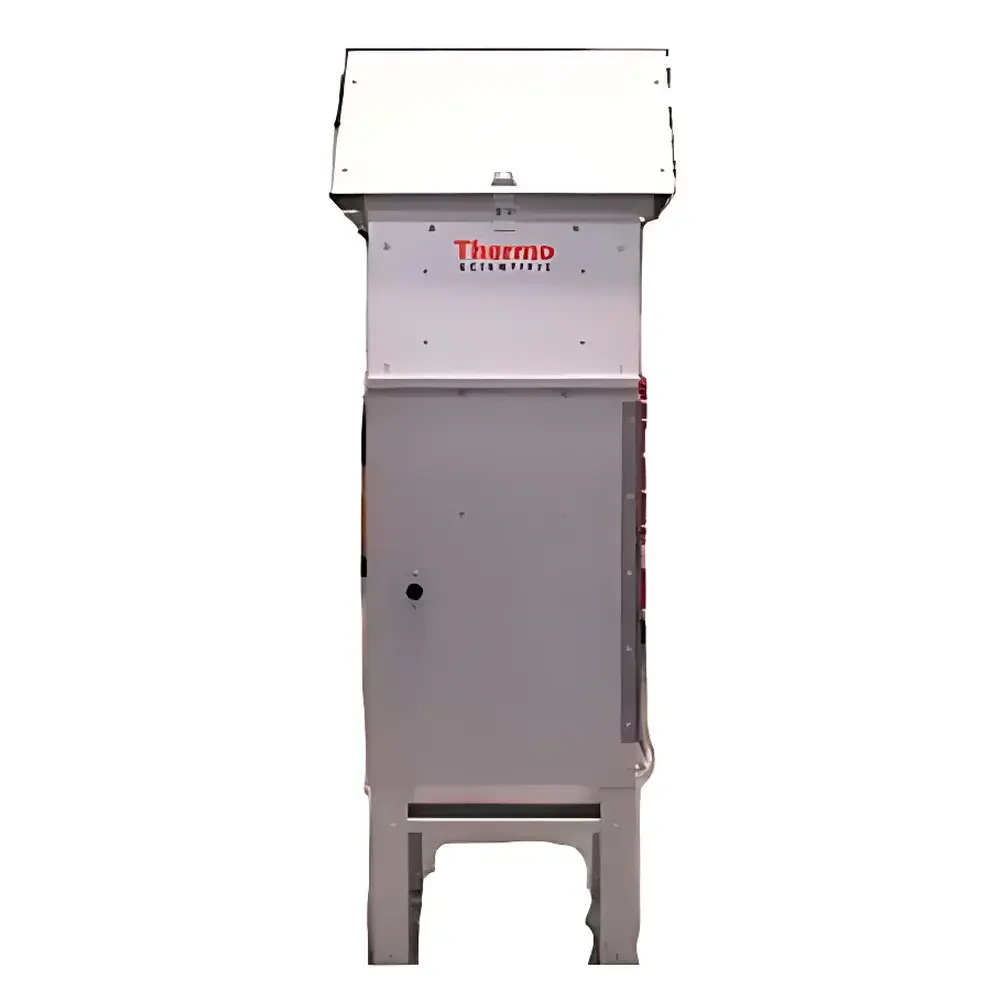
Thermo Fisher Scientific MFC-TSP High-Volume Particulate Matter Sampler
| Brand | Thermo Fisher Scientific |
|---|---|
| Origin | USA |
| Manufacturer Type | Original Equipment Manufacturer (OEM) |
| Product Origin | Imported |
| Model | MFC-TSP |
| Typical Configuration | Total Suspended Particulates (TSP) Sampling System |
| Flow Rate Range | 1.13 m³/min (40 ACFM) |
| Flow Accuracy | < ±1% deviation over 24 h |
| Pressure Drop Compensation | Aerodynamically optimized critical-flow Venturi restrictor |
| Flow Stability | Independent of filter loading, ambient temperature, and barometric pressure |
| Power Supply | 110 VAC, single-phase, 60 Hz (optional configurations available) |
| Motor | 1.0 HP, 7 A, 840 W |
| Weight | 62 kg (total system) |
| Cabinet | 22 kg |
| Cyclone/Cut-point Assembly | 25 kg |
| Blower & Filter Holder | 12 kg |
| Dimensions (Cabinet) | 129 cm H × 56 cm W × 56 cm D |
| Dimensions (Cyclone) | 81 cm H × 81 cm W × 63.5 cm D |
| Dimensions (Blower + Filter Holder) | 71 cm H × 53 cm W × 48 cm D |
Overview
The Thermo Fisher Scientific MFC-TSP High-Volume Particulate Matter Sampler is an EPA Reference Method–compliant instrument engineered for gravimetric determination of Total Suspended Particulates (TSP) in ambient air. It operates on the principle of critical-flow Venturi restriction—leveraging choked flow dynamics to maintain a constant volumetric sampling rate independent of upstream or downstream pressure fluctuations, filter media resistance, ambient temperature, or barometric variation. This passive, mechanically robust flow control architecture eliminates reliance on moving regulators, feedback electronics, or active servo systems—ensuring long-term metrological stability and minimal calibration drift. Designed specifically for regulatory monitoring networks and reference-grade environmental laboratories, the MFC-TSP delivers traceable, repeatable collection of airborne particulate mass across defined spatial and temporal scales.
Key Features
- Critical-flow Venturi restrictor with polished internal bore—engineered to achieve ≥95% static pressure recovery downstream, minimizing total system energy loss and enabling efficient blower operation under high-resistance conditions.
- No electronic flow controllers or rotating valves: flow regulation is purely aerodynamic and physics-based, eliminating sensor drift, firmware dependencies, and power supply sensitivity.
- Anodized aluminum cabinet structure providing corrosion resistance, structural rigidity, and thermal stability—maintains horizontal filter orientation during extended sampling campaigns (24 h or longer).
- Integrated 1.0 HP induction motor (840 W, 7 A) delivering stable 40 ACFM (1.13 m³/min) at rated voltage (110 VAC, 60 Hz), with optional configurations for international power standards.
- Compliance-ready mechanical design: all wetted surfaces are non-reactive, smooth-finish, and free of particulate-trapping crevices—facilitating cleaning validation and reducing blank contamination risk.
Sample Compatibility & Compliance
The MFC-TSP is validated for use with standard 20.3 cm (8-inch) diameter glass fiber or quartz filters (e.g., Pallflex Tissuquartz™, Whatman GF/F) in accordance with U.S. EPA Reference Method RFPS-1287-063 for TSP measurement. Its aerodynamic inlet geometry and unobstructed flow path ensure inertial particle penetration efficiency consistent with ISO 7708:1995 and EN 12341:2014 definitions of total suspended particulates. The system supports full-chain chain-of-custody documentation and is compatible with GLP-compliant laboratory workflows—including pre- and post-weighing protocols per EPA Method IO-3.1 and ASTM D1357. No software-based audit trail is required for flow verification, as volumetric constancy is inherent to the Venturi’s choked-flow condition—a physical property verified during factory certification and traceable to NIST standards.
Software & Data Management
The MFC-TSP is a hardware-only, analog flow-regulated platform requiring no embedded firmware, touchscreen interface, or data logging module. All operational parameters—including runtime, power status, and filter identification—are recorded manually or via external environmental data loggers synchronized to UTC time stamps. For laboratories operating under FDA 21 CFR Part 11 or EU Annex 11 requirements, the absence of digital control systems simplifies compliance validation: no electronic records, no user access controls, and no software lifecycle management are necessary. Optional integration with third-party meteorological stations or central SCADA systems can be achieved via dry-contact relay outputs (available upon request).
Applications
- Ambient air quality monitoring networks conducting long-term TSP trend analysis per national regulatory frameworks (e.g., U.S. Clean Air Act, EU Directive 2008/50/EC).
- Reference method validation studies comparing gravimetric samplers against beta attenuation (BAM) or tapered element oscillating microbalance (TEOM) instruments.
- Source apportionment research requiring high-volume, low-blank filter samples for subsequent elemental analysis (ICP-MS, XRF) or organic speciation (GC-MS, HPLC).
- Indoor air quality assessments in industrial hygiene settings where TSP exposure limits must be evaluated against OSHA or ACGIH TLV® benchmarks.
- Calibration transfer experiments between regional monitoring labs using identical Venturi-referenced flow standards.
FAQ
Does the MFC-TSP require periodic electronic recalibration?
No. Flow accuracy is derived from the fixed geometry and surface finish of the certified Venturi restrictor. Recertification is only necessary after physical damage or replacement of the restrictor assembly—and is performed by Thermo Fisher service engineers using NIST-traceable flow benches.
Can the MFC-TSP be used for PM10 or PM2.5 sampling?
Not natively. The MFC-TSP is configured for TSP collection. For size-selective sampling, it must be paired with an externally mounted, EPA-certified PM10 or PM2.5 cyclone (e.g., VSC-10 or BGI SCC-1.062), which introduces additional pressure drop and requires flow verification per EPA guidance.
What maintenance intervals are recommended for routine field operation?
Motor lubrication and belt tension checks every 6 months; visual inspection of Venturi bore and filter holder gasket integrity before each sampling event; annual anodized surface inspection for pitting or coating degradation in coastal or high-humidity environments.







