
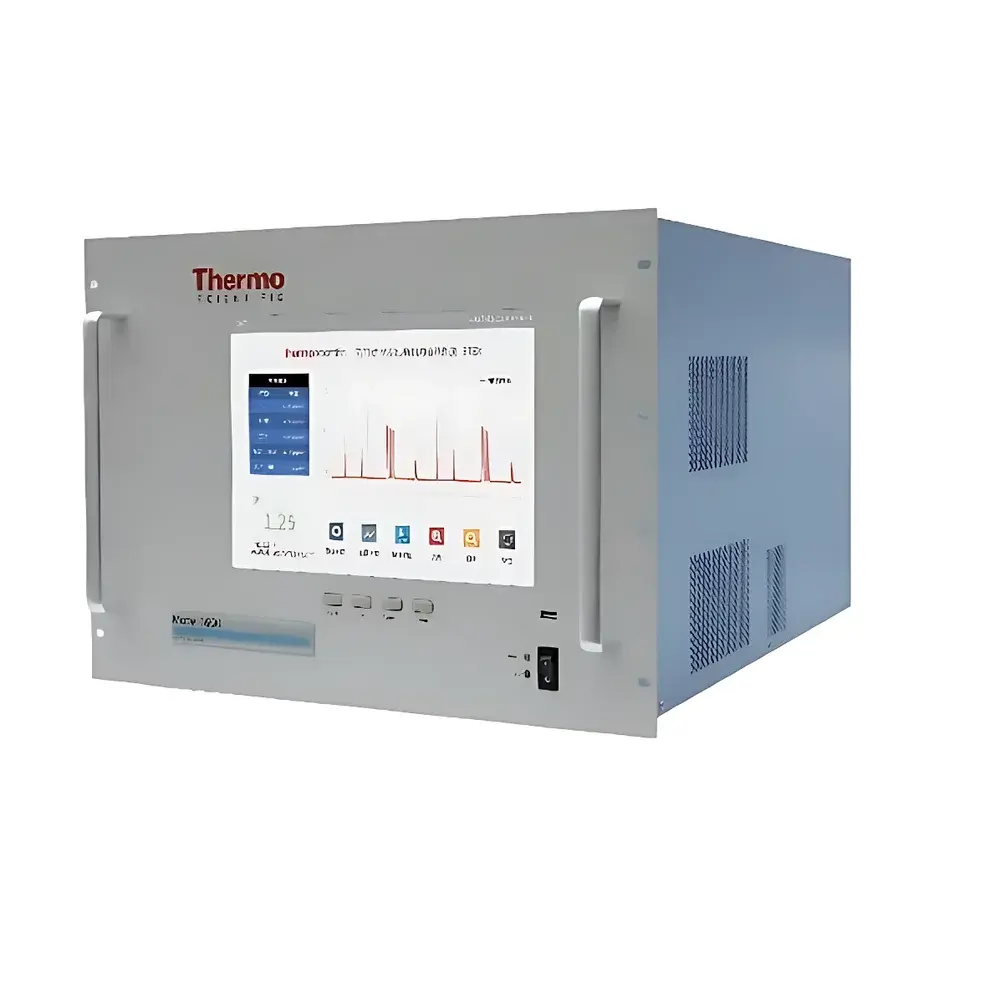
Thermo Fisher 5900-D Customizable Online VOCs Monitoring System
| Brand | Thermo Fisher |
|---|---|
| Origin | Shanghai, China |
| Manufacturer Type | Original Equipment Manufacturer (OEM) |
| Product Origin | Domestic (China) |
| Model | 5900-D |
| Detection Principle | Gas Chromatography (GC) with Flame Ionization Detection (FID) and Flame Photometric Detection (FPD) |
| Instrument Type | Continuous Online Analyzer |
| Configuration | Dual-Detector GC-Based VOC Analyzer |
| Measurement Range | Direct Sampling: 0–500 / 1,000 / 2,000 / 3,000 ppm (v/v) |
| Pre-concentrated Sampling | 0–50 / 100 / 200 / 300 / 500 ppb (v/v) |
| Detection Limit | Direct Sampling (benzene-equivalent): 25 ppb (v/v) |
| Pre-concentrated Sampling (benzene-equivalent) | 30 ppt (v/v) |
| Accuracy | ≤2% (benzene, NIST-traceable calibration) |
| Zero Drift | ≤0.1% FS or ≤0.02 ppb (benzene) per 24 h |
| Span Drift | ≤0.5% FS per 24 h |
| Repeatability | ≤2% RSD (benzene) |
| Cycle Time | Typically <40 min (configurable for zero-gap sampling) |
| Sample Flow Rate | 5–50 mL/min (adjustable) |
| Sample Volume | 200–2,000 mL (default 400 mL, programmable) |
| Column Oven Temperature Range | 15–180 °C (stability ±0.1 °C) |
| Valve Type | Heated Pneumatic Membrane Valve (30–180 °C, temperature-controlled) |
| Carrier Gas | Helium, Hydrogen, or Nitrogen (>99.9995% purity, 30–50 mL/min) |
| Fuel Gas (FID) | H₂ ≥99.999% (30–50 mL/min) |
| Make-up/Support Air (FID/FPD) | Clean, oil-free air (300–500 mL/min) |
Overview
The Thermo Fisher 5900-D Customizable Online VOCs Monitoring System is an industrial-grade, continuous-emission monitoring (CEM) platform engineered for regulatory-compliant, unattended operation in demanding environmental and process environments. It integrates dual-channel gas chromatography (GC) with parallel flame ionization detection (FID) and flame photometric detection (FPD), enabling simultaneous qualitative identification and quantitative trace-level analysis of volatile organic compounds (VOCs) across complex matrices. The system operates on a two-stage sampling architecture: direct injection for high-concentration applications (e.g., stack emissions, landfill gas) and thermal desorption pre-concentration for ultra-trace ambient or fugitive emission monitoring. Its core analytical workflow—comprising precision mass-flow-controlled sample introduction, cryo-focused trapping, temperature-programmed capillary column separation, and dual-detector signal acquisition—is fully automated and synchronized via embedded real-time control firmware. Designed to meet the operational rigor of ISO 16000-6, EPA Method TO-17, and EN 14662 compliance frameworks, the 5900-D delivers metrologically traceable data suitable for environmental reporting, process optimization, and health & safety surveillance.
Key Features
- Modular dual-detector GC architecture supporting concurrent FID (hydrocarbon-sensitive) and FPD (sulfur/phosphorus-selective) quantification without hardware reconfiguration
- Programmable pre-concentration module with cryogenic focusing (−30 °C to +30 °C range) and thermal desorption ramp control (up to 400 °C at 50 °C/s), achieving sub-ppt(v/v) detection limits for aromatic and aliphatic VOCs
- Heated, temperature-stabilized pneumatic membrane valves (30–180 °C) ensuring reproducible switching integrity under high-humidity or condensable-vapor conditions
- Column oven with ±0.1 °C thermal stability over 15–180 °C, enabling robust retention time locking (RTL) for long-term method transfer and inter-instrument comparability
- Integrated sample conditioning subsystem: particulate filtration (0.3 µm), moisture removal (Nafion® or chilled trap), and pressure regulation—all monitored with redundant sensors and auto-diagnostic logging
- Embedded Linux-based controller with deterministic real-time scheduling, supporting >10,000-hour mean time between failures (MTBF) and full remote firmware update capability via TLS-secured SSH or HTTPS
Sample Compatibility & Compliance
The 5900-D accepts gaseous samples from ambient air, ducted exhaust streams, soil vapor extraction lines, and biogas conduits. It accommodates variable matrix compositions—including up to 80% relative humidity, particulate loads ≤1 mg/m³, and total hydrocarbon concentrations up to 10,000 ppm(v)—without performance degradation. All wetted materials comply with ASTM D5502 and ISO 10156 standards for inertness and outgassing control. Data integrity conforms to FDA 21 CFR Part 11 requirements through electronic audit trails, role-based access control, and immutable raw-data archiving. The system supports GLP/GMP-aligned validation protocols—including IQ/OQ/PQ documentation templates—and meets EU Industrial Emissions Directive (IED) Annex VIII reporting granularity for CEMS-class deployment.
Software & Data Management
Thermo Fisher ChromaView™ 5900-D Edition provides a web-native interface (HTML5, responsive design) accessible via secure TLS 1.2+ connections. It features method editor with drag-and-drop GC parameter sequencing, real-time chromatogram overlay, automated peak integration using iterative Gaussian deconvolution, and customizable report generation (PDF/CSV/XML) compliant with ISO 14064-3 and GHG Protocol guidelines. Raw chromatographic data (including detector voltage traces, valve timing logs, and temperature profiles) are stored in HDF5 format with SHA-256 checksums. Integrated OPC UA server enables seamless integration into SCADA, DCS, or enterprise LIMS platforms. Remote diagnostics include predictive maintenance alerts based on valve cycle count, column backpressure trends, and detector baseline noise statistics.
Applications
- Continuous compliance monitoring of VOC emissions from chemical manufacturing, pharmaceutical coating lines, and semiconductor fabrication cleanrooms
- Fugitive emission detection and quantification (LDAR programs) across refinery flanges, pump seals, and storage tank vents
- Ambient air quality networks targeting BTEX, formaldehyde, chlorinated solvents, and oxygenated VOCs (e.g., acetone, MEK)
- Soil vapor intrusion assessment at brownfield sites with dynamic multi-point sampling manifolds
- Biogas composition profiling (VOC impurities affecting anaerobic digestion efficiency and downstream utilization)
- Indoor air quality auditing in hospitals, laboratories, and high-occupancy commercial buildings per ASHRAE Standard 62.1
FAQ
What regulatory methods does the 5900-D support out-of-the-box?
The system ships with pre-validated methods aligned with EPA TO-14A, TO-15, and TO-17; ISO 16000-6; and EN 14662. Custom method development services are available through Thermo Fisher Application Support.
Can the 5900-D operate unattended for extended periods?
Yes—designed for 24/7 operation with automatic zero/span verification (user-configurable frequency), self-diagnostics, and battery-backed real-time clock. Scheduled maintenance intervals exceed 6 months under typical ambient monitoring duty cycles.
Is hydrogen carrier gas safe for continuous use in indoor installations?
Hydrogen is supported with integrated leak detection, automatic shutoff solenoids, and catalytic recombiners meeting IEC 60079-29-1 requirements. Alternative helium or nitrogen configurations are available for Class I Div 1 hazardous locations.
How is data security ensured during remote access?
All remote sessions enforce mutual TLS authentication, AES-256 encryption, and session timeout policies. Audit logs record every configuration change, user login, and data export event with UTC timestamps and IP attribution.
Does the system support third-party calibration gas delivery systems?
Yes—the 5900-D features standardized ¼″ VCR fittings and Modbus TCP interface for interoperability with certified dynamic dilution calibrators (e.g., Brooks, Mesa Labs, or custom OEM systems).
Related Products







