
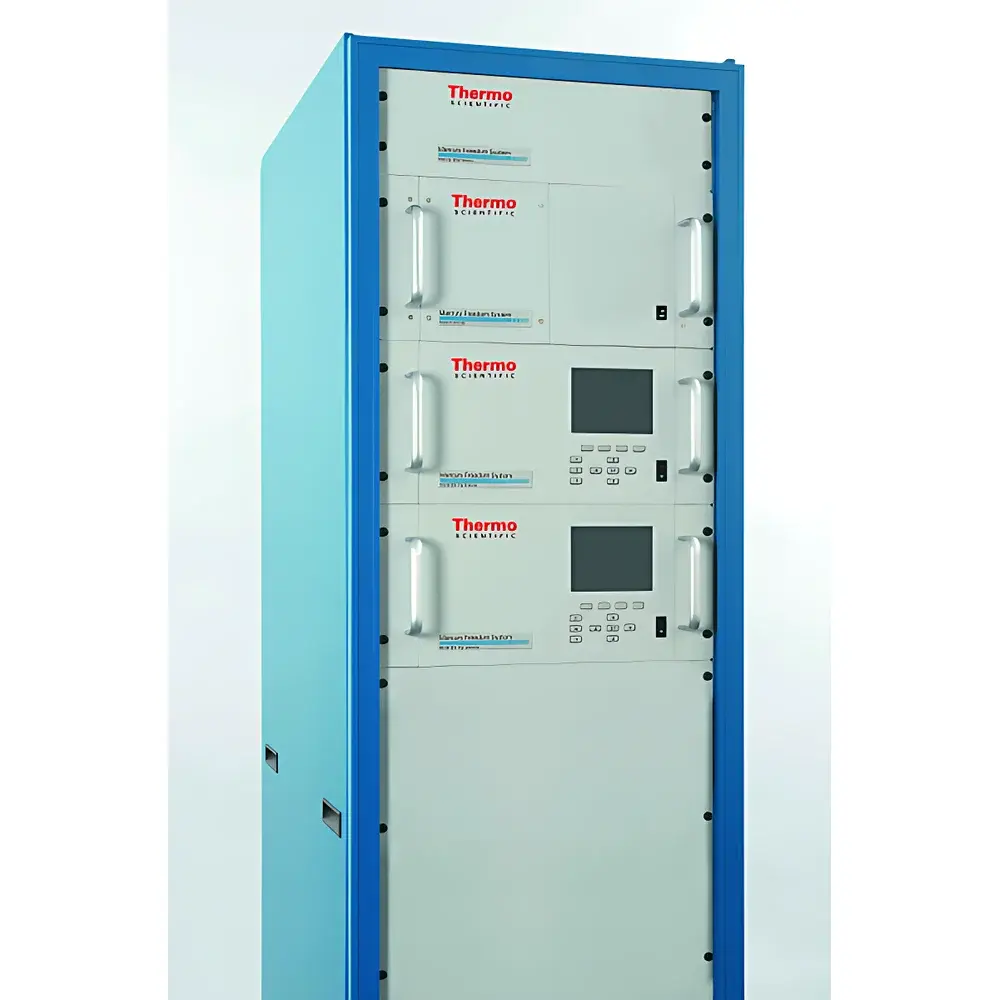
Thermo Scientific Hg CEMS Flue Gas Mercury Continuous Emission Monitoring System
| Brand | Thermo Fisher |
|---|---|
| Origin | USA |
| Manufacturer | Thermo Fisher Scientific |
| Product Type | Imported |
| Model | Hg CEMS |
| Pricing | Upon Request |
Overview
The Thermo Scientific Hg CEMS is a fully compliant, EPA-certified flue gas mercury continuous emission monitoring system engineered for regulatory-grade measurement of elemental mercury (Hg⁰), oxidized mercury (Hg²⁺), and total mercury in real time. Designed in strict accordance with U.S. Environmental Protection Agency (EPA) Performance Specification 12A (PS-12A) and 40 CFR Part 75 requirements, the system employs cold vapor atomic fluorescence spectroscopy (CVAFS) coupled with in-situ catalytic conversion and dilution sampling to deliver high-fidelity, trace-level mercury quantification under harsh stack conditions. Unlike conventional gold amalgamation-based analyzers, this system eliminates reliance on consumable gold traps, sulfur dioxide scrubbers, or chemical reagents—reducing operational complexity while maintaining metrological integrity across long-term unattended operation. Its wet-base reporting capability—derived directly from dilution-calibrated sampling—eliminates the need for concurrent moisture measurement, simplifying integration into existing CEMS infrastructure.
Key Features
- Sub-ng/m³ detection sensitivity: Achieves a method detection limit (MDL) of 2 ng/m³ and zero noise of ≤1 ng/m³, enabling reliable quantification at ultra-trace levels required by MATS (Mercury and Air Toxics Standards).
- In-situ Hg²⁺ conversion and capture: Utilizes a thermally controlled, glass-coated inertial filter integrated within the probe assembly to quantitatively retain and convert oxidized mercury species prior to transport—minimizing adsorption losses and ensuring stoichiometric recovery.
- Dilution-based sampling architecture: Operates at adjustable dilution ratios from 25:1 to 100:1, effectively reducing stack gas temperature, humidity, and particulate loading at the analyzer inlet—enhancing optical path stability and detector longevity.
- Reagent-free, consumable-free operation: No gold traps, no SO₂ scrubbers, no acid-gas neutralization chemicals—eliminating hazardous waste generation and recurring consumable costs.
- True real-time measurement: Delivers 120-second system response time (60-second averaging) without pre-concentration cycles—enabling dynamic emission profiling during load transients and startup/shutdown events.
- i-Series platform integration: Built on Thermo Fisher’s standardized i-Series hardware and firmware architecture, supporting intuitive menu-driven configuration, remote diagnostics, and seamless data export via Modbus TCP or OPC UA.
- Robust mechanical design: Probe assembly constructed from 316 stainless steel and borosilicate glass components; rated for continuous operation at stack temperatures up to 200 °C and particulate concentrations exceeding 10 g/Nm³.
Sample Compatibility & Compliance
The Hg CEMS is validated for use across coal-fired power plants, municipal waste incinerators, cement kilns, and industrial boilers emitting flue gas with typical O₂ (3–15%), CO₂ (8–18%), SO₂ (0–3,000 ppm), NOₓ (0–800 ppm), and moisture content up to 15% v/v. It meets all PS-12A performance criteria—including precision (≤5% RSD), accuracy (±5% of reference value), drift (<2% F.S./24 h), and interference rejection (e.g., Cl₂, HCl, NH₃). The system supports EPA Method 29 and ASTM D6784-22 equivalency for manual audit validation. Data acquisition and storage comply with 40 CFR Part 75 Appendix A, including full audit trail logging, electronic signature support, and 21 CFR Part 11–ready data security architecture for GLP/GMP environments.
Software & Data Management
Control and data handling are managed through Thermo Scientific’s Mercury iQ software—a Windows-based application providing instrument configuration, calibration scheduling, QA/QC trending, and automated report generation per EPA 75.21 and 75.22 requirements. All raw spectral data, calibration logs, maintenance records, and alarm histories are timestamped and stored locally with optional encrypted cloud backup. The software supports dual-range calibration verification, multi-point linearity checks, and automatic zero/span drift correction. Export formats include CSV, XML, and EPA-compliant .DAT files compatible with EGMS (Emissions Generation and Monitoring System) platforms and state-level data submission portals such as EDI and CDX.
Applications
- Continuous compliance monitoring for MATS and state-level mercury regulations (e.g., CA AB 2588, NY Part 200)
- Process optimization and mercury control technology evaluation (e.g., activated carbon injection, SCR/Hg oxidation correlation studies)
- Source testing and performance audits per EPA Methods 29 and 30B
- Long-term trend analysis of mercury speciation shifts under varying boiler operating conditions
- Integration with broader CEMS suites for co-emission correlation (e.g., Hg vs. SO₂, NOₓ, PM₂.₅)
FAQ
Does the Hg CEMS require external moisture measurement for wet-base reporting?
No. The system performs dilution sampling with certified zero air, enabling direct wet-base concentration calculation without independent humidity sensors or compensation algorithms.
How often does the system require calibration?
Per EPA PS-12A, daily zero/span checks are recommended; full multi-point calibration is performed weekly or after maintenance events. Automated calibration scheduling and verification are built into Mercury iQ software.
Can the system distinguish between Hg⁰ and Hg²⁺ in real time?
Yes—via parallel sampling paths: one bypassing the catalytic converter (measuring Hg⁰ only), and one passing through it (measuring total Hg); oxidized mercury is derived by difference with <±3% uncertainty.
Is the probe suitable for high-dust applications?
Yes. The inertial filter design and heated sample line (maintained at >120 °C) prevent particulate buildup; field deployments exceed 2 years mean time between cleaning in coal-fired units with >5 g/Nm³ fly ash loading.
What electrical and utility requirements does the system have?
Probe control unit requires 10 LPM clean, oil-free instrument air; zero air generator supplies 4 CFM dry air at <−40 °C dew point; standard 120/240 VAC, 50/60 Hz power with surge protection.
Related Products







