
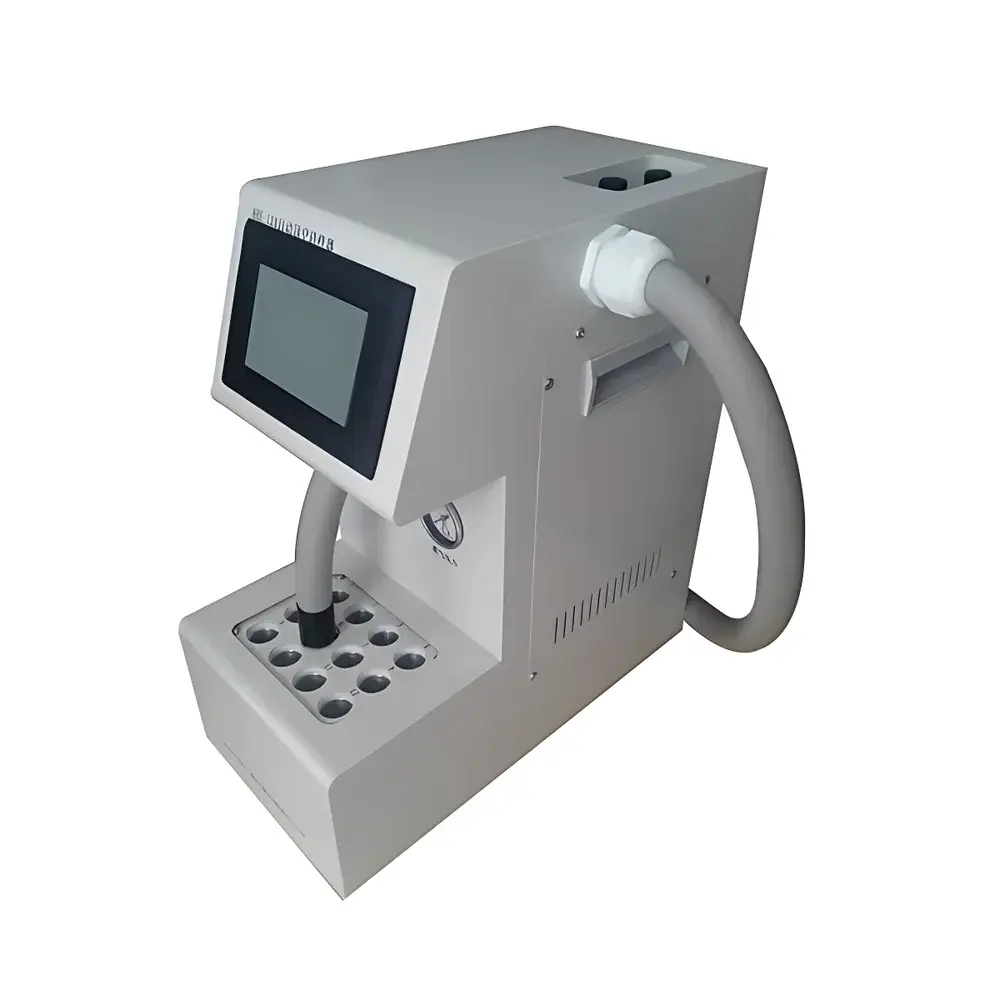
Beifen Sanpu AHS-10A 12-Position Static Headspace Sampler
| Brand | Beifen Sanpu |
|---|---|
| Origin | Beijing, China |
| Manufacturer Type | OEM Manufacturer |
| Regional Category | Domestic (China) |
| Model | AHS-10A |
| Instrument Type | Static Headspace Sampler |
| Automation Level | Semi-Automatic |
| Vial Heating Range | Ambient to 200 °C |
| Valve & Quantitation Loop Temperature Control Range | Ambient to 220 °C |
| Quantitation Loop Volume | 1 mL |
| Vial Capacity | 12 positions |
| Vial Size Compatibility | 10 mL or 20 mL |
| Temperature Control Accuracy | < ±0.5 °C |
| RSD (n=6, 40 ppm ethanol in water) | ≤1.5% |
| Purge Flow Rate | 0–500 mL/min (continuously adjustable) |
| Dimensions (L×W×H) | 200 × 360 × 420 mm |
| Weight | ~18 kg |
Overview
The Beifen Sanpu AHS-10A is a 12-position static headspace sampler engineered for precise, reproducible extraction and introduction of volatile organic compounds (VOCs) from aqueous, solid, or semi-solid matrices into gas chromatography (GC) or GC–mass spectrometry (GC–MS) systems. It operates on the principle of phase equilibrium partitioning: samples are sealed in crimp-top vials and heated to promote volatilization of target analytes into the headspace above the sample matrix. Once thermodynamic equilibrium is achieved between the condensed and vapor phases, a pressurized syringe or six-port valve system withdraws a representative aliquot of the equilibrated headspace gas and injects it directly onto the GC column. This technique eliminates matrix interference, reduces contamination risk, and avoids thermal degradation associated with direct liquid injection—making it ideal for regulated environmental, pharmaceutical, food safety, and forensic applications requiring compliance with HJ 810–2016, HJ 642–2013, HJ 643–2013, USP , EP 2.4.24, and ISO 15681.
Key Features
- 12-position sample carousel with front-access design for ergonomic operation—enabling seated use without repositioning.
- Triple-zone independent temperature control: vial block (ambient to 200 °C), valve/quantitation loop (ambient to 220 °C), and transfer line (ambient to 200 °C), all adjustable in 1 °C increments to prevent condensation and ensure quantitative transfer.
- Electrically actuated high-pressure six-port valve with stainless-steel quantitation loop (standard 1 mL; optional 0.5 mL or 3 mL) enabling positive-pressure sampling for enhanced sensitivity and precision.
- Uniform heating distribution across all vial positions minimizes inter-vial thermal gradients, improving inter-run reproducibility (RSD ≤1.5% at 40 ppm ethanol in water, n=6).
- Integrated purge function with 0–500 mL/min adjustable flow rate for automated backflush of sampling lines and valve pathways—effectively eliminating carryover between runs.
- 5-inch full-color capacitive touchscreen interface with intuitive icon-driven navigation; supports storage and recall of up to 10 user-defined methods for rapid method deployment.
- Hardware-level synchronization signal output to trigger GC oven start, detector acquisition, and third-party data systems (e.g., Chromeleon, OpenLab CDS, Empower) in accordance with ASTM D7923 and ISO/IEC 17025 traceability requirements.
- Comprehensive safety architecture including overtemperature cutoff, real-time thermal fault detection, and automatic power disconnect upon sensor failure.
- Modular needle interface compatible with Agilent, Shimadzu, Thermo Fisher, PerkinElmer, and other major GC platforms—no adapter kits required.
Sample Compatibility & Compliance
The AHS-10A accommodates standard 10 mL and 20 mL crimp-cap headspace vials (e.g., Gerstel, Supelco, Thermo) and supports diverse sample types including drinking water (per GB 5749–2006), wastewater (HJ 810–2016), soil/sludge extracts (HJ 642–2013), pharmaceutical residual solvents (ChP 2020 Vol. IV, General Chapter 0861), food packaging migrants (SN/T 4068–2014), and forensic biological fluids (GA/T 842–2009). Its hardware and firmware architecture support audit-trail generation and electronic signature functionality—facilitating alignment with FDA 21 CFR Part 11, EU Annex 11, and GLP/GMP laboratory workflows when integrated with compliant chromatography data systems.
Software & Data Management
While the AHS-10A operates as a standalone instrument via its embedded controller, it delivers native TTL-level start/stop signals and status flags compatible with all major GC vendor software suites. Method parameters—including equilibration time, vial temperature ramp profiles, pressurization duration, loop fill volume, and purge timing—are fully programmable and stored in non-volatile memory. All operational logs (temperature setpoints, actual readings, valve actuation timestamps, error codes) are timestamped and exportable via USB for external review. When deployed in regulated environments, the system supports IQ/OQ documentation packages and can be validated per USP Analytical Instrument Qualification protocols.
Applications
- Environmental analysis: VOCs in surface water, groundwater, and treated effluents per HJ 810–2016 and EPA Method 502.2.
- Pharmaceutical quality control: Residual solvents (e.g., methanol, acetone, dichloromethane) in APIs and excipients per ICH Q3C and ChP 2020.
- Food and beverage safety: Ethanol in vinegar, acetaldehyde in PET packaging, hexane in edible oils (GB 5009.193–2016).
- Forensic toxicology: Quantification of ethanol, isopropanol, and acetone in blood and urine specimens (GA/T 842–2009).
- Polymer and packaging testing: Monomer residues (e.g., vinyl chloride, styrene) and catalyst traces in plastics per ISO 11843.
- Industrial hygiene: Workplace air monitoring of halogenated hydrocarbons using sorbent tube–thermal desorption–GC–MS workflows.
FAQ
Does the AHS-10A support dynamic headspace (purge-and-trap) mode?
No—the AHS-10A is designed exclusively for static headspace analysis. Dynamic headspace functionality requires separate purge-and-trap instrumentation.
Can the instrument be operated unattended overnight?
Yes—its robust thermal management, automatic vial positioning, and fail-safe shutdown logic enable extended unattended operation. Sequence files may include delay intervals between runs to accommodate long equilibration times.
Is method validation support available from the manufacturer?
Beifen Sanpu provides IQ/OQ templates, calibration certificates for temperature sensors (NIST-traceable), and application notes aligned with HJ 810–2016 and USP —all included with shipment.
What maintenance is required for long-term reliability?
Routine tasks include quarterly cleaning of the valve seat and transfer line with methanol, annual verification of temperature accuracy using calibrated reference probes, and biannual replacement of septa and O-rings in the vial carrier assembly.
How is data integrity ensured during GC–MS synchronization?
The AHS-10A outputs deterministic TTL pulses with sub-millisecond jitter; these signals are logged by the GC data system as discrete events—ensuring temporal correlation between headspace injection and spectral acquisition for full 21 CFR Part 11 compliance.





