
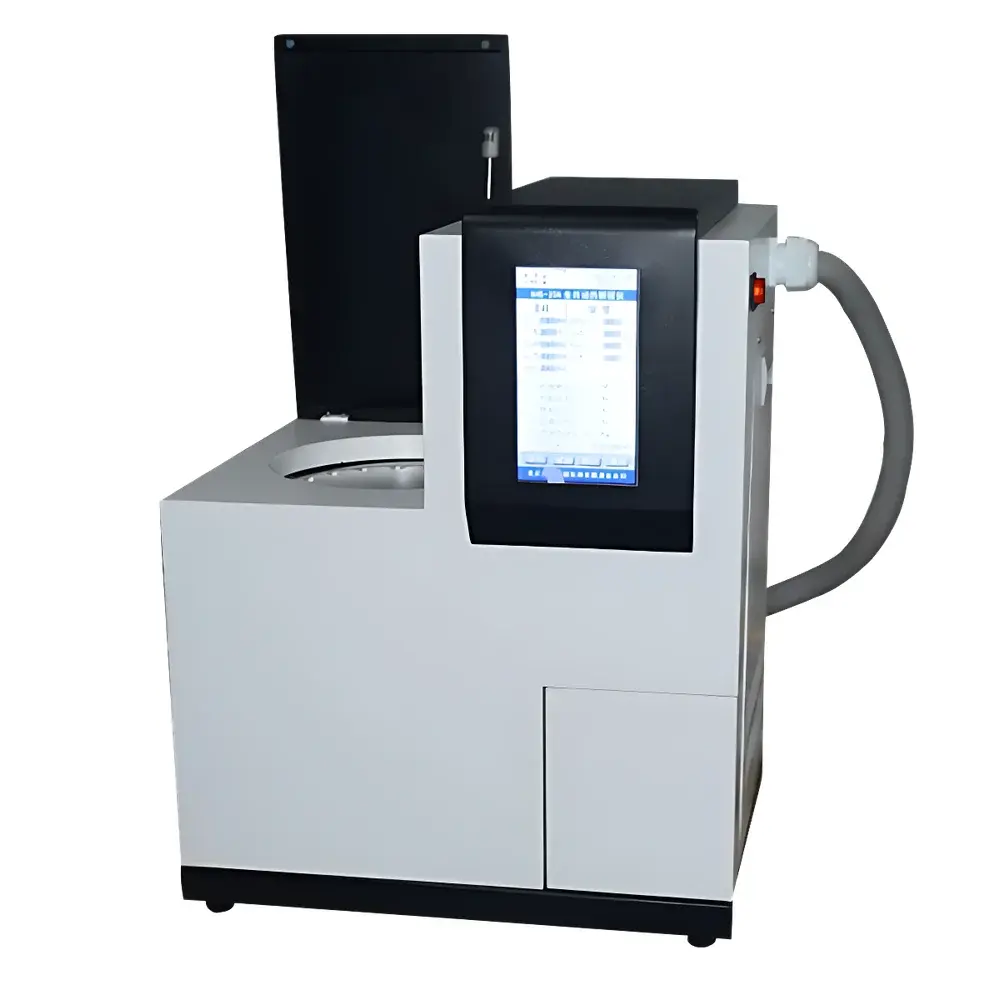
Beifen Sanpu ATDS-20A Cryogenic Cold Trap Fully Automated Two-Stage Thermal Desorber
| Brand | Beifen Sanpu |
|---|---|
| Origin | Beijing, China |
| Manufacturer Type | Direct Manufacturer |
| Product Origin | Domestic (China) |
| Model | ATDS-20A |
| Pricing | Upon Request |
Overview
The Beifen Sanpu ATDS-20A Cryogenic Cold Trap Fully Automated Two-Stage Thermal Desorber is a high-precision sample introduction system engineered for trace-level volatile organic compound (VOC) and semi-volatile organic compound (SVOC) analysis in environmental, occupational health, and industrial hygiene applications. It operates on the principle of two-stage thermal desorption coupled with cryogenic focusing: first-stage desorption releases analytes from sorbent tubes under controlled heating; analytes are then transferred to a cryogenically cooled trap (–35 °C to ambient), where they are refocused into a narrow band; second-stage rapid flash desorption (≥3000 °C/min) delivers a sharp, solvent-free injection into the gas chromatograph (GC) or GC–MS. This architecture ensures superior peak shape, enhanced sensitivity, reduced matrix interference, and quantitative reproducibility — critical for compliance with regulatory methods including EPA TO-17, ISO 16017-1, and Chinese national standards HJ 644–2013, HJ 734–2014, and GB/T 18883–2002.
Key Features
- Fully automated 20-position sample carousel with unattended operation — ideal for high-throughput laboratory environments.
- Integrated self-diagnostic startup sequence with real-time fault detection, automatic sample tray calibration, and error logging.
- Independent four-zone temperature control: primary desorption oven (RT–450 °C), valve manifold (RT–300 °C), transfer line (RT–300 °C, 24 V low-voltage heating), and secondary desorption/cold trap zone (RT–450 °C / –35 °C to RT).
- Programmable time-based method sequencing supporting full workflow automation: desorption → purge → cryo-trapping → flash desorption → GC injection → back-flush cleaning.
- Dedicated electronic Peltier cooling system enables precise cold trap temperature control from –35 °C to ambient, eliminating liquid nitrogen dependency while maintaining consistent focusing efficiency.
- Motor-driven 6-port switching valve ensures repeatable, leak-tight valving; compatible with all major GC and GC–MS inlets via standardized 1/4″ OD stainless steel or optional fused quartz transfer lines.
- Onboard tube activation protocol with programmable heating and purging cycles — extends sorbent tube lifetime and ensures baseline integrity across batches.
- Simulated sampling function enables direct generation of calibration curves using standard gases or permeation sources without external hardware.
- Back-flush capability for both transfer line and valve manifold (0–100 mL/min, continuously adjustable) minimizes carryover between samples and supports long-term analytical stability.
Sample Compatibility & Compliance
The ATDS-20A accepts standard 1/4″ × 3.5″ (OD × length) US EPA/TO-17-compliant sorbent tubes (e.g., Tenax TA, Carbopack B/C, Carboxen 1000). Its design accommodates both single-bed and multi-bed configurations for broad analyte coverage — from C2 hydrocarbons to polycyclic aromatic hydrocarbons (PAHs) up to 350 °C boiling point. The instrument meets essential requirements for GLP and ISO/IEC 17025-accredited laboratories: temperature accuracy ±0.5 °C, RSD ≤2.5% (measured at 0.05 μg benzene in methanol), and desorption recovery >99% for target VOCs. Method validation data align with HJ 644–2013 (ambient air VOCs), HJ 734–2014 (stack emissions), and GB 50325–2020 (indoor air quality), supporting auditable reporting for third-party environmental testing and occupational exposure assessments.
Software & Data Management
Controlled via a dedicated embedded microprocessor with 7-inch capacitive touchscreen interface, the ATDS-20A supports fully customizable method programming, real-time status visualization (including temperature profiles and valve timing), and event-triggered GC start synchronization. All method parameters, run logs, calibration records, and maintenance alerts are timestamped and stored locally with export capability to CSV or PDF. While the base system does not include 21 CFR Part 11-compliant audit trail functionality, it is compatible with external LIMS integration via RS-232 or Ethernet (optional module), enabling traceable data handling in regulated QA/QC workflows. Firmware updates are delivered via USB and support backward-compatible method migration.
Applications
This thermal desorber serves as a core sample preparation platform for accredited environmental laboratories performing: ambient and indoor air monitoring (TVOC, BTEX, aldehydes); workplace exposure assessment per OELs (occupational exposure limits); building material emission testing (e.g., carpets, adhesives, insulation); automotive cabin air quality evaluation (HJ/T 400–2007); and stationary source emission characterization (e.g., industrial stacks, wastewater treatment off-gases). Its dual-stage architecture with cryogenic trapping significantly improves detection limits for polar and reactive compounds (e.g., formaldehyde, acetaldehyde) that exhibit poor retention or degradation in conventional single-stage systems.
FAQ
What is the difference between thermal desorption and headspace analysis?
Thermal desorption extracts analytes adsorbed onto solid sorbents (e.g., Tenax), enabling preconcentration and analysis of trace VOCs at sub-ppt levels; headspace analysis equilibrates volatile compounds in the gas phase above liquid or solid samples, typically limited to higher-concentration, more volatile species.
Can the ATDS-20A be used with GC–MS systems from Agilent, Thermo Fisher, or Shimadzu?
Yes — it features universal mechanical and electrical interfaces, including GC trigger output and inlet-compatible transfer tubing, and has been validated with all major OEM platforms.
Is liquid nitrogen required for the cold trap?
No — the integrated thermoelectric (Peltier) cooling system achieves –35 °C without consumables, ensuring operational continuity and reducing lab infrastructure dependencies.
Does the system support method validation per ISO 16017-1?
Yes — its temperature precision, recovery performance (>99%), and repeatability (RSD ≤2.5%) meet the instrumental performance criteria specified in ISO 16017-1 for active sampling and thermal desorption.
Can I upgrade from single-stage to two-stage configuration after purchase?
The ATDS-20A is factory-configurable as a 20-position one-stage, ambient two-stage, or cryogenic two-stage unit; hardware options (cold trap assembly, secondary heater) must be selected at time of order but are mechanically integrated for future field retrofit if planned in advance.





