
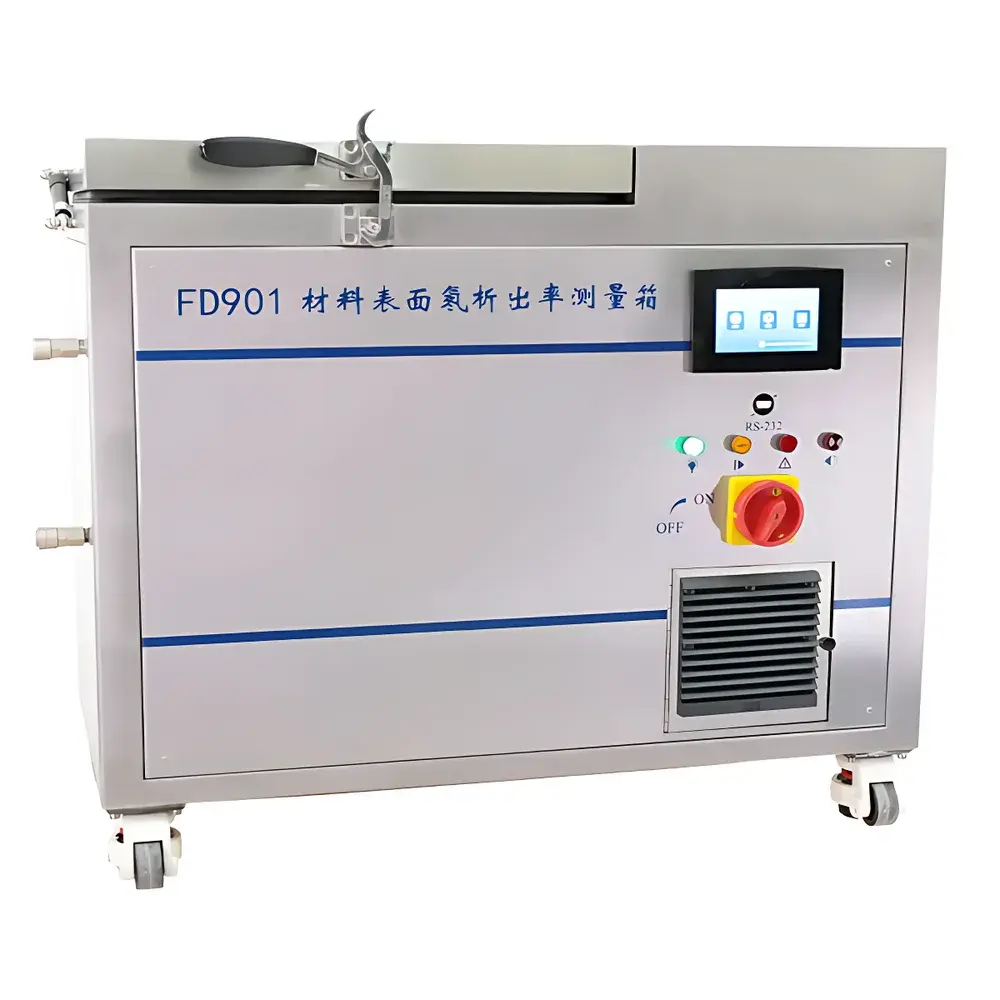
Beifen Sanpu FD901 Radon Exhalation Rate Measurement Chamber
| Brand | Beifen Sanpu |
|---|---|
| Model | FD901 |
| Chamber Effective Volume | 0.06 m³ |
| Temperature Control Range | +20–+30 °C |
| Temperature Accuracy | ±0.5 °C |
| Humidity Control Range | 30–60 %RH |
| Humidity Accuracy | ±5 %RH |
| Chamber Material | 304 Stainless Steel |
| Interface | USB |
| Power Supply | ~220 V / 50 Hz, ~800 W |
| Display | 5″ TFT Capacitive Touch LCD |
| Operating Ambient | +5–+40 °C, ≤95 %RH at +40 °C |
| Dimensions (W×D×H) | 850×420×740 mm |
| Weight | ~60 kg |
Overview
The Beifen Sanpu FD901 Radon Exhalation Rate Measurement Chamber is a purpose-built environmental test chamber engineered for standardized, quantitative determination of radon (222Rn) exhalation rates from solid construction materials—including concrete, granite, gypsum board, bricks, and soil samples—under controlled temperature and humidity conditions. It operates on the accumulation method per ISO 11665-3:2019 (“Measurement of radon-222 and its short-lived decay products — Part 3: Protocols for assessing radon exhalation rate from building materials”) and aligns with national standards GB/T 16147–1995 and GB 50325–2020 (China’s Code for Indoor Environmental Pollution Control). The chamber features a rigorously sealed 304 stainless steel enclosure (0.06 m³ effective volume), internal forced-air circulation via a low-turbulence fan, and precisely regulated thermal-hygric conditions to ensure homogeneous radon distribution and reproducible boundary conditions during sampling intervals (typically 2–7 days). Its design eliminates uncontrolled air exchange, minimizes wall adsorption effects, and supports traceable calibration against reference sources or certified radon monitors.
Key Features
- Hermetically sealed 304 stainless steel chamber with leak rate < 0.5% volume/hour under 1 kPa differential pressure, verified per ASTM E283–22.
- Integrated axial-flow circulation fan with laminar flow optimization to achieve <±3% spatial radon concentration uniformity (measured at nine equidistant points per ISO 11665-7).
- Semiconductor-based thermoelectric cooling/heating module enabling precise, oil-free, vibration-free temperature control without refrigerant emissions.
- Dual-stage humidity regulation system combining ultrasonic misting and desiccant-assisted dehumidification for stable RH maintenance across full 30–60% range.
- Redundant temperature monitoring using three calibrated NIST-traceable Pt100 sensors (Class A, IEC 60751), with independent overtemperature cutoff circuitry.
- 5-inch capacitive touch TFT display with real-time dual-axis plot of temperature and relative humidity, including min/max/average tracking over user-defined intervals.
- USB 2.0 interface compliant with CDC ACM class for plug-and-play connection to Windows-based host systems; no proprietary drivers required.
Sample Compatibility & Compliance
The FD901 accommodates flat or irregular material specimens up to 400 × 300 mm footprint and 50 mm thickness, placed on a removable, inert PTFE-coated sample tray. Its standardized geometry enables direct correlation with ISO 11665-3 Annex B calculation protocols for surface exhalation rate (in mBq·m−2·s−1) and mass exhalation rate (in mBq·kg−1·s−1). All control algorithms and data logging routines are designed to support GLP-compliant laboratory workflows: timestamped measurements include sensor diagnostics, setpoint deviations, and system status flags. The device meets electromagnetic compatibility requirements per EN 61326-1:2013 and safety standards per IEC 61010-1:2010 for laboratory equipment.
Software & Data Management
The included Windows-compatible control software provides full remote supervision via USB. It logs all environmental parameters at configurable intervals (1 s to 10 min resolution), stores raw time-series data in UTF-8 encoded CSV files, and exports summary reports—including mean, standard deviation, and confidence intervals—as Excel (.xlsx) files with embedded metadata (operator ID, sample ID, test duration, chamber serial number). Audit trails record all parameter changes, manual overrides, and system alerts with digital signatures. Software architecture supports integration into LIMS environments via OPC UA or custom API wrappers, and complies with FDA 21 CFR Part 11 requirements for electronic records and signatures when deployed with validated IT infrastructure.
Applications
- Quality assurance testing of natural stone, recycled aggregates, and industrial by-products (e.g., fly ash, slag) prior to use in residential or public buildings.
- Research into radon diffusion coefficients and emanation efficiency as functions of porosity, moisture content, and grain size distribution.
- Validation of radon suppression coatings and barrier membranes under accelerated aging conditions (e.g., cyclic T/RH exposure).
- Interlaboratory comparison studies coordinated under national metrology institutes (e.g., CNIM, NIM) for proficiency testing and uncertainty budgeting.
- Supporting compliance documentation for LEED v4.1 MR Credit: Building Product Disclosure and Optimization – Material Ingredients.
FAQ
What radon detection instruments are compatible with the FD901 chamber?
The chamber features standardized 6 mm quick-connect pneumatic fittings (ISO 8573-1 Class 2) compatible with alpha-spectrometric radon monitors (e.g., RAD7, Alpha Energy RAD-7, SARAD RTM 2200), electrostatic collection detectors, and continuous radon/thoron monitors meeting IEC 61577-1:2021 specifications.
Can the FD901 be used for thoron (220Rn) exhalation studies?
Yes—its rapid gas exchange capability (t95% < 30 min) and low memory effect enable reliable thoron measurement when paired with a thoron-capable monitor and shortened sampling intervals (≤2 hours); protocol adaptation per ISO 11665-5 is recommended.
Is external calibration of the built-in sensors required?
Annual verification against NIST-traceable reference standards is advised; the system includes sensor offset adjustment fields in service mode and auto-diagnostics for drift detection.
Does the chamber support automated long-term unattended operation?
Yes—programmable start/stop schedules, power-fail recovery, and watchdog-triggered email/SMS alerts (via optional RS-485 gateway) are supported in advanced configuration mode.
How is condensation prevented during high-RH operation at low temperatures?
The chamber employs dew-point prediction logic and dynamic heater biasing on all internal surfaces, combined with hydrophobic coating on sensor housings, to maintain sub-saturation conditions throughout the operational envelope.







