
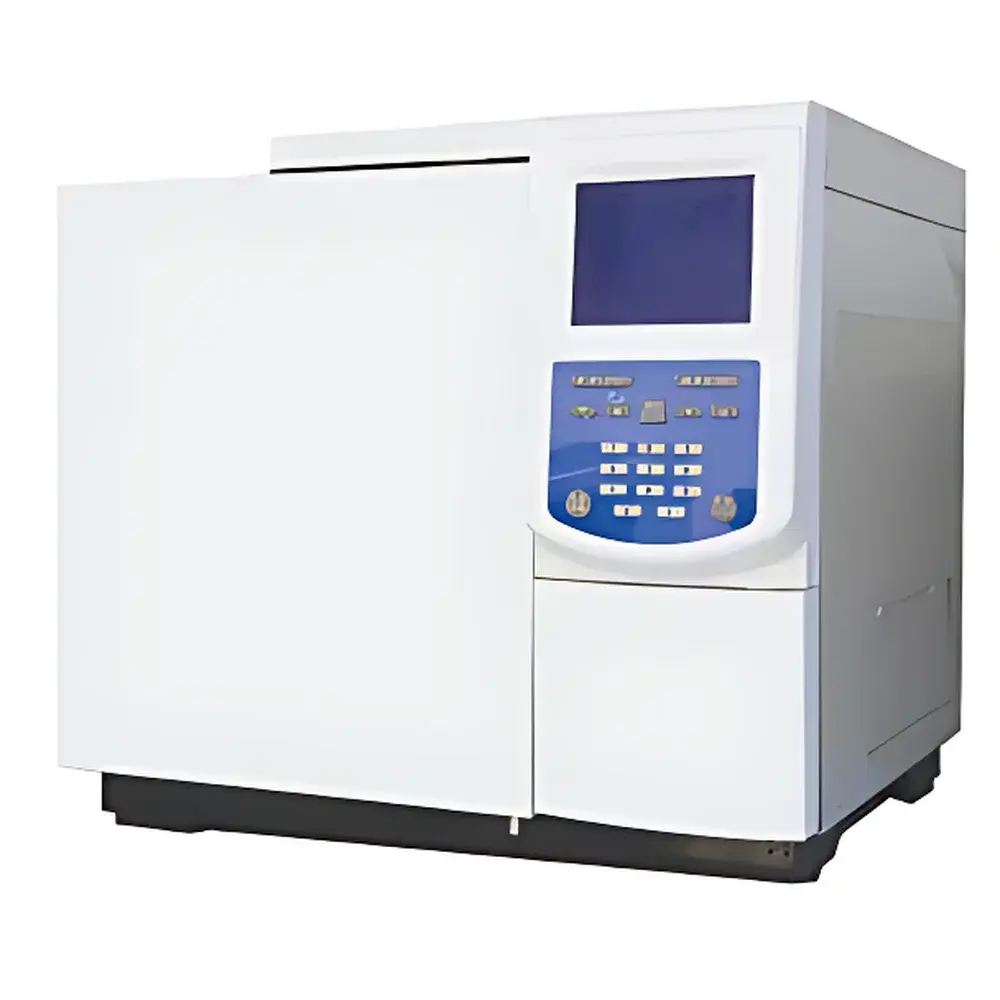
Beifen Sanpu GC-8890A Dedicated Gas Chromatograph for Acetaldehyde Residue Analysis in PET Preform and Chip Samples
| Brand | Beifen Sanpu |
|---|---|
| Origin | Beijing, China |
| Manufacturer Type | Direct Manufacturer |
| Regional Category | Domestic (China) |
| Model | GC-8890A |
| Instrument Type | Laboratory Gas Chromatograph |
| Application Field | Food & Pharmaceutical Packaging Quality Control |
| Oven Temperature Range | Up to 450 °C |
| Maximum Ramp Rate | 80 °C/min |
| Cooling Rate | 40 °C/min |
| Carrier Gas Flow Range & Control | 0–1200 sccm |
| Carrier Gas Pressure Range & Control | 0–0.4 MPa |
| Injector Max Temp | 450 °C |
| Injector Pressure Setting Range | 0–0.4 MPa |
| Injector Total Flow Setting Range | 0–1200 sccm |
Overview
The Beifen Sanpu GC-8890A Dedicated Gas Chromatograph is a purpose-engineered analytical system designed specifically for the quantitative determination of acetaldehyde (AA) residues in polyethylene terephthalate (PET) preforms and chip samples used in pharmaceutical and food-grade packaging applications. Acetaldehyde is a critical quality parameter—its migration from PET into contained products can compromise organoleptic properties and regulatory compliance. Per China’s National Standard GB/T 17931–2018 and ISO 16290:2015, the maximum permissible acetaldehyde content in bottle-grade PET chips is strictly limited to <1.0 × 10⁻⁸ w/w (10 ppb). This instrument implements headspace gas chromatography with flame ionization detection (HS-GC-FID), a method validated for linearity (R² = 0.9995), low detection limit (0.2 µg), high recovery (98.3% mean), and precision (RSD = 2.5%), fully satisfying GLP-compliant routine QC workflows in PET polymer manufacturing and packaging converter laboratories.
Key Features
- Dedicated HS-GC-FID configuration optimized for volatile aldehyde analysis in solid polymer matrices, including PET chips, preforms, and injection-molded containers.
- Integrated AHS-20A全自动顶空进样器 (fully automated headspace sampler) with precise temperature-controlled vial heating (up to 200 °C), pressurized transfer lines, and programmable equilibration time—ensuring reproducible vapor-phase extraction.
- High-stability quartz capillary column (e.g., DB-VRX or equivalent polar phase) selected for baseline resolution of acetaldehyde against common PET thermal degradation byproducts (e.g., formaldehyde, benzene, terephthalic acid derivatives).
- Advanced electronic pressure/flow control (EPC/EFC) with 4-stage pressure programming, 0.01 kPa pressure resolution, and 0.01 sccm flow resolution across N2, H2, air, and He carrier gases.
- Ultra-fast oven thermal management: 80 °C/min ramp rate, −80 °C to 450 °C operating range (with optional LN2 cooling), and dual automatic backdoor control for rapid cooldown and thermal stability.
- 6-zone independent temperature control (oven, injector, detector, transfer line, valve box, auxiliary heater), each with ±0.1 °C accuracy and 1 °C increment resolution.
- FID detection with linear dynamic range ≥106, noise ≤5 × 10⁻¹⁴ A, and drift ≤1 × 10⁻¹³ A/30 min—enabling reliable quantitation at sub-ppb levels.
Sample Compatibility & Compliance
This system is validated for direct analysis of PET chips (2–5 g, particle size <2 mm), preform shavings, and ground bottle fragments following standardized headspace equilibrium (e.g., 60 min at 150 °C per GB/T 29607–2013). It supports full traceability under FDA 21 CFR Part 11 requirements when paired with compliant chromatography data systems (CDS), including audit trails, electronic signatures, and secure user access control. Method performance meets ISO/IEC 17025:2017 criteria for calibration verification, intermediate precision, and method robustness. The configuration aligns with ASTM D6954 (standard guide for PET packaging characterization) and USP for extractables profiling in pharmaceutical primary packaging.
Software & Data Management
The GC-8890A employs embedded Ethernet-based communication (10/100M adaptive interface), enabling seamless integration into laboratory LANs and remote operation from up to three concurrent workstations. Its native software supports real-time spectral visualization (dual-channel display), automated peak integration using retention time locking (RTL), and customizable report templates compliant with GMP documentation standards. Raw data files are stored in vendor-neutral formats (e.g., .CDF) and support post-run reprocessing. System suitability tests—including resolution, tailing factor, and relative standard deviation of replicate injections—are programmable and automatically logged. Optional CDS modules provide full 21 CFR Part 11 compliance, including electronic signature workflows, version-controlled method storage, and immutable audit logs for regulatory inspections.
Applications
- QC release testing of bottle-grade PET chips prior to extrusion or injection molding.
- Stability assessment of PET preforms during storage under varying humidity/temperature conditions.
- Root cause analysis of AA spikes linked to catalyst residue, thermal history, or drying inefficiency in polymer processing lines.
- Validation of de-aldehydization treatments (e.g., vacuum devolatilization, nitrogen purge) in PET recycling streams.
- Supporting regulatory submissions for pharmaceutical primary packaging dossiers (e.g., CTD Module 3, section 3.2.P.2.2).
- Interlaboratory method transfer studies between contract testing labs and PET resin producers.
FAQ
What sample preparation is required for PET chip analysis?
No solvent extraction or derivatization is needed. Chips are weighed directly into 20-mL headspace vials, sealed with crimp caps, and equilibrated under controlled temperature/time conditions prior to automated injection.
Can this system quantify other volatiles besides acetaldehyde?
Yes—the GC-8890A platform supports multi-analyte profiling (e.g., formaldehyde, vinyl acetate, residual ethylene glycol) via method revalidation and column/detector optimization.
Is method validation documentation provided?
Beifen Sanpu supplies a comprehensive IQ/OQ protocol package, including system suitability criteria, linearity range verification data, LOD/LOQ determination, and repeatability reports aligned with ICH Q2(R2).
How is carrier gas purity managed for low-level AA detection?
The system includes integrated gas purification modules (oxygen/moisture traps) for H2, air, and N2; recommended grade is 99.999% purity with hydrocarbon scrubbers to prevent FID background interference.
Does the instrument support 21 CFR Part 11-compliant electronic records?
When operated with the optional validated CDS software suite, full Part 11 functionality—including role-based access, audit trail review, and electronic signature capture—is enabled and documented in the system validation report.





