
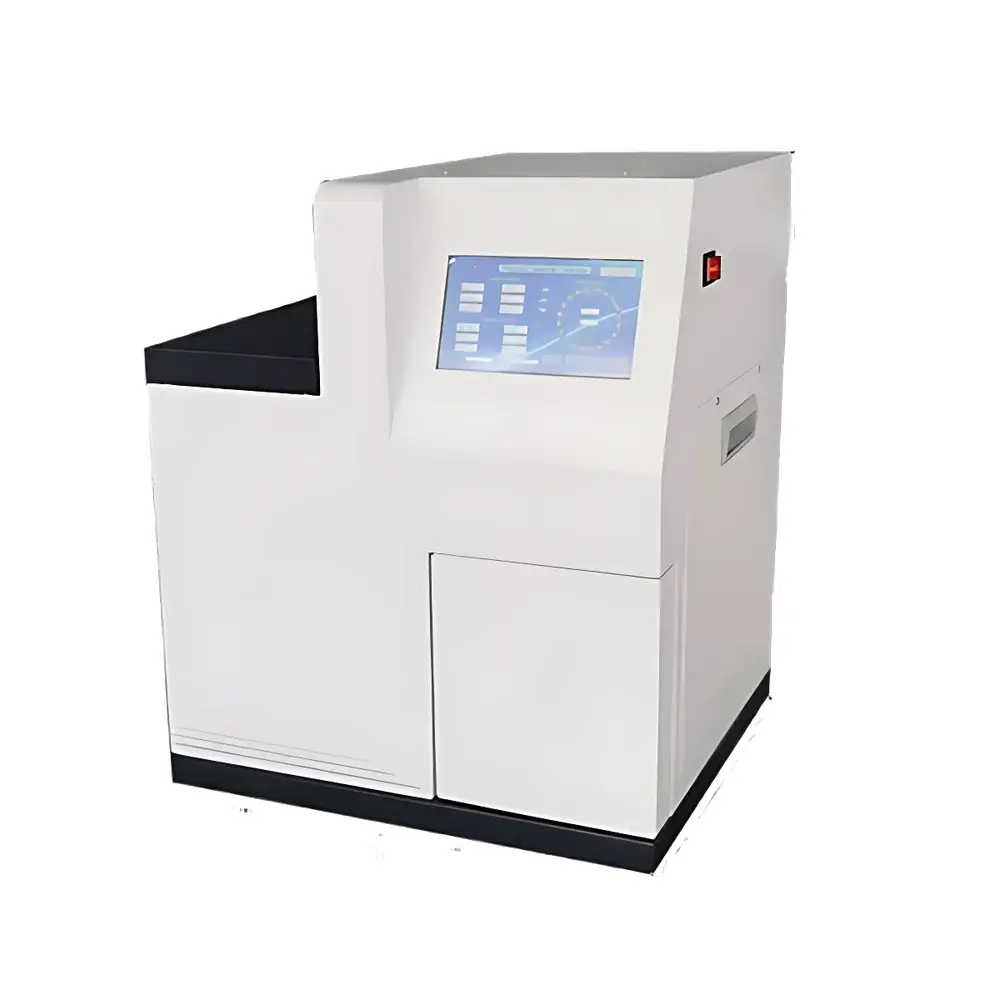
Beifen Sanpu BAHS-20A Plus Fully Automated Headspace Sampler
| Brand | Beifen Sanpu |
|---|---|
| Origin | Beijing, China |
| Manufacturer Type | Direct Manufacturer |
| Automation Level | Fully Automated |
| Sample Vial Capacity | 20 positions |
| Vial Size | 20 mL (customizable: 10 mL, 50 mL, 100 mL) |
| Sample Heating Range | 40–220 °C (optional up to 300 °C) |
| Valve & Transfer Line Heating Range | 40–220 °C (optional up to 300 °C) |
| Temperature Accuracy | ±0.5 °C |
| Temperature Stability | < ±0.5 °C |
| Pressurization Time | 0–999 s |
| Sampling Time | 0–30 min |
| Injection Time | 0–999 s |
| Bake-out/Flush Time | 0–30 min |
| Minimum Time Resolution | 1 ms |
| Pressurization Pressure | 0–0.25 MPa (continuously adjustable) |
| Quantitative Loop Volume | 1 mL (optional: 0.5, 2, 5 mL) |
| RSD | < 1.0% (for 100 ppm ethanol in water) |
| Purge Flow Rate | 0–100 mL/min (adjustable) |
| Interface | USB |
| Inert Flow Path | Deactivated fused-silica and PEEK tubing throughout |
| Valve Configuration | High-precision 6-port rotary valve with integrated heated zone |
| Sampling Mode | Single-shot, multi-shot per vial, or sequential multi-vial |
Overview
The Beifen Sanpu BAHS-20A Plus Fully Automated Headspace Sampler is an engineered solution for reproducible, unattended volatile organic compound (VOC) extraction from liquid and solid matrices prior to gas chromatographic analysis. It operates on the principle of equilibrium headspace sampling—where a sealed sample vial is thermostatically heated to establish vapor-phase equilibrium between the non-volatile matrix and target analytes. A precise volume of equilibrated headspace gas is then pressurized, transferred via a heated, inert flow path, and injected into the GC inlet using a temperature-controlled 6-port rotary valve and quantitative loop. Designed for laboratories requiring high throughput and regulatory compliance, the BAHS-20A Plus delivers robust performance in environmental testing, pharmaceutical residual solvent analysis (per USP , ICH Q3C), food flavor profiling, forensic toxicology, and polymer off-gassing studies.
Key Features
- Fully automated 20-position carousel with real-time positional validation—avoids collision during vial handling through intelligent fault detection and adaptive motion control.
- Triple-zone independent temperature control: sample block, valve manifold, and transfer line—all maintained within ±0.5 °C stability and calibrated to NIST-traceable standards.
- Heated 6-port valve housed entirely within the thermal enclosure eliminates cold spots, preserving analyte integrity and preventing condensation-induced bias.
- Positive-pressure sampling architecture ensures compatibility with both liquid and solid samples without baseline drift; no carrier gas consumption during pressurization.
- Full inertness: all wetted surfaces—including quantitative loop, valve rotor seal, and sampling needle—are constructed from deactived fused silica and PEEK, minimizing adsorption, carryover, and cross-contamination (RSD < 1.0% confirmed with 100 ppm ethanol standard).
- Motor-driven actuation system—no external compressed air or nitrogen required—reducing infrastructure dependency and operational hazards.
- Configurable timing resolution down to 1 millisecond, enabling fine-grained method optimization for trace-level VOCs with narrow retention windows.
- Integrated self-diagnostics: power-on hardware verification, vial presence sensing, thermal fault logging, and emergency motion halt upon mechanical anomaly detection.
Sample Compatibility & Compliance
The BAHS-20A Plus accommodates standard 20 mL crimp-top headspace vials (also supports 10 mL, 50 mL, and 100 mL formats upon request) and accepts diverse sample types—including aqueous solutions, soils, polymers, pharmaceutical tablets, beverages, and biological tissues. Its design adheres to core requirements of ISO 17025-accredited laboratories, supporting audit-ready operation under GLP and GMP frameworks. The instrument’s deterministic timing, electronic parameter logging, and USB-based configuration enable full traceability—critical for FDA 21 CFR Part 11 compliance when paired with validated chromatography data systems (CDS). Method parameters—including temperature ramps, pressurization profiles, and purge flows—are stored digitally with timestamped version history.
Software & Data Management
Control is executed either locally via the 7-inch graphical LCD interface—with animated workflow guidance—or remotely via USB-connected PC running vendor-provided configuration software. All method parameters (heating profiles, timing sequences, pressure setpoints, and GC synchronization triggers) are programmable and exportable as XML or CSV files for backup and cross-instrument replication. The system logs runtime events—including vial ID, cycle completion time, temperature deviations, and error codes—in a structured local database. Optional EPC (Electronic Pressure Control) module enables dynamic backpressure regulation during transfer, further enhancing precision for low-concentration analytes. No proprietary drivers are required; standard Windows-compatible HID protocols ensure seamless integration with third-party CDS platforms (e.g., Thermo Chromeleon, Agilent OpenLab, Shimadzu GC Solutions).
Applications
This headspace sampler is routinely deployed in regulated and research settings for: residual solvent quantification in active pharmaceutical ingredients (APIs) per USP ; benzene and toluene screening in drinking water per EPA Method 502.2; ethanol and fusel oil profiling in alcoholic beverages; monomer release testing in medical device packaging (ISO 10993-12); and volatile metabolite screening in clinical urine or blood specimens. Its ability to handle heterogeneous solids—such as soil cores or polymer granules—without derivatization or solvent extraction makes it ideal for environmental forensics and materials science QA/QC workflows.
FAQ
What vial sizes does the BAHS-20A Plus support?
Standard configuration supports 20 mL crimp-top vials; optional adapters accommodate 10 mL, 50 mL, and 100 mL formats.
Can the instrument be synchronized with any gas chromatograph?
Yes—it provides TTL-level trigger outputs and accepts external start signals, ensuring full interoperability with GC systems from Agilent, Thermo Fisher, Shimadzu, PerkinElmer, and others.
Is the quantitative loop volume customizable?
Yes—standard is 1 mL, but 0.5 mL, 2 mL, and 5 mL loops are available as factory-configured options.
Does the system meet regulatory requirements for pharmaceutical testing?
It supports USP , ICH Q3C, and EP 2.4.24 methods; full 21 CFR Part 11 compliance depends on CDS integration and procedural validation.
What maintenance is required for long-term reliability?
Quarterly inspection of vial septa penetration depth, annual calibration of temperature sensors against certified references, and periodic replacement of rotor seal (recommended every 10,000 injections).
Related Products




