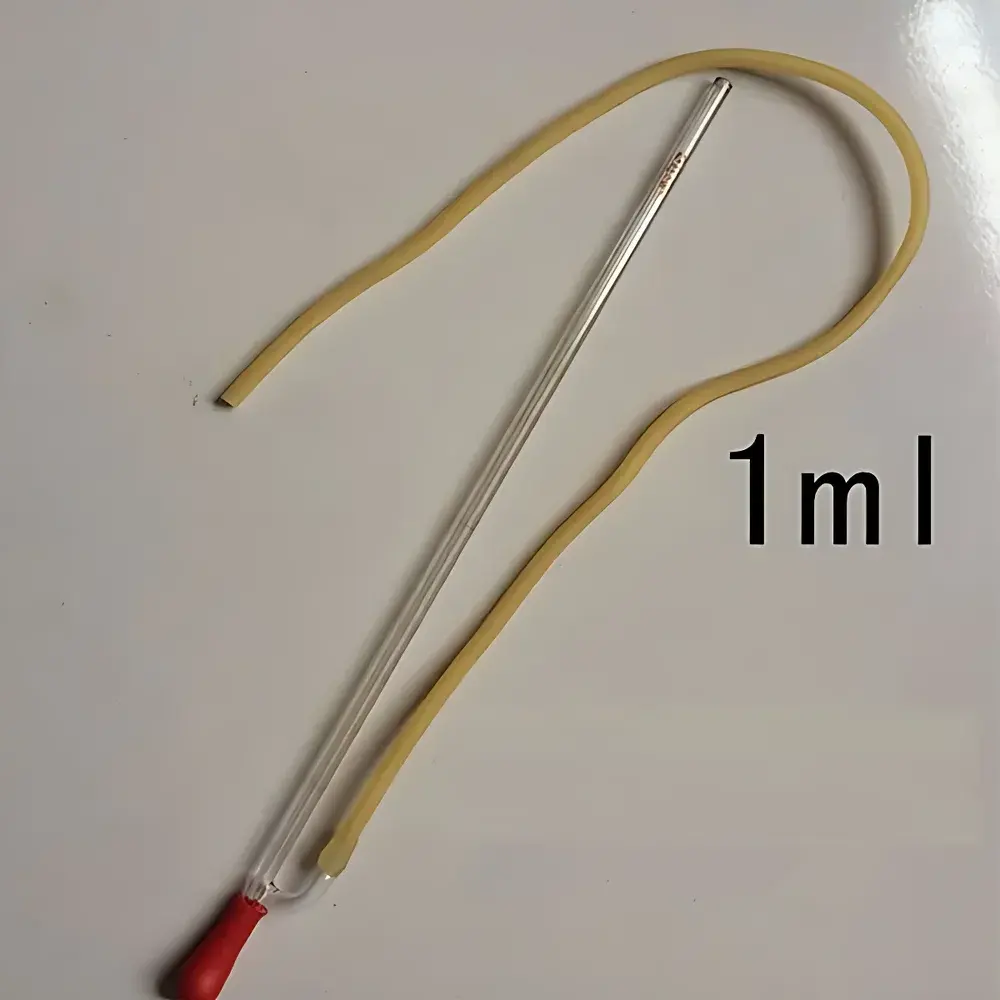
Beifen Sanpu 1 mL Glass Soap Film Flowmeter
| Brand | Beifen Sanpu |
|---|---|
| Origin | Hebei, China |
| Manufacturer Type | Manufacturer |
| Product Category | Domestic |
| Model | 1 mL |
| Type | Volumetric Flowmeter |
| Measurement Principle | Volumetric Displacement via Soap Film Transit Time |
| Volume Calibration | 1 mL |
| Typical Uncertainty | ±0.5% of full scale (subject to operator technique, temperature/pressure correction, and calibration traceability) |
| Operating Pressure Range | Near-ambient (≤ 5 kPa differential) |
| Temperature Sensitivity | Requires concurrent gas temperature measurement for standardized volume correction (e.g., to 25 °C, 101.325 kPa) |
| Compliance Basis | Designed in accordance with ISO 4064-2 (Water meters — Part 2: Test methods and equipment) principles for volumetric displacement verification |
Overview
The Beifen Sanpu 1 mL Glass Soap Film Flowmeter is a precision volumetric displacement instrument engineered for high-reproducibility gas flow rate determination under low-differential-pressure conditions. It operates on the fundamental principle of timed transit: a soap film—generated manually at the base of a vertically oriented, solvent-etched borosilicate glass tube—is propelled upward by the test gas flow. The time required for the film to traverse a precisely engraved 1 mL calibration segment is measured using a high-resolution stopwatch (≥ 0.01 s resolution recommended). Flow rate (mL/min or L/min) is calculated as V / t, where V is the calibrated volume (1.000 mL ± tolerance) and t is the transit time in minutes. This method eliminates moving mechanical parts, minimizing hysteresis and wear-related drift. Its operation relies on laminar, non-turbulent flow and requires simultaneous recording of gas temperature and absolute pressure to correct measured volume to standard reference conditions (e.g., STP or SATP), enabling conversion to mass flow (e.g., mg/min) via ideal gas law application.
Key Features
- Optically clear, chemically resistant borosilicate glass construction ensures long-term dimensional stability and visual clarity for unambiguous film tracking.
- Precision-etched 1 mL calibration segment with ±0.005 mL linearity tolerance, verified against NIST-traceable volumetric standards.
- Integrated silicone-based foam generator bulb (reusable, solvent-compatible) enables rapid, repeatable soap film formation without contamination risk.
- Zero internal moving parts—no valves, pistons, or rotors—eliminating mechanical hysteresis and maintenance requirements.
- Low-pressure drop design (< 200 Pa at 100 mL/min air flow) preserves upstream system integrity in sensitive sampling trains (e.g., air quality monitors, GC carrier gas verification).
- Compatible with common laboratory surfactants (e.g., aqueous sodium lauryl sulfate solutions) and inert carrier gases (N₂, He, CO₂, synthetic air).
Sample Compatibility & Compliance
This flowmeter is validated for use with non-corrosive, non-condensing gases at ambient temperatures (15–30 °C) and near-atmospheric pressures. It is not suitable for vapors prone to condensation, reactive gases (e.g., Cl₂, NH₃, H₂S), or particulate-laden streams without upstream filtration. While not certified to ISO/IEC 17025 as a standalone measuring instrument, its methodology aligns with ISO 4064-2 Annex C (volumetric displacement verification) and ASTM D3195 (Standard Test Method for Rotameters and Other Variable-Area Meters) for primary flow calibration traceability. When integrated into GLP or GMP workflows, it supports audit-ready documentation when paired with calibrated timers (e.g., NIST-traceable electronic stopwatch), digital thermobarometers, and controlled procedural logs per FDA 21 CFR Part 11 data integrity expectations.
Software & Data Management
The 1 mL Glass Soap Film Flowmeter is a manual, analog instrument requiring no embedded electronics or firmware. Data acquisition is operator-mediated: transit time, ambient temperature, and barometric pressure are recorded manually or via external digital sensors interfaced with laboratory information management systems (LIMS) or Excel-based calculation templates. Beifen Sanpu provides a downloadable ISO-compliant calibration certificate template and uncertainty budget worksheet (based on GUM—Guide to the Expression of Uncertainty in Measurement) to support metrological rigor. Users may integrate readings into automated workflows using USB-connected timers or Bluetooth thermobarometers exporting CSV-formatted timestamped data.
Applications
- Calibration and verification of low-flow gas sources in environmental monitoring (e.g., EPA Method TO-15 canister pressurization, passive sampler flow validation).
- Flow rate auditing of laboratory fume hood face velocities and cleanroom supply lines.
- Primary standard for validating thermal mass flow controllers (MFCs) and rotameters below 500 mL/min.
- Teaching tool in undergraduate fluid mechanics and analytical chemistry labs for demonstrating volumetric flow principles and uncertainty propagation.
- QC testing of portable gas detectors and respirator fit-test systems requiring traceable sub-L/min flow verification.
- Research applications in catalysis, membrane permeation studies, and microfluidic device characterization where laminar, pulsation-free flow quantification is critical.
FAQ
What is the typical measurement uncertainty of the 1 mL model?
The combined standard uncertainty is typically ≤ 0.5% of full scale when operated by trained personnel using a 0.01 s resolution timer, corrected for temperature and pressure, and following ISO 4064-2 alignment protocols.
Can this flowmeter be used for corrosive gases?
No. Borosilicate glass resists mild alkalis and acids but is incompatible with halogens, strong oxidizers, or condensable vapors that compromise soap film integrity or etch the刻度.
Is calibration certification included?
Each unit ships with a factory verification report referencing traceable volumetric standards; full ISO/IEC 17025 calibration with uncertainty statement is available as an optional service.
How often should the soap solution be replaced?
Fresh surfactant solution should be prepared daily or per shift to ensure consistent film formation, surface tension, and minimal evaporation-induced error.
Does the flowmeter require power or compressed air?
No. It is entirely passive and gravity-assisted—only manual actuation of the foam bulb and external timing/thermobarometric instrumentation are needed.