
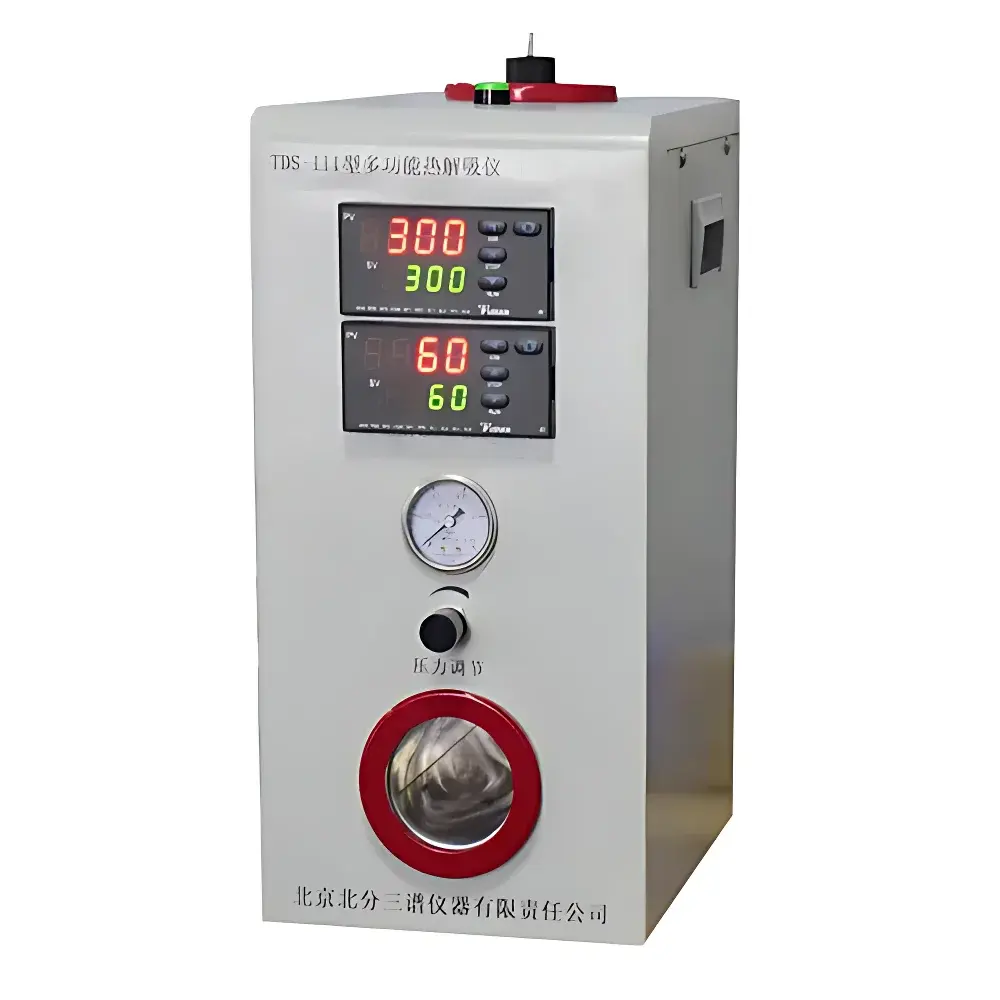
Beifen Sanpu BFTDS-III Multi-Function Thermal Desorption Unit for Extracted Oil Analysis
| [Brand | Beifen Sanpu |
|---|---|
| Model | BFTDS-III |
| Origin | Beijing, China |
| Manufacturer Type | Original Equipment Manufacturer (OEM) |
| Instrument Class | Benchtop Laboratory Thermal Desorption System |
| Heating Zones | Dual independent temperature-controlled zones (desorption furnace + syringe heater) |
| Desorption Temp Range | Ambient to 400 °C (1 °C increment, stability < ±0.5 °C) |
| Syringe Heater Temp Range | Ambient to 100 °C (1 °C increment, stability < ±0.5 °C) |
| Compatible Tube OD | 6 mm or 1/4″ |
| Carrier Gas Flow Control | 10–200 mL/min, stability < 0.1% |
| Syringe Capacity | Up to 100 mL gas-tight glass syringe |
| Desorption Recovery | >85% (compound-dependent) |
| Dimensions (H×W×D) | 390 × 170 × 360 mm |
| Power Consumption | ~500 W |
| Net Weight | ~9 kg |
| Compliance | Designed per GBZ/T 300.62–2017, GB 50325–2006, and ISO 16000-6 for VOC analysis] |
Overview
The Beifen Sanpu BFTDS-III Multi-Function Thermal Desorption Unit is a benchtop, dual-zone thermal desorption system engineered for precise, reproducible pre-concentration and transfer of volatile and semi-volatile organic compounds (VOCs and SVOCs) from solid sorbent tubes—particularly activated carbon—into gas chromatographic systems. It operates on the principle of controlled resistive heating to thermally desorb analytes adsorbed onto sorbent media, followed by quantitative transfer into a large-volume gas-tight syringe (up to 100 mL). This manual transfer method enables direct, carrier-gas-free introduction of the desorbed vapor into a GC inlet via syringe injection—eliminating cold spots, dead volumes, and condensation losses common in older single-stage desorption units. The BFTDS-III is specifically validated for regulatory methods including GBZ/T 300.62–2017 (Determination of extracted oil in workplace air), GB 50325–2006 (indoor benzene and TVOC analysis), and aligns with the analytical workflow described in ISO 16000-6 for indoor air VOC monitoring.
Key Features
- Dual independent temperature control zones: a high-temperature desorption furnace (ambient to 400 °C, ±0.5 °C stability) and a low-temperature syringe heater (ambient to 100 °C, ±0.5 °C stability), both programmable in 1 °C increments.
- Integrated mechanical design eliminates alignment errors and ensures leak-tight, zero-dead-volume connection between desorption tube outlet and syringe inlet—critical for quantitative recovery of light hydrocarbons such as extracted oil components.
- Compatible with standard 6 mm OD (or 1/4″) sorbent tubes of arbitrary length; supports both single-bed and multi-bed configurations without hardware modification.
- Carrier gas flow regulation (10–200 mL/min) with <0.1% short-term stability, enabling consistent desorption kinetics across replicate analyses.
- Manual syringe-based transfer supports method flexibility: users may perform multiple injections from the same desorbed sample volume to assess repeatability or confirm peak identity via retention time consistency.
- Compact footprint (390 × 170 × 360 mm) and low power draw (~500 W) make it suitable for shared laboratory environments and mobile testing labs complying with occupational hygiene field protocols.
Sample Compatibility & Compliance
The BFTDS-III is optimized for thermally labile and moderately volatile C5–C12 hydrocarbon mixtures—including extracted oil, solvent gasoline, LPG fractions, and turpentine—adsorbed onto activated carbon (100 mg bed mass, as specified in GBZ/T 300.62–2017). It accommodates standard glass or stainless-steel sorbent tubes without adapter kits. Method validation data indicate >85% average desorption recovery for representative n-hexane, toluene, and ethylbenzene standards under 300 °C/30 mL/min N₂ conditions. The system meets essential requirements for GLP-compliant laboratories: temperature calibration traceability to NIST-traceable references, documented thermal uniformity mapping, and full operational parameter logging capability when paired with external data acquisition software. While not inherently 21 CFR Part 11 compliant (lacking electronic signatures or audit trail firmware), its analog control architecture permits integration into validated workflows where manual logbook entries and instrument calibration records fulfill local QA/QC documentation mandates.
Software & Data Management
The BFTDS-III operates via front-panel digital controllers with LED display—no embedded microprocessor or proprietary software stack. All temperature setpoints, ramp rates, hold times, and gas flow values are manually entered and retained in non-volatile memory. For traceable data management, laboratories integrate the unit with external GC data systems (e.g., Shimadzu GCsolution, Thermo Chromeleon, or OpenLab CDS) using standard analog voltage outputs (0–5 V) for event synchronization (e.g., “desorption start” or “syringe ready” signals). Users maintain compliance with ISO/IEC 17025 and CNAS-CL01 through printed calibration certificates (temperature, flowmeter), daily verification logs, and annual performance qualification reports—covering desorption efficiency, carryover, and inter-unit reproducibility across ≥3 replicates per analyte.
Applications
- Workplace air monitoring per GBZ/T 300.62–2017 for extracted oil, solvent gasoline, LPG, and turpentine in petrochemical, refining, and storage facility environments.
- Indoor air quality assessment per GB 50325–2006 for benzene and total volatile organic compounds (TVOC), using cost-effective activated carbon tubes instead of expensive multi-sorbent cartridges.
- Method development for thermal desorption–GC–FID quantification of aliphatic and aromatic hydrocarbons in ambient, occupational, or emissions sampling matrices.
- Reference laboratory verification of sorbent tube batch performance, including breakthrough volume determination and desorption efficiency profiling across concentration gradients (0.0–0.70 µg/mL).
- Training platform for chromatography novices: intuitive manual operation reduces learning curve while preserving fundamental understanding of desorption thermodynamics and GC inlet dynamics.
FAQ
What is the primary analytical purpose of the BFTDS-III?
It serves as a thermal desorption pre-concentrator for VOC analysis—specifically designed to release analytes from activated carbon tubes and deliver them quantitatively into a gas chromatograph via manual syringe injection.
How does it differ from automated or secondary thermal desorbers?
Unlike cryo-focused or trap-based systems, the BFTDS-III uses direct syringe transfer without cold trapping, making it simpler to operate and maintain—but requiring manual intervention at the injection step.
Is it compatible with GC systems other than Shimadzu GC-2010?
Yes. Its output is carrier-gas-free vapor delivered via standard 100 mL gas-tight syringe, compatible with any GC injector accepting liquid or gas-phase manual injection (split/splitless, PTV, or cold-on-column inlets).
Can it be used for polar compounds like alcohols or ketones?
Limited applicability: recovery may decline for highly polar or thermally unstable analytes due to adsorption on metal surfaces or decomposition at 300–400 °C; method validation is required prior to routine use.
Does it support method-defined flow programming during desorption?
No. Carrier gas flow is fixed during each desorption cycle; however, the precision flow controller allows stable, repeatable settings across runs—sufficient for standardized methods like GBZ/T 300.62–2017.




