
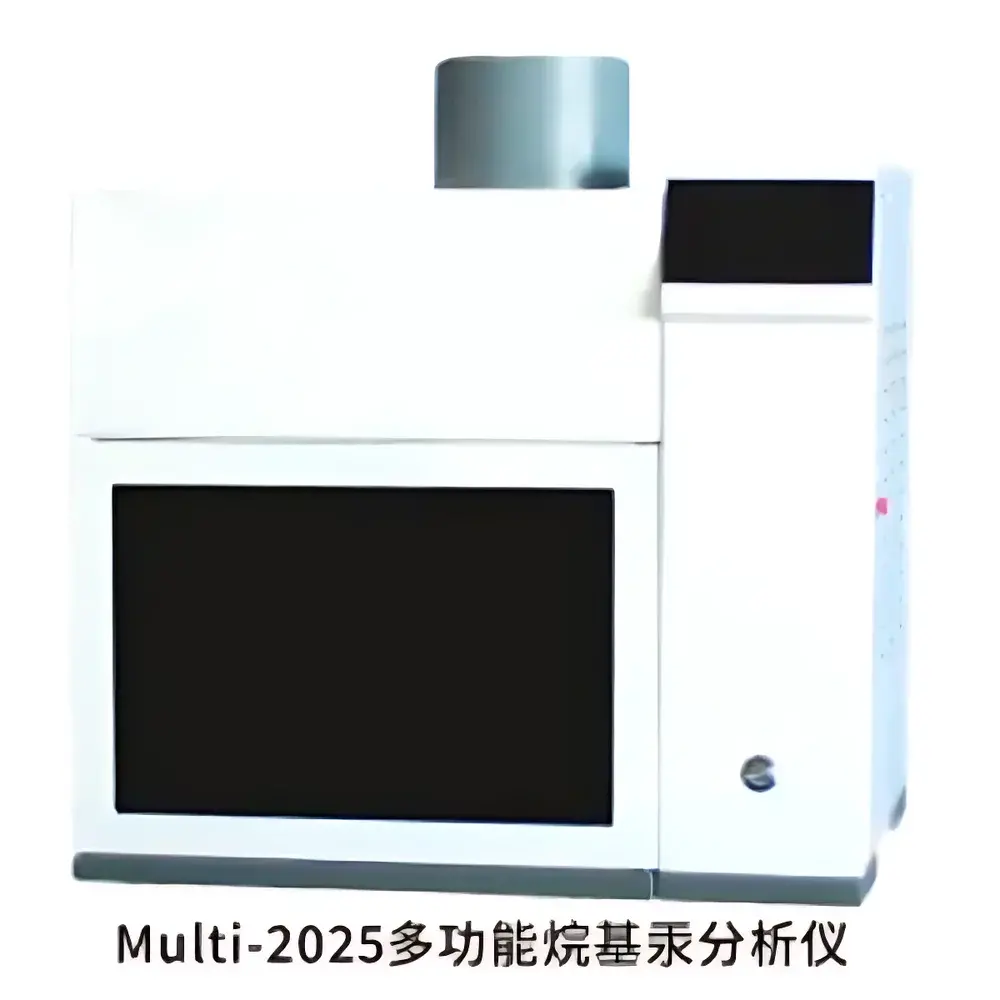
Beifen Sanpu Multi-2025 Alkylmercury Analyzer (Methylmercury & Ethylmercury)
| Brand | Beifen Sanpu |
|---|---|
| Origin | Beijing, China |
| Manufacturer Type | Direct Manufacturer |
| Product Category | Domestic Laboratory Instrument |
| Model | Multi-2025 |
| Instrument Type | Laboratory Water Quality Analyzer |
| Target Analytes | Methylmercury (CH₃Hg⁺), Ethylmercury (C₂H₅Hg⁺) |
| Detection Principle | Purge-and-Trap Coupled with Gas Chromatography–Cold Vapor Atomic Fluorescence Spectrometry (PT-GC-CVAFS) |
| Regulatory Compliance | HJ 977–2018, HJ 1269–2022, HJ 1268–2022, SNT 5517–2023 |
| Elemental Capability | As, Hg, Pb, Se, Sb, Bi, Cd, Te, Sn, Ge, Zn, Au (12 elements via hydride generation-AFS) |
| Column | Modified OV-3 packed column |
| Pyrolysis Temperature | Up to 1050 °C |
| Software | Graphical GUI with real-time status monitoring, consumables lifetime tracking, and multi-format reporting (PDF/Excel/Word) |
| Data Integrity Features | Audit trail support, user access control, instrument state logging |
Overview
The Beifen Sanpu Multi-2025 Alkylmercury Analyzer is a dual-mode laboratory instrument engineered for the selective, sensitive, and regulatory-compliant quantification of methylmercury (CH₃Hg⁺) and ethylmercury (C₂H₅Hg⁺) in aqueous matrices. It integrates purge-and-trap sample enrichment with gas chromatographic separation and cold vapor atomic fluorescence detection (PT-GC-CVAFS)—a reference method endorsed by Chinese environmental standards including HJ 977–2018 (for water) and HJ 1269–2022 (for soil and sediment). Unlike conventional single-purpose mercury analyzers, the Multi-2025 also functions as a full-capability hydride generation atomic fluorescence spectrometer (HG-AFS), enabling simultaneous determination of total concentrations of 12 regulated elements—including As, Se, Sb, Bi, Cd, Pb, and Zn—in environmental, biological, and industrial samples. Its architecture prioritizes trace-level mercury stability through minimized memory effects, low-dead-volume fluidic design, and mercury-inert material selection—critical for achieving sub-pg/L detection capability in compliance-driven laboratories.
Key Features
- Modular PT-GC-CVAFS configuration compatible with third-party purge-and-trap concentrators (e.g., Tekmar, OI, or legacy lab systems), enabling seamless integration into existing workflows without hardware redundancy.
- Thermally robust pyrolysis furnace operating up to 1050 °C, ensuring complete thermal decomposition of alkylmercury species prior to atomic fluorescence detection.
- Custom-packed GC column with modified OV-3 stationary phase—optimized for alkylmercury resolution, offering enhanced column longevity and reproducible retention times compared to standard fused-silica capillaries.
- Monolithic 3D-printed reaction module integrating hydride generation, gas–liquid separation, and quartz cell positioning in a single mercury-passivated polymer structure; eliminates tubing interconnections and reduces carryover risk by >90% versus traditional modular assemblies.
- Dual analytical modes: dedicated alkylmercury speciation (via PT-GC-CVAFS) and total elemental analysis (via HG-AFS) on one platform—reducing capital expenditure and footprint while maintaining method independence.
- Real-time graphical software interface displaying instrument status (e.g., carrier gas pressure, oven temperature, lamp warm-up progress, and line flushing cycles), with automated alerts for maintenance thresholds.
Sample Compatibility & Compliance
The Multi-2025 supports direct analysis of filtered aqueous samples (surface water, wastewater, drinking water, leachates) without derivatization. For solid matrices—including soils, sediments, biological tissues, and feedstuffs—extraction follows standardized protocols (e.g., HJ 1269–2022 acid leaching with CuSO₄ catalysis). The system meets all performance criteria outlined in HJ 977–2018 (detection limit ≤ 0.02 ng/L for CH₃Hg⁺ in water) and SNT 5517–2023 (export seafood testing). It supports GLP-aligned operation through configurable user roles, electronic signature capability, and time-stamped audit logs—facilitating FDA 21 CFR Part 11 readiness when deployed in contract testing labs serving pharmaceutical or food safety markets.
Software & Data Management
The embedded Windows-based software provides intuitive method setup, sequence scheduling, and live signal visualization. All acquisition parameters—including purge time, trap desorption temperature, GC ramp profiles, and AFS integration time—are fully programmable and stored with metadata. Consumables tracking monitors cumulative usage hours for peristaltic pump tubing, hollow cathode lamps, and quartz cells, triggering configurable notifications before scheduled replacement. Reporting adheres to ISO/IEC 17025 documentation requirements: raw data files (.raw), processed chromatograms, calibration curves, QC check results, and final reports export natively to PDF, Excel (.xlsx), and Word (.docx) formats—with optional watermarking and digital signature embedding.
Applications
- Regulatory monitoring of methylmercury in municipal drinking water supplies and wastewater effluents per national environmental quality standards.
- Speciation analysis of alkylmercury in fish tissue, shellfish, and aquaculture products for export certification under SNT 5517–2023.
- Multi-element screening of As, Hg, Se, and Sb in agricultural soils, fertilizers, and animal feed to assess bioaccumulation risk.
- Research-grade investigation of methylation/demethylation kinetics in anaerobic sediments and microbial consortia.
- Quality control of pharmaceutical excipients and herbal medicine extracts where elemental impurities are governed by ICH Q3D guidelines.
- Forensic toxicology labs performing blood and urine analysis for occupational mercury exposure assessment.
FAQ
Does the Multi-2025 require dedicated purge-and-trap hardware?
No—it is designed for interoperability with commercially available purge-and-trap concentrators. Users may retain existing systems or select from validated third-party models.
Can the instrument quantify both methylmercury and ethylmercury separately?
Yes. Chromatographic separation using the OV-3 column resolves CH₃Hg⁺ and C₂H₅Hg⁺ peaks with baseline resolution (Rs > 1.5) under optimized temperature programming.
Is the software compliant with 21 CFR Part 11 for electronic records?
The software supports role-based access control, audit trail generation, and electronic signatures—providing foundational capabilities for Part 11 implementation when configured within a validated IT environment.
What maintenance intervals are recommended for the 3D-printed reaction module?
Under routine use (≤ 20 samples/day), the module requires cleaning every 200 injections and replacement every 12 months or after 5,000 analyses—whichever occurs first.
Does the system support method validation per ISO 17025?
Yes. Built-in calibration verification, continuing calibration checks (CCCs), blank monitoring, and spike recovery tracking enable full validation documentation per ISO/IEC 17025:2017 Clause 7.7.
Related Products







