
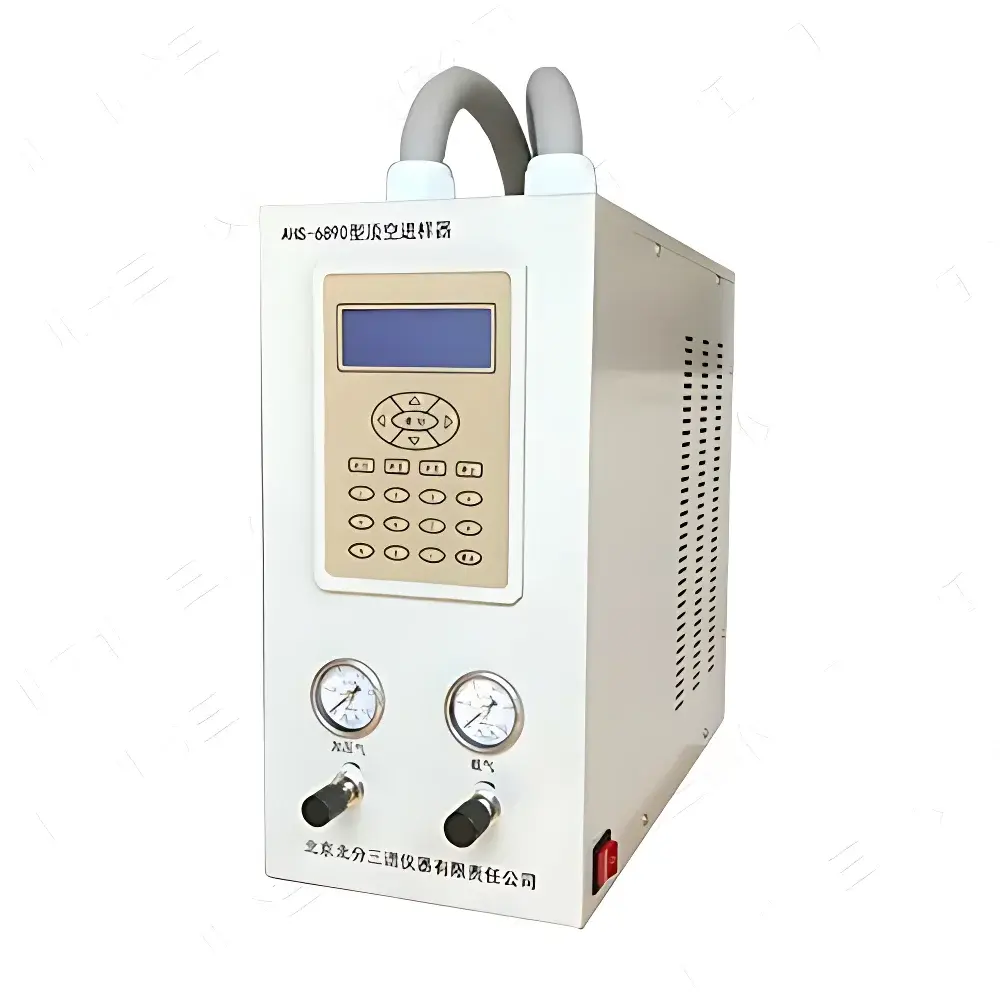
Beifen Sanpu AHS-6890 9-Position High-Pressure Automated Headspace Sampler
| Brand | Beifen Sanpu |
|---|---|
| Origin | Beijing, China |
| Manufacturer Type | Manufacturer |
| Product Category | Domestic |
| Model | AHS-6890 |
| Instrument Type | Static Headspace Sampler |
| Automation Level | Semi-Automatic |
| Vial Heating Range | Ambient to 200 °C |
| Valve Temperature Control Range | Ambient to 200 °C |
| Sample Loop Volume | 1 mL |
| Vial Capacity | 9 positions |
| Vial Size | 20 mL |
Overview
The Beifen Sanpu AHS-6890 is a static high-pressure automated headspace sampler engineered for precise, reproducible sample introduction into gas chromatography (GC) systems. It operates on the principle of equilibrium headspace analysis—where volatile analytes partition between a solid or liquid sample matrix and the gaseous phase above it in a sealed vial. Under controlled temperature and pressure conditions, the vapor-phase composition reaches thermodynamic equilibrium, enabling quantitative extraction without solvent interference. The AHS-6890 implements a high-pressure pressurization method (0–0.4 MPa, continuously adjustable), eliminating reliance on traditional six-port valves and fixed-volume loops—thereby reducing carryover, improving injection precision, and extending system longevity. Designed specifically for laboratories requiring robust routine analysis of volatile organic compounds (VOCs), residual solvents, disinfectant byproducts, and environmental contaminants, this instrument delivers consistent performance across regulated and research-driven workflows.
Key Features
- 9-position sample carousel with standardized 20 mL headspace vials (10 mL and 50 mL options available upon request)
- Triple-zone independent temperature control: sample oven (ambient–200 °C), valve box (ambient–160 °C), and transfer line (ambient–160 °C), each with ±0.5 °C accuracy and uniformity
- Low-voltage (18 V) heated transfer lines and metal isothermal vial heating blocks—eliminating oil-bath maintenance and thermal gradient artifacts
- Microprocessor-based control with Chinese-language LCD interface, membrane keypad, and programmable event timing (3 external triggers, 8-step sequence)
- Integrated pressure-controlled sampling: automatic pressurization, equilibration, syringe aspiration, GC injection, and post-injection backflush (0–20 mL/min, adjustable)
- Self-cleaning function for both sampling needle and transfer tubing; optional 0.53 mm fused silica capillary for active compound analysis
- Modular architecture compatible with multiple GC systems simultaneously; no hardware modification required to existing GC inlets
- Onboard diagnostics, real-time status display (method parameters, elapsed time, date/time stamp), and adjustable LCD brightness
- Imported pneumatic components for long-term reliability and cycle stability (RSD < 1% under optimal GC conditions)
Sample Compatibility & Compliance
The AHS-6890 supports aqueous, viscous, semi-solid, and solid matrices—including pharmaceuticals, polymers, food packaging, soil, water, biological fluids, and medical devices. Its design accommodates standard 20 mL crimp-top or screw-cap vials compliant with ASTM D6866, ISO 17025, and USP residual solvents guidelines. The instrument meets technical requirements referenced in major regulatory methods, including EPA Method 502.2, HJ 642–2013 / HJ 643–2013 (China’s environmental VOC standards), GB 5749–2006 (drinking water), GB 8537–2008 (mineral water), YC/T 207–2014 (tobacco packaging), SN/T 4068–2014 (food contact materials), and ChP 2015 Vol. III & IV (Chinese Pharmacopoeia headspace procedures). While not inherently 21 CFR Part 11 compliant, its event logging, method storage (up to 9 user-defined protocols), and hardware-level audit trail capabilities support GLP/GMP-aligned validation when integrated with compliant chromatography data systems.
Software & Data Management
The AHS-6890 operates as a standalone hardware module with embedded firmware—no proprietary PC software required. All method parameters (vial temperature, valve/line setpoints, pressurization duration, injection volume, backflush flow rate, and multi-step timing sequences) are configured directly via the front-panel interface and retained in non-volatile memory. Time-programmed events can be synchronized with external GC start signals or initiate GC acquisition autonomously. For traceability, the unit logs operational timestamps and displays real-time status during runs. When paired with third-party chromatography data systems (e.g., OpenLab CDS, Chromeleon, Empower), full audit trails—including method versioning, operator ID entry (via external login), and electronic signature integration—are achievable through system-level configuration—not device-native functionality.
Applications
The AHS-6890 is routinely deployed in quality control and regulatory testing environments where solvent-free, high-fidelity VOC quantification is critical. Key application domains include: residual solvent analysis in APIs and excipients per ICH Q3C; disinfection byproduct monitoring (e.g., chloroform, bromodichloromethane) in drinking water per GB 5749–2006; packaging migration studies (e.g., ethylene oxide, acetaldehyde, hexane) in food and pharmaceutical containers; forensic toxicology (ethanol, acetone, isopropanol in blood/urine); environmental screening of halogenated hydrocarbons in soil and wastewater per HJ 736–2015; and flavor/aroma profiling in beverages and agricultural commodities. Its high-pressure sampling mechanism ensures efficient transfer of low-volatility analytes while minimizing adsorption losses—particularly advantageous for polar or thermally labile compounds.
FAQ
What is the maximum operating temperature for the sample transfer line?
The transfer line is rated for continuous operation up to 160 °C. For extended service life, maintain ≥5 °C below the GC inlet temperature.
Can the AHS-6890 be used with multiple GC instruments?
Yes—the modular design allows one unit to serve two or more GC systems via manual or automated valve switching; no GC hardware modification is needed.
Is the instrument suitable for analyzing highly adsorptive compounds?
Yes; optional 0.53 mm deactivated fused silica transfer tubing minimizes surface interactions, and automated backflush prevents cross-contamination between runs.
How is vial seal integrity verified?
An integrated leak-test accessory enables rapid assessment of crimp/seal quality prior to equilibration—critical for method reproducibility and compliance with ISO 17025 clause 7.7.
What maintenance is required for long-term stability?
Routine cleaning of the sampling needle and transfer line using solvent flushes (e.g., methanol, acetone) is recommended after every 50–100 injections; periodic calibration of temperature sensors per manufacturer’s SOP ensures continued accuracy.






