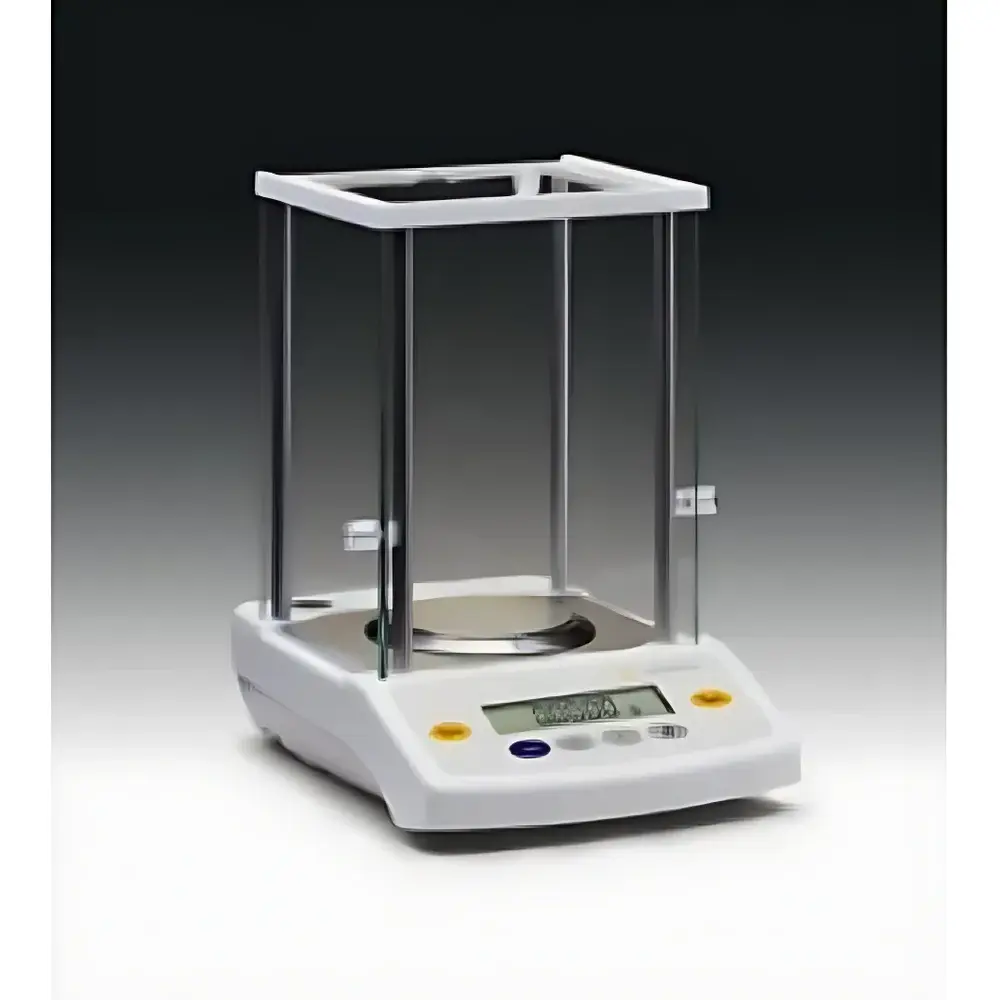
Sartorius TE64 Analytical Balance
| Brand | Sartorius |
|---|---|
| Origin | Germany |
| Model | TE64 |
| Instrument Type | Analytical Balance |
| Maximum Capacity | 120 g |
| Readability | 0.1 mg |
| Repeatability | 1 mg |
| Calibration | External |
| Weighing Pan Diameter | 90 mm |
| Display | High-Contrast LCD |
| Compliance | ISO/GLP |
| Interface | Bidirectional RS-232C |
| Environmental Filtering | 4-Level Digital Filtering |
| Functions | Percentage Weighing, Net Weight Summation, Average/Dynamic Weighing, Piece Counting, Unit Conversion |
| Overload Protection | Built-in |
| Draft Shield | Full-Glass Windscreen |
Overview
The Sartorius TE64 Analytical Balance is a precision laboratory instrument engineered for high-reproducibility mass measurement in regulated and research-intensive environments. Operating on electromagnetic force compensation (EMFC) principle, the TE64 delivers stable, drift-compensated readings under variable ambient conditions—including minor air currents, temperature fluctuations, and vibration. With a nominal readability of 0.1 mg and maximum capacity of 120 g, it meets the performance requirements of Class I analytical balances per OIML R 76 and ASTM E898–22. Designed and manufactured in Germany, the TE64 adheres to stringent quality control protocols throughout its production lifecycle, ensuring long-term metrological integrity and traceability to national standards via external calibration with certified weights.
Key Features
- High-contrast, backlit LCD display with intuitive icon-based navigation for rapid parameter recognition and operator guidance.
- Full-glass draft shield with optimized geometry—minimizing turbulence while enabling unobstructed visual access and easy cleaning—critical for ISO 17025-compliant weighing procedures.
- Bidirectional RS-232C interface supporting real-time data streaming to PCs, LIMS, or optional Sartorius printers; enables automated record generation compliant with FDA 21 CFR Part 11 when paired with validated software.
- Four-level digital filtering algorithm dynamically adjusts response time to environmental perturbations, enhancing stability during low-mass or volatile-sample measurements without sacrificing speed.
- Integrated mechanical overload protection safeguards the load cell from accidental overloading up to 150% of maximum capacity—reducing downtime and extending service intervals.
- Comprehensive weighing modes including percentage weighing, net weight summation across multiple containers, dynamic averaging of successive readings, piece counting (with user-defined reference weight), and SI-unit conversion (g, mg, oz, ct, etc.).
Sample Compatibility & Compliance
The TE64 accommodates a broad range of sample types—from powders and granules to small-volume liquids in tared vessels—within its 90 mm diameter stainless-steel weighing pan. Its sealed internal architecture resists dust ingress, while the glass enclosure prevents electrostatic interference and supports static-dissipative handling protocols. The balance conforms to ISO 9001, ISO/IEC 17025, and GLP documentation standards. All printouts and electronic records include timestamp, operator ID (when configured), balance ID, calibration status, and environmental metadata (if connected to external sensors), fulfilling audit requirements for pharmaceutical QC, academic research, and contract testing laboratories.
Software & Data Management
Data export and integration are supported natively via RS-232C without proprietary drivers. Raw measurement values, statistics (mean, SD, CV%), and event logs (tare, calibration, error flags) transmit in ASCII format compatible with Excel, LabArchives, and custom SQL-based LIMS deployments. When used with Sartorius’ optional LabX Lite software or third-party platforms supporting Modbus RTU over serial, the TE64 enables full ALCOA+ data governance—including attributable, legible, contemporaneous, original, accurate, complete, consistent, enduring, and available records. Audit trails capture all configuration changes, calibration events, and user actions—essential for GMP and FDA inspection readiness.
Applications
- Quantitative preparation of reference standards and calibration solutions in analytical chemistry labs.
- Weighing of active pharmaceutical ingredients (APIs) and excipients during formulation development under cGMP Annex 11 guidelines.
- Gravimetric analysis of filter residues in environmental testing (e.g., PM2.5 particulate mass determination per EPA Method IO-3.2).
- Material science workflows involving catalyst loading, thin-film deposition mass verification, and polymer blend ratio validation.
- Educational use in university teaching labs where robustness, clarity of operation, and compliance transparency support student training in metrology fundamentals.
FAQ
What calibration method does the TE64 require?
The TE64 is externally calibrated using certified standard weights traceable to national metrology institutes (e.g., PTB, NIST). Internal calibration is not supported.
Is the TE64 suitable for use in a fume hood?
No—it requires stable thermal and airflow conditions. The full-glass draft shield is not rated for corrosive or high-velocity environments typical of fume hoods.
Can the TE64 store measurement data internally?
No. It operates as a real-time output device only; persistent storage requires external logging via RS-232C-connected hardware or software.
Does the TE64 meet USP <41> requirements for balance qualification?
Yes—when deployed with documented calibration, routine performance verification (e.g., repeatability, eccentricity, linearity checks), and environmental monitoring, it satisfies USP <41> and <1251> criteria for analytical balance suitability.
What is the recommended warm-up time before critical measurements?
Minimum 30 minutes after power-on under stable ambient conditions (20–25 °C, <60% RH) to ensure thermal equilibrium of the EMFC sensor and electronics.