
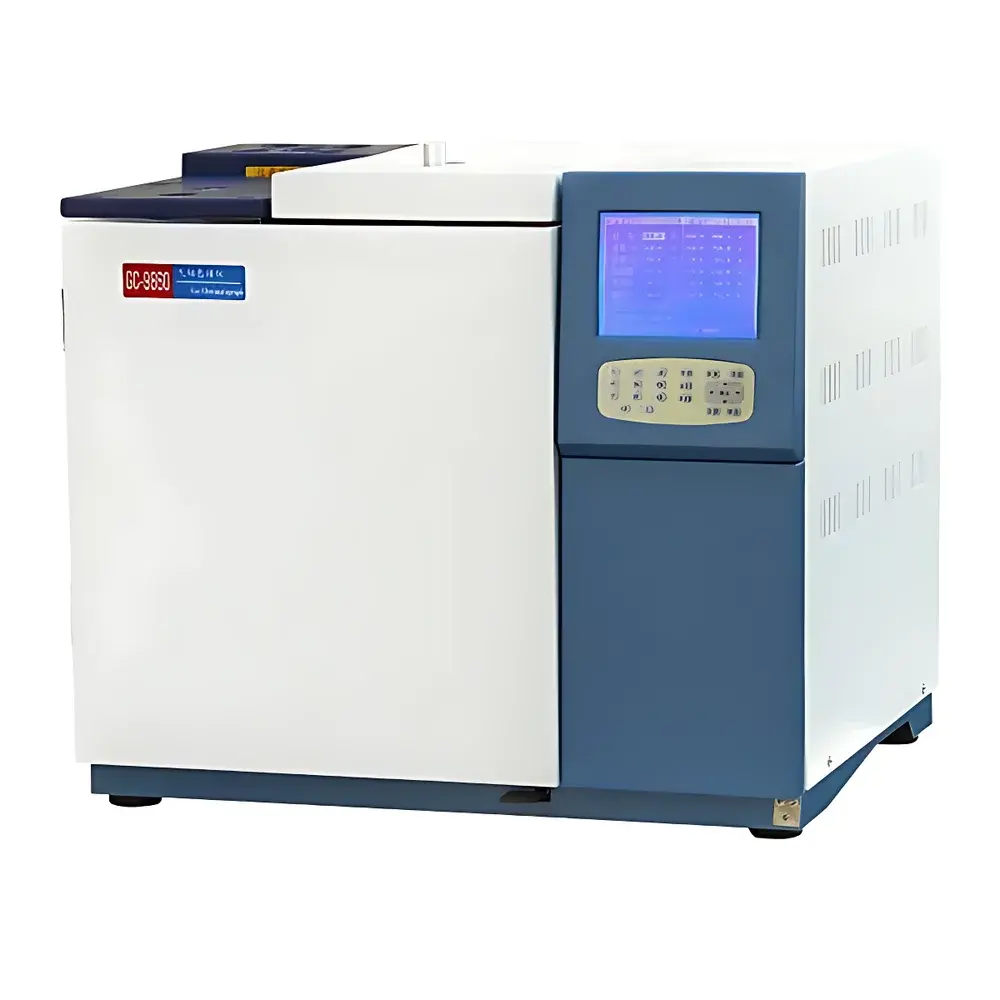
Beifen Sanpu GC-9860 Laboratory Gas Chromatograph for Baijiu (Chinese Liquor) Analysis
| Brand | Beifen Sanpu |
|---|---|
| Origin | Beijing, China |
| Manufacturer Type | Direct Manufacturer |
| Instrument Type | Laboratory Gas Chromatograph |
| Model | GC-9860 |
| Temperature Control Range | 100–350 °C |
| Heating Rate | 0.1–40 °C/min |
| Cooling Time | ~6 min (from 350 °C to 100 °C) |
| Carrier Gas Flow Range & Control | 0–1200 mL/min |
| Carrier Gas Pressure Range & Control | 0–970 kPa |
| Injector Maximum Operating Temperature | 100–350 °C |
| Injector Pressure Setting Range | 0–970 kPa |
| Injector Total Flow Setting Range | 0–1000 mL/min |
Overview
The Beifen Sanpu GC-9860 is a dedicated laboratory gas chromatograph engineered for the precise quantitative analysis of volatile organic compounds in baijiu — traditional Chinese distilled spirit. It operates on the principle of gas-liquid partition chromatography, where analytes are separated based on their relative volatility and polarity as they migrate through a temperature-controlled column under carrier gas flow. Detection is performed using a flame ionization detector (FID), which provides high sensitivity and linear response for hydrocarbons, alcohols, esters, aldehydes, and organic acids — key contributors to baijiu’s sensory profile and quality grading. Designed specifically for regulatory compliance and production QC in distilleries and provincial market supervision laboratories, the GC-9860 supports both packed-column and wide-bore capillary column configurations, enabling method flexibility across ISO 22311:2021 (baijiu — determination of volatile flavor compounds), GB/T 10345–2007 (Chinese national standard for baijiu analysis), and internal SOPs aligned with GLP practices.
Key Features
- Programmable oven with precise temperature control (100–350 °C), heating rate adjustable from 0.1 to 40 °C/min, and rapid cooling capability (~6 minutes from 350 °C to 100 °C) for high-throughput batch analysis.
- Dual independent inlet systems configurable for split/splitless injection or direct on-column introduction; each inlet supports pressure and total flow control (0–970 kPa and 0–1000 mL/min respectively) to ensure reproducible retention times and peak shape integrity.
- FID optimized for low-noise baseline stability and detection limits < 3 pg C/s (as n-decane), suitable for trace-level quantification of ethyl acetate, ethyl hexanoate, ethyl lactate, and other minor esters critical to baijiu typicity.
- Robust mechanical architecture with sealed electronics compartment and corrosion-resistant gas path components, ensuring long-term reliability in humid, ethanol-rich laboratory environments typical of distillery QC labs.
- Integrated hardware synchronization with N2000 chromatography data system (CDS), supporting real-time signal acquisition, peak integration, calibration curve generation, and audit-trail-enabled reporting compliant with basic 21 CFR Part 11 requirements.
Sample Compatibility & Compliance
The GC-9860 accommodates direct liquid injection of diluted baijiu samples (typically 1–5 µL), headspace vials (for volatile acid profiling), and derivatized extracts (e.g., for free fatty acids). It is validated for use with DNP-packed columns (for routine alcohol/ester screening), 0.53 mm ID wide-bore fused-silica capillary columns (for simultaneous quantification of C₂–C₆ fatty acids and >20 flavor congeners), and narrow-bore columns (for high-resolution separation of co-eluting pairs such as acetaldehyde/n-butanol). All operational parameters adhere to GB/T 10345–2007, QB/T 4257–2011 (method for ester analysis), and ASTM D7217–18 (standard guide for GC analysis of alcoholic beverages). System suitability testing includes resolution ≥1.5 between critical pairs, RSD ≤3% for replicate injections, and linearity (r² ≥0.999) over 0.1–1000 mg/L concentration ranges.
Software & Data Management
The instrument integrates with the N2000 chromatography workstation — a Windows-based CDS offering sequence-driven acquisition, automated calibration (internal standard and external standard modes), customizable report templates, and electronic signature support. Raw data files (.dat) are stored with embedded metadata (operator ID, method name, injection time, column history), enabling full traceability. Audit trail functionality logs all method modifications, integration parameter changes, and result reprocessing events. Export options include CSV, PDF, and XML formats compatible with LIMS interfaces. While not fully 21 CFR Part 11-compliant out-of-the-box, the system can be configured with user access controls, electronic signatures, and backup protocols meeting GLP/GMP documentation standards upon site-specific validation.
Applications
- Quantitative determination of major and minor volatile compounds in baijiu: methanol, ethanol, propanol, butanols, pentanols, acetaldehyde, ethyl acetate, ethyl butyrate, ethyl caproate, ethyl lactate, and higher fatty acid ethyl esters (C₇–C₁₀).
- Discrimination of baijiu aroma types (e.g., strong-aroma, light-aroma, sauce-aroma) via multivariate statistical analysis of congener profiles.
- Batch release testing in distillery QC labs, including verification of methanol content against GB 2757–2012 safety limits (<0.6 g/L in 100% vol spirit).
- Stability monitoring during aging and storage, tracking ester hydrolysis and aldehyde formation kinetics.
- Authenticity assessment and adulteration screening by comparing congener fingerprint patterns against reference databases.
FAQ
What column types are supported for baijiu analysis?
The GC-9860 supports stainless-steel or glass packed columns (e.g., DNP + 10% OV-101) and fused-silica capillary columns (0.32–0.53 mm ID), including proprietary wide-bore baijiu-specific phases optimized for C₂–C₆ acid separation.
Is hydrogen generator integration required for FID operation?
Yes — BF-300E high-purity hydrogen generator (≥99.999% H₂, <0.1 ppm O₂/H₂O) is recommended for stable FID performance and elimination of cylinder logistics.
Can the system meet regulatory reporting requirements for food safety agencies?
When deployed with validated methods, calibrated standards, and documented system suitability checks, it satisfies reporting requirements of SAMR (State Administration for Market Regulation) and provincial CDC laboratories per GB/T 27404–2008 (laboratory quality control guidelines).
What is the typical analysis time for a full baijiu congener panel?
Using a wide-bore capillary column and programmed temperature ramp, full quantification of ≥22 target compounds is achievable in ≤15 minutes; packed-column methods require 30–40 minutes for comparable coverage.
Does the GC-9860 support unattended overnight operation?
Yes — with autosampler compatibility (optional), thermal stability verified over 12-hour runs, and automatic shutdown safeguards, it supports extended batch processing in regulated environments.





