
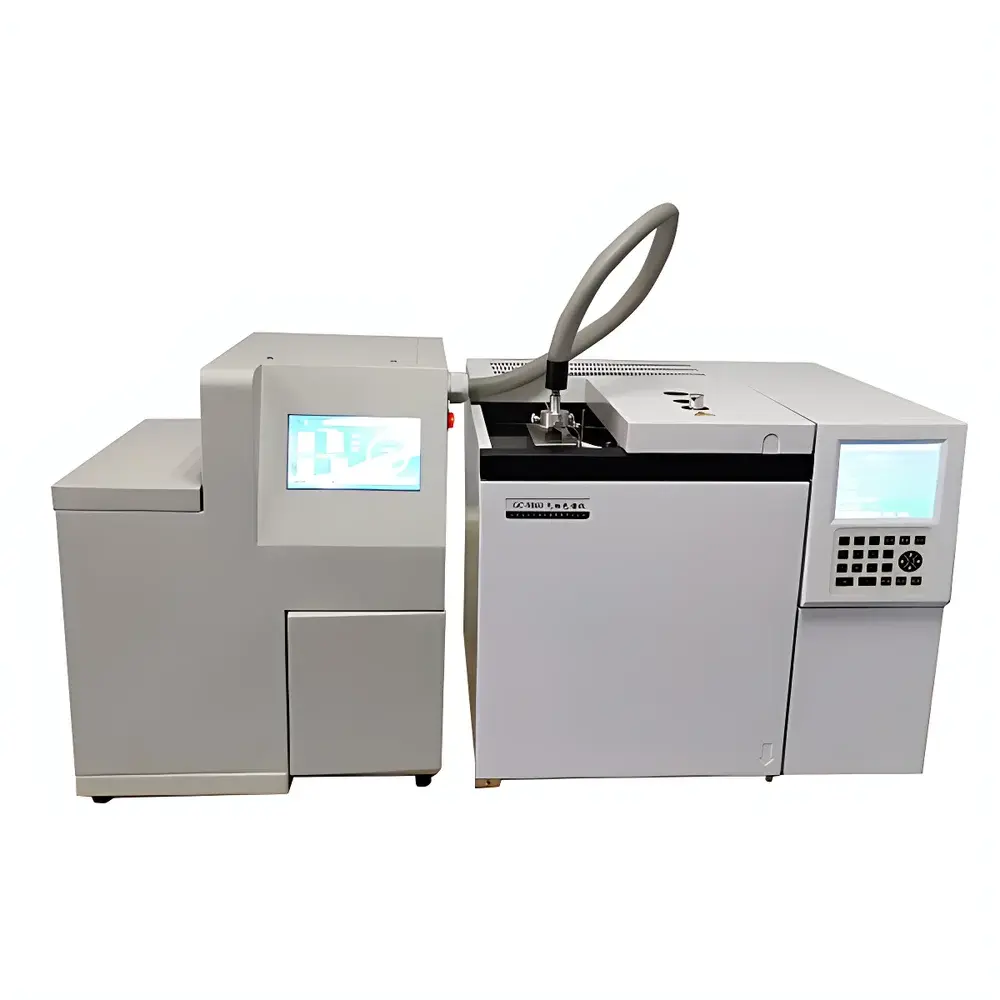
Beifen Sanpu AHS-20A Plus Fully Automated Static Headspace Sampler for Ethylene Oxide Residue Analysis in Single-Use Medical Masks
| [Brand | Beifen Sanpu |
|---|---|
| Origin | Beijing, China |
| Manufacturer Type | Original Equipment Manufacturer (OEM) |
| Instrument Type | Static Headspace Sampler |
| Automation Level | Fully Automatic |
| Vial Heating Range | Ambient to 200 °C (1 °C increments) |
| Valve Temperature Control Range | 40–220 °C (±1 °C stability) |
| Sample Loop Volume | 1 mL |
| Vial Capacity | 20 positions |
| Compatible Vial Sizes | 10 mL or 20 mL] |
Overview
The Beifen Sanpu AHS-20A Plus is a fully automated static headspace sampler engineered for precise, reproducible quantification of residual ethylene oxide (EO) in single-use medical devices—particularly surgical masks, respirators, gowns, and other sterilized disposables. EO is a highly effective low-temperature sterilant widely employed in Class II and III medical device manufacturing; however, its classification as a Group 1 human carcinogen (IARC) mandates strict regulatory control over residual levels post-sterilization. This instrument operates on the principle of static headspace gas-phase equilibration: solid or liquid samples are sealed in heated vials, allowing volatile EO to partition into the headspace above the matrix. A precisely metered volume of this equilibrium vapor is then transferred via thermostatically controlled injection valve and loop to a coupled gas chromatograph (e.g., GC-2010) for separation and detection—typically using a flame ionization detector (FID) or mass spectrometer (MS). The AHS-20A Plus is designed to meet the methodological rigor required by ISO 10993-7, GB/T 16886.7–2015 (revised), and USP <231>, serving as a core component in GLP-compliant EO residue testing workflows.
Key Features
- Fully automated 20-position carousel with programmable vial selection and sequential analysis—eliminating manual handling and inter-run variability.
- Independent dual-zone temperature control: vial oven (ambient to 200 °C, ±0.5 °C uniformity) and injection valve/loop assembly (40–220 °C, ±1 °C stability), ensuring optimal EO vapor pressure generation and transfer integrity.
- 1 mL fixed-volume sample loop with inert internal surface (siliconized stainless steel or fused silica), minimizing adsorption and carryover—critical for sub-µg/g sensitivity.
- Intuitive touchscreen interface with password-protected method storage, audit trail logging, and real-time status monitoring (vial position, temperature, cycle progress).
- Robust mechanical architecture with corrosion-resistant housing and sealed electronics—optimized for continuous operation in regulated QC laboratories.
- Compliance-ready design: supports 21 CFR Part 11–compliant electronic signatures and data integrity features when integrated with validated chromatography data systems (CDS).
Sample Compatibility & Compliance
The AHS-20A Plus accommodates standard 10 mL and 20 mL crimp-top headspace vials, compatible with common septa (PTFE/silicone) and sealing tools used in ISO 17025-accredited labs. It supports heterogeneous sample types per regulatory guidance—including non-woven mask layers, polypropylene tubing, PVC blood bags, and silicone-coated catheters—when prepared per GB/T 14233.1–2022 Section 7.3.2 (aqueous extraction at 60 °C for 40 min). The system is validated for use with EO calibration standards traceable to NIST SRM 1691 (ethylene oxide in air) and supports linearity verification across 0.1–50 µg/g ranges. All operational parameters align with the analytical requirements of ISO 10993-7:2019 Annex B, ASTM F2737–22, and China’s YY/T 0698.5–2011 for packaging material validation.
Software & Data Management
Control software provides method-driven automation: users define vial heating time/temperature, equilibration delay, valve heat-up profile, loop fill/purge cycles, and GC trigger timing—all saved as version-controlled methods. Raw acquisition files (.csv or .txt) include embedded metadata (operator ID, timestamp, vial ID, setpoints, actual temperatures). When interfaced with chromatography data systems (e.g., Shimadzu LabSolutions, Thermo Chromeleon), the sampler enables full audit trail generation—including user logins, parameter changes, and run history—with immutable timestamps. Electronic records comply with ALCOA+ principles (Attributable, Legible, Contemporaneous, Original, Accurate, Complete, Consistent, Enduring, Available) and support FDA inspection readiness for GMP environments.
Applications
- Quantitative EO residue testing in single-use surgical masks, N95 respirators, isolation gowns, and face shields per GB/T 16886.7–2015 and ISO 10993-7.
- Batch release testing for EO-sterilized infusion sets, syringes, blood filters, plasma separation cups, and urinary catheters.
- Stability studies evaluating EO desorption kinetics under accelerated aging conditions (e.g., 40 °C/75% RH per ISO 11607-2).
- Validation of EO sterilization cycles—including half-cycle and worst-case load studies—by measuring residual concentrations across product geometries and material compositions.
- Investigational analysis of EO migration from packaging materials (e.g., Tyvek pouches, PET trays) into device surfaces.
FAQ
What is the minimum detectable EO concentration achievable with this system?
Detection limits depend on GC detector sensitivity and sample mass, but typical method detection limits (MDL) range from 0.05 to 0.2 µg/g when using FID and 1.0 g sample weight in 20 mL vials—fully compliant with ISO 10993-7’s 4 µg/g limit for most devices.
Can the AHS-20A Plus be used with GC systems from other manufacturers?
Yes—it features universal TTL and RS-232/485 interfaces compatible with Shimadzu, Agilent, Thermo Fisher, and PerkinElmer GC platforms, including trigger synchronization and status feedback protocols.
Is method validation support provided?
Beifen Sanpu supplies IQ/OQ documentation templates, system suitability test procedures, and a certified reference method aligned with GB/T 16886.7–2015, supporting laboratory-specific PQ execution.
How is carryover mitigated during high-concentration sample runs?
The system includes programmable loop and transfer line bake-out (up to 220 °C), multi-stage purge cycles with carrier gas, and optional inert liner upgrades—validated to achieve <0.1% carryover between 50 µg/g and blank injections.
Does the instrument meet electromagnetic compatibility (EMC) and safety standards for CE marking?
Yes—the AHS-20A Plus conforms to IEC 61326-1 (EMC) and IEC 61010-1 (safety), with full CE declaration available upon request for EU-based installations.





