
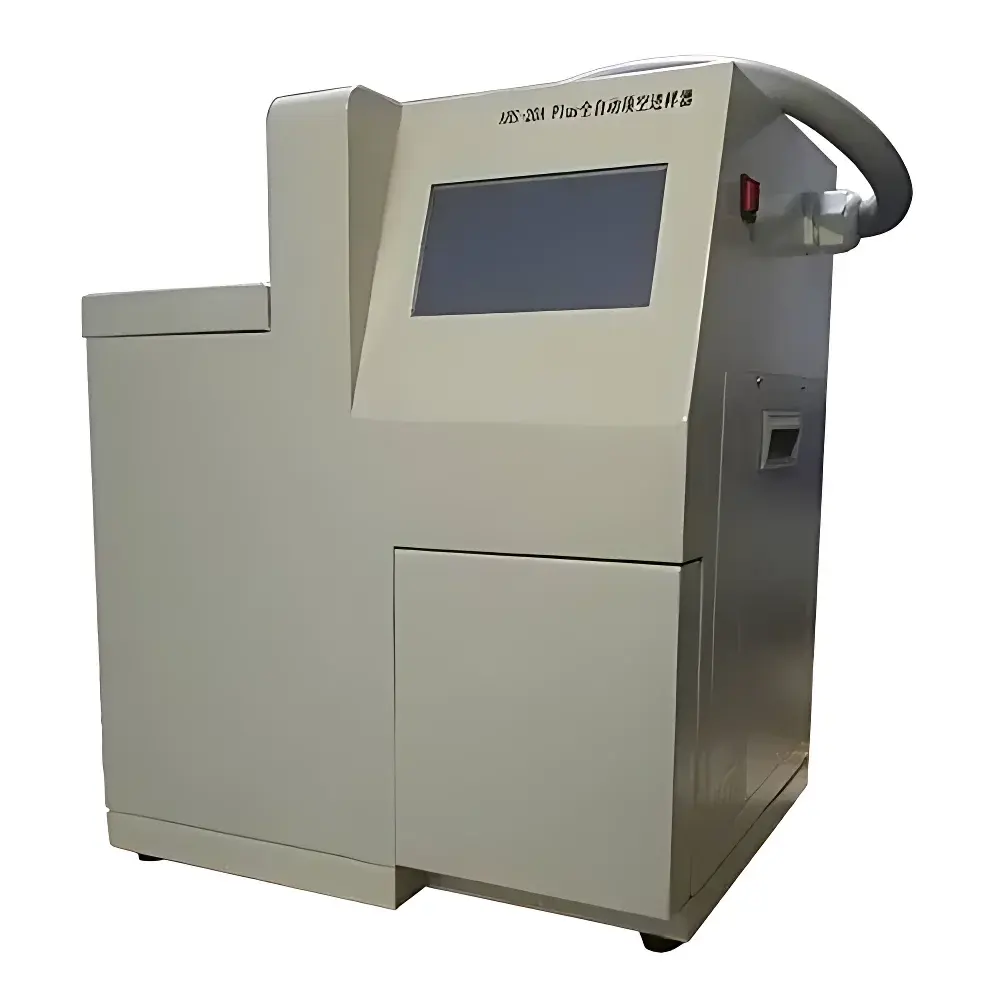
Beifen Sanpu PAHS-20A Plus Fully Automated Headspace Sampler
| [Brand | Beifen Sanpu |
|---|---|
| Origin | Beijing, China |
| Manufacturer Type | Original Equipment Manufacturer (OEM) |
| Country of Manufacture | China |
| Model | PAHS-20A Plus |
| Sample Positions | 20 |
| Sample Vial Capacity | 10 mL or 20 mL (customizable up to 100 mL) |
| Quantitative Loop Volume | 1 mL (optional: 0.5 / 2 / 5 mL) |
| Sample Heating Range | 40–220 °C (extendable to 300 °C) |
| Valve & Transfer Line Heating Range | 40–220 °C (extendable to 300 °C) |
| Temperature Accuracy | ±0.5 °C |
| Temperature Stability | < ±0.5 °C |
| Pressure Control Range | 0–0.25 MPa (continuously adjustable) |
| Pressurization Time | 0–999 s |
| Sampling Time | 0–30 min |
| Injection Time | 0–999 s |
| Bake-out/Flush Time | 0–30 min |
| Minimum Time Resolution | 1 ms |
| Carrier Gas Flow Control | EPC-compatible (optional) |
| RSD | < 1.0% (measured on 100 ppm ethanol in water) |
| Backflush Flow Rate | 0–100 mL/min (adjustable) |
| Interface | USB 2.0 |
| Compliance | ASTM D6866, ISO 11843-2, USP <467>, ICH Q3C compliant workflows] |
Overview
The Beifen Sanpu PAHS-20A Plus Fully Automated Headspace Sampler is an engineered solution for precise, reproducible, and unattended volatile organic compound (VOC) analysis in complex matrices. Designed around the principle of equilibrium headspace gas-phase extraction, it thermally equilibrates liquid or solid samples in sealed vials, followed by pressurized transfer of the vapor phase into a gas chromatograph (GC) via a high-inertness six-port valve and heated transfer line. This methodology eliminates matrix interference, reduces column contamination, and ensures compatibility with trace-level quantitation required in environmental testing, pharmaceutical residual solvent analysis (per USP and ICH Q3C), food flavor profiling, and forensic toxicology. The system operates under positive-pressure sampling—eliminating baseline drift associated with vacuum-based systems—and maintains full thermal integrity from vial to GC inlet through independently controlled, insulated heating zones.
Key Features
- 20-position autosampler carousel with automatic vial detection and intelligent position skipping—avoids mechanical collision during operation even if vials are missing.
- Triple-zone independent temperature control: sample incubation oven (40–220 °C, extendable), valve block (40–220 °C), and transfer line (40–220 °C), all with ±0.5 °C accuracy and < ±0.5 °C stability over 8-hour operation.
- High-inertness flow path: deactived fused-silica capillary tubing and electropolished stainless-steel quantitative loop (standard 1 mL; optional 0.5/2/5 mL) minimize adsorption and carryover—RSD < 1.0% demonstrated on 100 ppm ethanol in aqueous matrix.
- Motor-driven actuation system—no external compressed gas required—enhances lab safety and simplifies facility integration.
- 7-inch graphical LCD touchscreen with animated workflow guidance and bilingual (English/Chinese) UI; supports both front-panel and remote USB-hosted parameter configuration.
- Multi-mode injection logic: single-vial repeated injections, single-shot per vial, or multi-vial sequential analysis—all programmable with millisecond-level timing resolution (1 ms minimum step).
- Comprehensive self-diagnostics: power-on hardware verification, real-time positional feedback, thermal fault detection, and automated error logging with contextual alarm messages.
- EPC-compatible electronic pressure control option available for enhanced method robustness and retention time reproducibility across multi-day sequences.
Sample Compatibility & Compliance
The PAHS-20A Plus accommodates standard 10 mL and 20 mL crimp-top headspace vials (ASTM D7229-compliant); custom configurations support 50 mL and 100 mL formats for low-concentration environmental or wastewater analysis. It accepts liquid, semi-solid, and solid samples—including polymers, soils, pharmaceutical tablets, and packaged foods—without derivatization. All thermal and pneumatic parameters meet the operational prerequisites of pharmacopeial methods: USP Class 1–3 residual solvents, EP 2.4.24, and JP 17 Chapter 4.2.1. When integrated with GLP/GMP-regulated GC systems, audit trail generation, user access control, and electronic signature readiness can be implemented via third-party chromatography data systems (CDS) supporting FDA 21 CFR Part 11 compliance.
Software & Data Management
Control is executed via native USB 2.0 interface using Beifen Sanpu’s HS-Control Suite (Windows 10/11 compatible), enabling full method development, sequence building, real-time monitoring, and event-triggered synchronization with GC start signals or external TTL pulses. All method parameters—including temperature ramps, pressure profiles, timing sequences, and valve switching logic—are stored in encrypted binary format with timestamped version history. Raw instrument logs (including thermal deviations, motor current draw, and valve cycle counts) are exportable as CSV for preventive maintenance trending. The software architecture supports seamless integration with major CDS platforms including OpenLab CDS, Chromeleon, and Empower via ASCII command protocol or vendor-specific API extensions.
Applications
- Pharmaceutical QC: Residual solvent testing in APIs and excipients per ICH Q3C guidelines.
- Environmental analysis: VOC screening in groundwater, soil extracts, and air canister samples (EPA Method 502.2, 624, 8260D).
- Food & beverage: Ethanol quantification in non-alcoholic beverages, flavor compound profiling in dairy and fermented products.
- Forensics: Blood alcohol concentration (BAC) determination and ignitable liquid residue (ILR) identification in arson investigations (ASTM E1618).
- Materials science: Monomer release testing from adhesives, coatings, and composite resins.
FAQ
Is the PAHS-20A Plus compatible with Agilent, Thermo Fisher, and Shimadzu GC systems?
Yes—it provides universal TTL and contact-closure triggering, plus analog voltage output for GC start synchronization. No proprietary interface cards are required.
Can the system perform multiple injections from a single vial?
Yes—programmable “single vial, multiple injections” mode allows up to 99 replicate analyses per vial without manual intervention.
What maintenance intervals are recommended for long-term reliability?
Valve rotor seal replacement every 10,000 cycles; quantitative loop cleaning every 200 runs; annual calibration verification using NIST-traceable temperature and pressure standards.
Does the system support method validation documentation packages?
Instrument qualification documents (IQ/OQ) are provided upon request. PQ protocols aligned with ISO/IEC 17025 and ASTM E2500-22 are supported through configurable test scripts in HS-Control Suite.





