
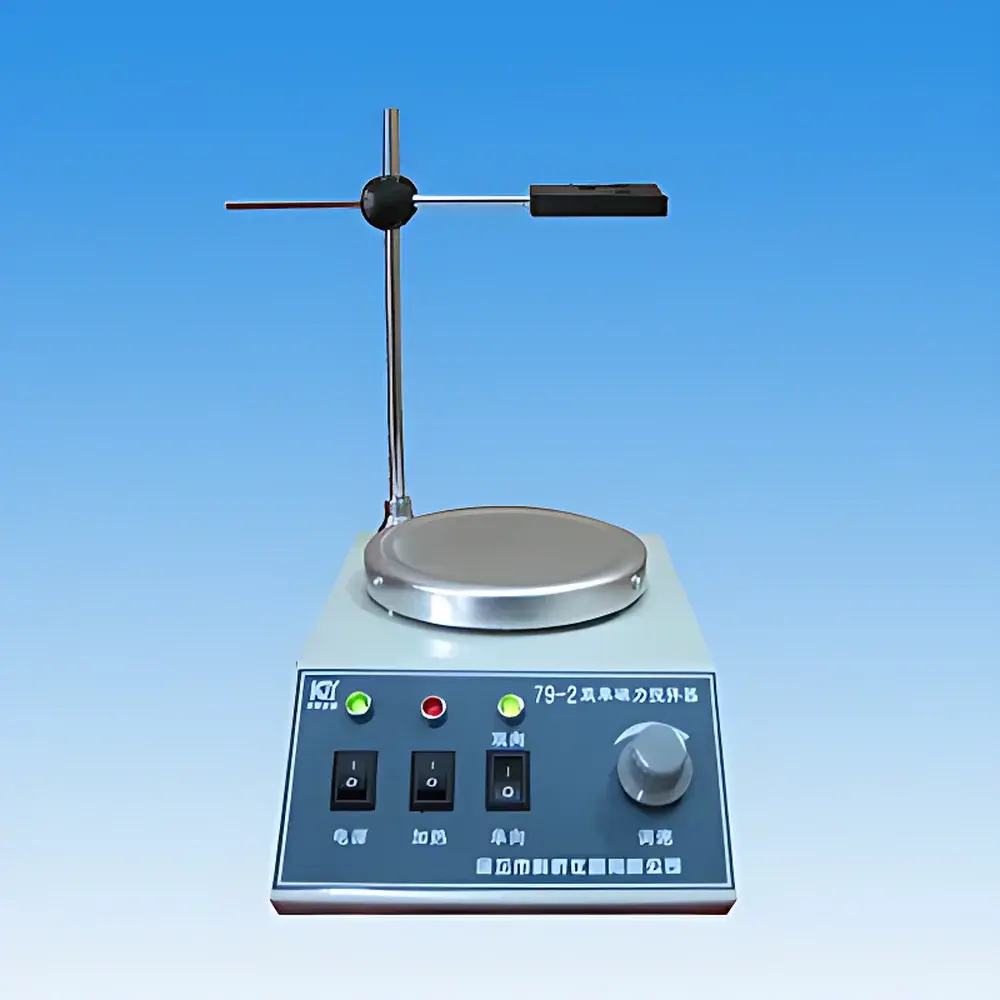
Beifen Sanpu 79-2 Dual-Direction Magnetic Hotplate Stirrer
| Brand | Beifen Sanpu |
|---|---|
| Origin | Beijing, China |
| Manufacturer Type | Direct Manufacturer |
| Country of Origin | China |
| Model | 79-2 |
| Power Supply | AC 220 V ±10 V, 50 Hz |
| Motor Power | 20 W |
| Heating Power | 200 W |
| Speed Range | 0–2400 rpm (infinitely variable) |
| Bidirectional Cycle | 60 s forward / 60 s reverse |
| Continuous Operation | 8 h at medium speed, 4 h at high speed |
| Included Accessories | PTFE-coated stir bar, support rod with clamp, power cord with grounded plug |
| Safety | Grounded chassis, overheat protection circuitry (implied by design standard) |
Overview
The Beifen Sanpu 79-2 Dual-Direction Magnetic Hotplate Stirrer is an electromechanically integrated laboratory instrument engineered for precise, reproducible mixing and temperature-controlled homogenization of low-to-medium viscosity liquid samples in glass or stainless-steel vessels. It operates on the principle of rotating magnetic coupling: a microcontroller-synchronized dual-polarity stator beneath the ceramic-coated aluminum hotplate generates alternating magnetic fields that drive rotation of a PTFE- or glass-coated magnetic stir bar immersed in the sample. The bidirectional mode—alternating 60-second forward and reverse rotations—minimizes vortex formation and promotes uniform suspension of particulates or reagents without mechanical agitation artifacts. Unlike gear-driven overhead stirrers, this device eliminates transmission noise, vibration transfer to sensitive instrumentation, and wear-prone moving parts. Its compact footprint (220 × 160 × 120 mm), grounded metal chassis, and sealed heating element meet IEC 61010-1 safety requirements for Class II laboratory equipment.
Key Features
- Dual-directional magnetic drive with automatic polarity reversal every 60 seconds—enhances dispersion efficiency for heterogeneous mixtures and prevents sediment accumulation at vessel walls.
- Infinitely variable speed control (0–2400 rpm) via analog potentiometer; ramp-up from low speed recommended to avoid stir-bar ejection during startup.
- Integrated 200 W resistive heating system with ceramic-coated aluminum plate; surface temperature range: ambient to ~300 °C (dependent on vessel thermal mass and ambient conditions).
- Low-noise, brushless 20 W synchronous motor with electromagnetic shielding—ensures stable operation near analytical balances, microscopes, or electrophysiology rigs.
- Grounded chassis and three-prong power cord compliant with GB 4706.1 and IEC 61010-1; includes implicit overtemperature cutoff to prevent dry-heating damage.
- Robust mechanical architecture: anodized aluminum housing, corrosion-resistant control panel, and IP20-rated enclosure suitable for general lab environments (non-explosive, non-humidified).
Sample Compatibility & Compliance
The 79-2 accommodates standard round-bottom flasks (up to 1000 mL), beakers (50–500 mL), and crystallizing dishes with flat, non-magnetic bases. Compatible stir bars include cylindrical, oval, and cross-shaped PTFE- or glass-coated variants (diameter 6–12 mm, length 20–40 mm). It is not intended for use with ferromagnetic containers, highly viscous media (>5000 mPa·s), or volatile organic solvents without secondary containment. While not certified to ISO/IEC 17025 or GLP as a standalone unit, its operational stability supports method validation under ASTM E2656 (Standard Practice for Laboratory Stirring) and USP <797> compounding workflows when paired with documented calibration procedures. Device labeling conforms to GB/T 19001–2016 (equivalent to ISO 9001) manufacturing standards.
Software & Data Management
This is a manually operated analog instrument with no embedded firmware, USB interface, or data logging capability. All parameters—speed, heating status, and direction mode—are set and monitored via tactile controls and LED indicators (power-on, heat-on, bidirectional-active). For traceability in regulated environments, users are advised to record operating conditions (e.g., speed setting, duration, observed temperature via external probe) in laboratory notebooks or LIMS-compatible electronic records. No software installation, driver dependency, or cybersecurity considerations apply. Firmware updates or remote access features are intentionally omitted to maximize long-term reliability and reduce failure vectors.
Applications
- Preparation of buffer solutions, culture media, and titrant stock solutions in QC/QA labs (ISO/IEC 17025-accredited facilities).
- Homogenization of polymer dispersions, nanoparticle suspensions, and colloidal systems prior to DLS or UV-Vis analysis.
- Controlled heating and stirring during extraction protocols (e.g., Soxhlet pre-concentration, acid digestion of environmental samples).
- Supporting ASTM D445 (kinematic viscosity) and D86 (distillation range) sample conditioning steps where consistent thermal-mixing profiles are required.
- Teaching laboratories: ideal for demonstrating conservation of angular momentum, heat transfer kinetics, and rheological behavior of Newtonian fluids.
FAQ
Can the 79-2 be used with plastic or aluminum containers?
No. Only non-magnetic, thermally stable vessels—such as borosilicate glass, ceramic, or stainless steel with non-ferromagnetic base—are compatible. Aluminum and most plastics attenuate magnetic flux and impair stir-bar coupling.
Is calibration required before use?
Speed and temperature are not independently calibrated; users should verify rotational stability with a tachometer and surface temperature with a NIST-traceable IR thermometer or contact probe if process-critical accuracy is needed.
What maintenance does the unit require?
Wipe the hotplate surface with isopropyl alcohol after cooling; inspect the stir bar for coating integrity before each use; ensure ventilation slots remain unobstructed. No internal lubrication or recalibration is specified by the manufacturer.
Does it comply with FDA 21 CFR Part 11?
No—this is an analog, non-data-generating device. It may be employed within Part 11-compliant workflows only when manual entries are governed by SOPs with audit trails and reviewer sign-offs.
Why must the stir bar be centered on the hotplate?
Off-center placement introduces torque asymmetry, increasing risk of stir-bar wobble, inefficient mixing, and localized overheating due to uneven magnetic field coupling.



