
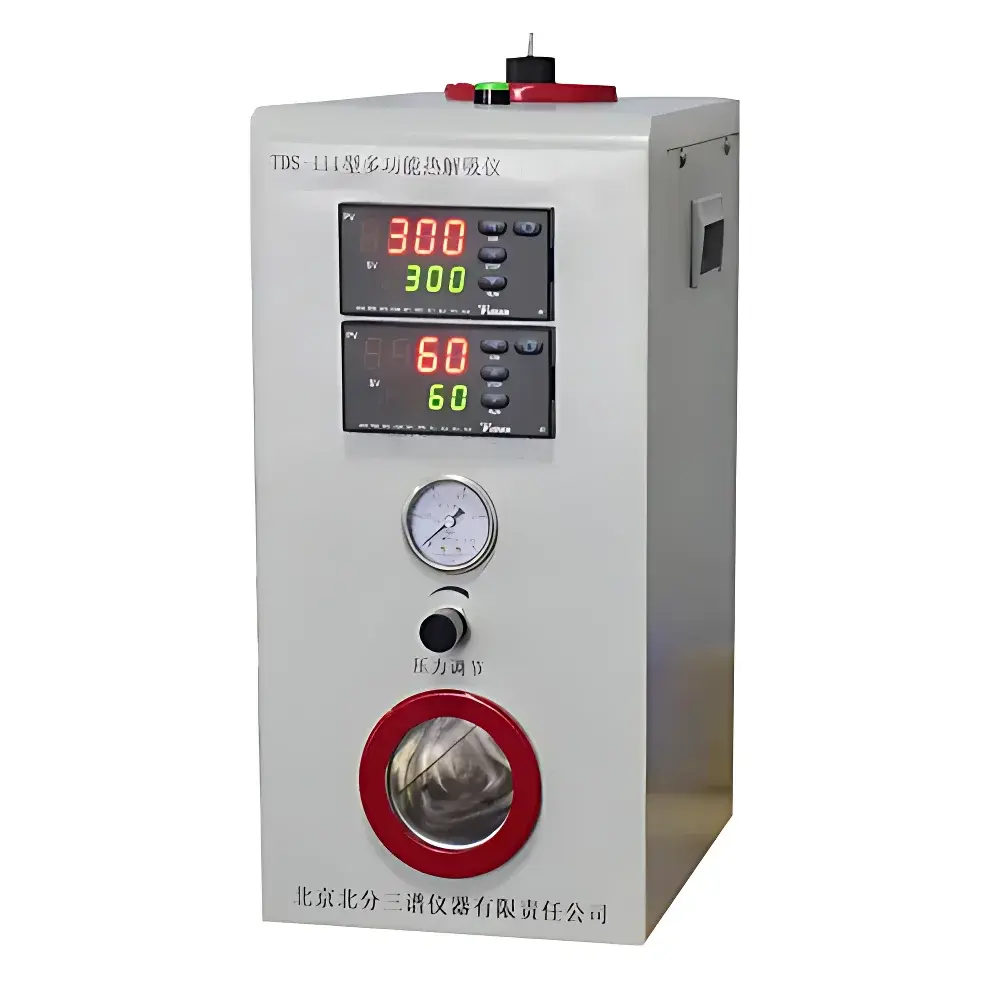
Beifen Sanpu HTDS-III Multi-Function Thermal Desorber for Solvent Gasoline Analysis by Gas Chromatography
| Brand | Beifen Sanpu |
|---|---|
| Origin | Beijing, China |
| Manufacturer Type | Manufacturer |
| Product Origin | Domestic (China) |
| Model | HTDS-III |
| Pricing | Upon Request |
Overview
The Beifen Sanpu HTDS-III Multi-Function Thermal Desorber is a dedicated sample pre-concentration and introduction system engineered for the quantitative determination of volatile organic compounds (VOCs), specifically solvent gasoline, in workplace air matrices. It operates on the principle of thermal desorption — a two-stage process wherein analytes adsorbed onto solid sorbent media (e.g., activated carbon tubes) are thermally released under controlled inert gas flow, then transferred quantitatively into a gas-tight syringe for manual injection into a gas chromatograph (GC). Coupled with flame ionization detection (FID) and PEG-20M capillary column separation, this method conforms to standardized analytical protocols including GBZ/T 300.62–2017 (“Determination of Solvent Gasoline in Workplace Air”) and GB 50325–2006 (“Control Standard for Indoor Environmental Pollution in Civil Construction Projects”). The system enables trace-level quantification (µg/m³ range) with high reproducibility and minimal carryover, supporting compliance-driven environmental monitoring, occupational hygiene assessment, and industrial hygiene surveillance programs.
Key Features
- Integrated dual-temperature control architecture: independent heating zones for thermal desorption furnace (room temperature to 400 °C, ±0.5 °C stability) and syringe heater oven (room temperature to 100 °C, ±0.5 °C stability)
- Optimized desorption geometry: zero-dead-volume interface between desorption tube and 100 mL gas-tight syringe, ensuring quantitative transfer and minimizing analyte loss
- Flexible sorbent tube compatibility: accepts standard 6 mm OD (¼″) activated carbon tubes of variable length, aligned with ISO 16000-6 and ASTM D5408 sampling conventions
- Repeat-injection capability: same desorbed sample can be manually re-injected multiple times, facilitating method validation, peak integration verification, and operator training
- User-centric design: simplified tube loading mechanism, intuitive manual operation, and low learning curve—particularly suitable for laboratories with mixed technical expertise levels
- Energy-efficient operation: 500 W maximum power draw; compact footprint (390 × 170 × 360 mm) optimized for benchtop GC laboratory integration
Sample Compatibility & Compliance
The HTDS-III supports analysis of solvent gasoline (a complex C4–C12 aliphatic/aromatic hydrocarbon mixture) as defined in GBZ/T 300.62–2017, alongside other regulated VOCs including benzene, toluene, ethylbenzene, xylenes (BTEX), and total volatile organic compounds (TVOC). It is validated for use with charcoal-based sorbent tubes per NIOSH Method 1501 and OSHA Method 1005. The system meets essential requirements for GLP-compliant laboratories conducting occupational exposure assessments under China’s Ministry of Health regulations. While not fully automated, its manual injection workflow remains compatible with audit-trail documentation practices required under ISO/IEC 17025:2017 accreditation frameworks when paired with appropriately configured GC data systems.
Software & Data Management
The HTDS-III operates as a stand-alone hardware module without embedded firmware or proprietary software. All instrument control is performed via physical dials and analog temperature indicators. Data acquisition, peak integration, calibration curve generation (linear regression, r ≥ 0.999), and reporting are executed externally using GC vendor software (e.g., Shimadzu GCsolution, Agilent OpenLab CDS) or validated third-party chromatography data systems (CDS). When integrated into regulated environments, users may configure electronic records—including injection logs, calibration files, and raw chromatograms—to satisfy FDA 21 CFR Part 11 requirements for electronic signatures and audit trails, provided the host CDS platform is properly qualified.
Applications
- Workplace air monitoring for solvent gasoline exposure in petrochemical refineries, paint manufacturing, printing facilities, and adhesive application sites
- Indoor air quality (IAQ) assessment per GB 50325–2006 for benzene and TVOC in residential and commercial buildings
- Method development and validation studies for thermal desorption–GC/FID workflows targeting mid-volatility hydrocarbons
- Reference laboratory support for third-party occupational hygiene testing services requiring trace-level VOC quantification
- Educational use in analytical chemistry curricula focusing on sample preparation techniques, GC theory, and regulatory method implementation
FAQ
What distinguishes thermal desorption from headspace analysis?
Thermal desorption extracts analytes adsorbed onto solid-phase sorbents (e.g., charcoal), enabling pre-concentration of trace vapors from large air volumes. Headspace analysis, by contrast, measures equilibrium vapor above liquid or solid samples and is generally less sensitive for ambient air applications.
Can the HTDS-III be used for benzene or TVOC analysis?
Yes—its design explicitly supports GB 50325–2006 methods for benzene and TVOC, utilizing the same activated carbon sampling and PEG-20M column conditions specified in those standards.
Is the HTDS-III compatible with all gas chromatographs?
It is mechanically and functionally compatible with any GC equipped with a split/splitless inlet and FID, provided manual 1 mL syringe injection is supported. No electronic interfacing is required.
What is the typical desorption recovery rate for solvent gasoline?
Recovery exceeds 85% under optimized conditions (230 °C, 50 mL/min N₂), consistent with performance expectations for mid-boiling hydrocarbons on activated carbon media.
Does the system meet international regulatory standards such as ISO or ASTM?
While the HTDS-III itself is not certified to ISO/IEC 17025, its operational parameters and method alignment enable full compliance with ISO 16000-6 (indoor air) and ASTM D5408 (activated carbon tube sampling) when implemented within a validated analytical procedure.
Related Products






