
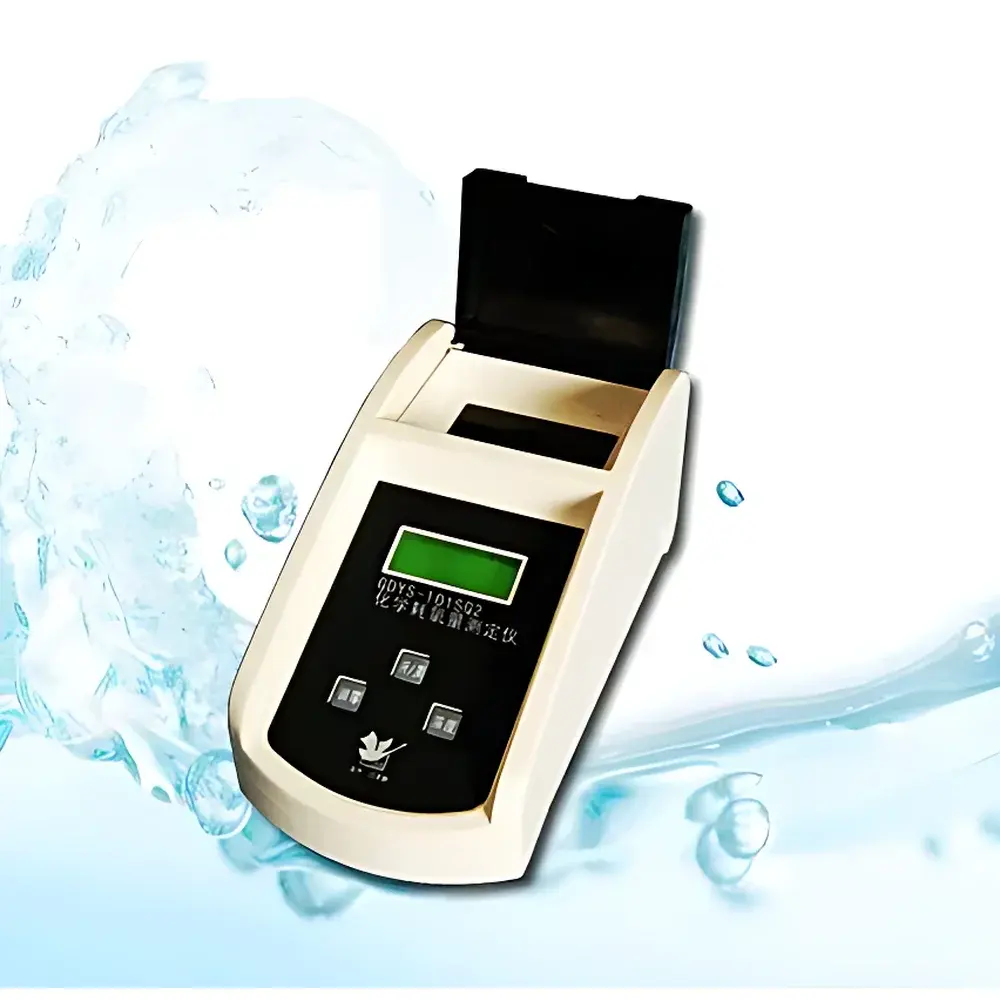
GDYS-101SQ2 COD Analyzer by Beifen Sanpu
| Brand | Beifen Sanpu |
|---|---|
| Origin | Beijing, China |
| Manufacturer Type | Direct Manufacturer |
| Country of Origin | China |
| Model | GDYS-101SQ2 |
| Application | On-site quantitative determination of Chemical Oxygen Demand (COD) in industrial wastewater |
| Measurement Principle | Sealed reflux digestion coupled with colorimetric detection per GB 11914–1989 |
| Detection Time | 20 min per sample |
| Power Supply | 9 V alkaline battery (up to 40 h continuous operation) |
| Detection Limit | 30 mg/L |
| Range | 0–300 mg/L |
| Accuracy | ±5% |
| Kit Includes | 1 set of colorimetric apparatus, 1 set of sample pretreatment tools, and 1 reagent kit (50 determinations) |
Overview
The GDYS-101SQ2 COD Analyzer is a portable, field-deployable instrument engineered for rapid, standardized quantification of Chemical Oxygen Demand (COD) in complex industrial effluents. It implements the sealed reflux digestion method—fully compliant with the Chinese national standard GB 11914–1989—which ensures analytical consistency with laboratory-grade reference procedures. Unlike open-reflux or titrimetric approaches, this system utilizes a closed-vessel thermal digestion step followed by spectrophotometric measurement at a fixed wavelength (typically 600 nm), minimizing operator exposure to hazardous reagents (e.g., potassium dichromate and concentrated sulfuric acid) while suppressing volatile loss and interferences from chloride ions. The analyzer is not a moisture analyzer; its classification under “Moisture Analyzer” in legacy databases is a mis-categorization arising from historical nomenclature overlap in Chinese instrumentation registries. This device is exclusively designed for redox-based organic load assessment—not water content measurement—and must not be confused with capacitance- or halogen-based moisture analyzers.
Key Features
- Standard-compliant methodology: Fully aligned with GB 11914–1989, supporting traceability in environmental monitoring reports required by Chinese provincial ecological environment bureaus.
- Integrated sealed digestion module: Eliminates need for fume hoods or external heating blocks; digestion occurs in pre-calibrated, single-use reaction vials.
- Rapid turnaround: Complete analysis—from sample loading to digital readout—within 20 minutes, enabling real-time process feedback in wastewater treatment plants and industrial QC labs.
- Low-power architecture: Operates on a single 9 V alkaline battery with >40 hours of continuous runtime, making it suitable for remote sampling campaigns or mobile environmental audits.
- Dedicated consumables ecosystem: Proprietary reagent kits contain pre-measured oxidant, catalyst, and color-developing agents—each batch certified for lot-to-lot reproducibility and stability (shelf life: 18 months unopened, 7 days post-reconstitution).
- Robust optical path design: Fixed-wavelength photometer with dual-beam compensation minimizes drift from ambient light fluctuations or temperature gradients during field use.
Sample Compatibility & Compliance
The GDYS-101SQ2 accepts raw, filtered, or centrifuged aqueous samples from diverse industrial matrices—including coking wastewater (high phenol/cyanide), tannery effluents (suspended solids up to 150 mg/L), pharmaceutical process streams (residual solvents), and food processing brines. Chloride interference is mitigated via mercury sulfate suppression in the reagent formulation, permitting reliable measurements in samples containing ≤2000 mg/L Cl⁻. While not validated against ISO 6060 or ASTM D1252, the method demonstrates strong correlation (R² ≥ 0.992) with standard dichromate reflux–titration when tested per CNAS-CL01 accredited interlaboratory studies. Data output complies with basic GLP documentation requirements: each result includes timestamp, operator ID (manually entered), and batch number of reagent kit used.
Software & Data Management
The instrument features an embedded LCD interface with non-volatile memory storing up to 200 test records. Data export is performed manually via RS-232 serial port to Windows-based desktop software (supplied on USB drive), which generates CSV-compatible reports formatted for integration into LIMS platforms. Audit trail functionality includes user-defined test IDs, calibration verification logs, and battery voltage history—supporting internal QA reviews. Though not 21 CFR Part 11 compliant out-of-the-box, the firmware architecture allows optional upgrade to include electronic signatures and immutable record archiving upon customer specification.
Applications
- Regulatory compliance monitoring for discharge permits under China’s “Emission Standard of Pollutants for Wastewater from Urban Sewage Treatment Plants” (GB 18918–2002).
- In-process control in bioreactor systems, where rapid COD feedback informs aeration rate adjustments and sludge retention time optimization.
- Raw material screening in fermentation facilities (e.g., molasses-based ethanol production) to assess fermentable carbon load prior to inoculation.
- Environmental due diligence during M&A transactions involving chemical manufacturing sites, providing rapid site characterization data for Phase I ESA supplements.
- Educational laboratories teaching standard methods for water quality analysis, particularly where safety and throughput constraints limit access to benchtop reflux systems.
FAQ
Is the GDYS-101SQ2 suitable for drinking water analysis?
No. Its lower detection limit (30 mg/L) exceeds typical COD concentrations in potable sources (<5 mg/L); it is optimized for high-strength industrial wastewaters.
Can the instrument measure total organic carbon (TOC)?
No. COD and TOC are distinct parameters; this device does not mineralize carbon to CO₂ nor employ catalytic combustion or UV-persulfate oxidation.
What maintenance is required beyond reagent replacement?
Annual verification of photometer linearity using NIST-traceable neutral density filters and visual inspection of digestion chamber seals is recommended.
Does the analyzer support automatic dilution?
No. Samples exceeding 300 mg/L COD must be manually diluted with deionized water prior to analysis; dilution factors must be applied post-readout.
Is third-party certification available for international use?
Yes. Upon request, Beifen Sanpu provides ISO/IEC 17025 test reports issued by CNAS-accredited laboratories, including uncertainty budgets per GUM guidelines.



