
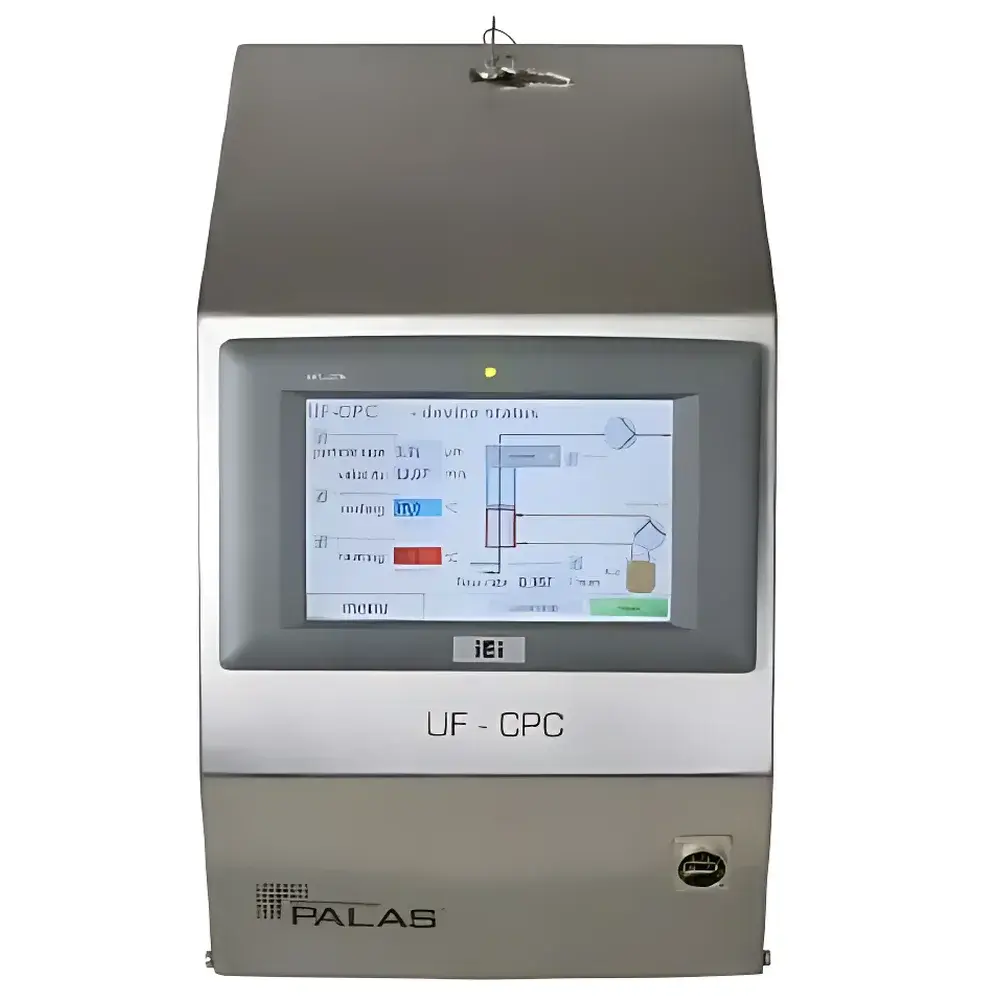
GRIMM UF-CPC Ultrafine Condensation Particle Counter
| Brand | GRIMM |
|---|---|
| Origin | Germany |
| Model | UF-CPC |
| Instrument Type | Aerosol Detector |
| Particle Size Range | 5 nm – 10,000 nm |
| Concentration Range (UF-CPC 100) | ≤ 20,000 P/cm³ (single-particle counting), < 10⁷ P/cm³ (photometric mode) |
| Concentration Range (UF-CPC 200) | ≤ 1,000,000 P/cm³ (single-particle counting), < 10⁷ P/cm³ (photometric mode) |
| Concentration Accuracy | ±5% (single counting), ±10% (photometric mode) |
| Response Time (t₉₀) | 3 s |
| Working Fluids | Butanol, Isopropanol, or Water |
| Aerosol Flow Rate | 0.30–0.60 L/min |
| Signal Processing | 20 MHz detection rate, 256 raw data channels |
| Embedded OS | Intel Atom™ 1.6 GHz processor, 2 GB CompactFlash, 800 × 480 touchscreen display |
| Connectivity | USB, Ethernet, RS232/RS485 |
| Power Supply | 115/230 V AC, 50/60 Hz |
| Dimensions (H×W×D) | 33 × 38 × 24 cm |
| Weight | 10 kg |
Overview
The GRIMM UF-CPC Ultrafine Condensation Particle Counter is a high-sensitivity, condensation-based aerosol instrument engineered for the quantitative detection and enumeration of ultrafine and nanoparticulate matter in air. Operating on the principle of heterogeneous nucleation—where supersaturated vapor preferentially condenses onto sub-10 nm particles—the UF-CPC enables reliable single-particle counting down to 5 nm diameter, far below the detection limit of conventional optical scattering instruments. This physical amplification mechanism is grounded in well-established thermodynamic principles of vapor saturation and surface energy minimization, making it particularly suitable for applications requiring trace-level particle number concentration measurements in research, regulatory monitoring, and industrial hygiene settings. The device complies with ISO 27891:2019 (aerosol instrumentation—requirements for condensation particle counters) and supports method validation under GLP and GMP frameworks where particle number concentration serves as a critical process parameter.
Key Features
- Modular architecture enabling rapid optical detector replacement for optimized performance across wide concentration ranges—from background ambient levels (<100 P/cm³) to high-concentration industrial exhaust streams (up to 10⁶ P/cm³).
- Multi-fluid compatibility: user-selectable working fluids—including n-butanol, isopropanol, and water—allowing tailoring of nucleation efficiency to particle surface chemistry (e.g., hydrophilic vs. hydrophobic aerosols).
- Dual-mode operation: high-precision single-particle counting mode (±5% accuracy) for low-concentration environments and photometric (nephelometric) mode for higher concentrations (±10% accuracy), with automatic mode switching based on real-time signal saturation.
- Embedded real-time signal processing: 20 MHz detection electronics with 256-channel raw data acquisition support advanced post-processing, including pulse height analysis for rudimentary size discrimination and noise rejection.
- Integrated touchscreen interface (800 × 480 pixels) powered by an Intel Atom™ 1.6 GHz processor and 2 GB CompactFlash storage, enabling local data logging without external hardware.
- Comprehensive remote operability via Ethernet and RS232/RS485 interfaces, supporting integration into SCADA systems, automated test benches, and centralized environmental monitoring networks.
Sample Compatibility & Compliance
The UF-CPC accepts ambient, ducted, or chamber-generated aerosols across diverse matrices—including combustion-generated soot, metallic fumes, pharmaceutical dry powder actuations, and biogenic nanoparticles—without requiring prior classification or size selection. Its design accommodates both continuous sampling and discrete batch analysis. All fluid pathways are constructed from chemically inert, non-outgassing materials compliant with USP Class VI and FDA 21 CFR Part 11 requirements for audit-trail-capable data systems. Firmware includes configurable electronic signatures, time-stamped event logs, and tamper-evident data export protocols—facilitating compliance with ISO/IEC 17025 accreditation and EU Regulation (EU) 2017/745 for medical device-related aerosol testing.
Software & Data Management
GRIMM’s proprietary GRIMM Control Software provides guided instrument setup, real-time visualization of counting statistics, and configurable alarm thresholds for exceedance events. Raw count data is stored in CSV and binary formats with embedded metadata (flow rate, temperature, fluid type, calibration timestamp). Export options include direct Ethernet transfer to LIMS platforms and scheduled USB dump routines. The system supports synchronized operation with Differential Mobility Analyzers (DMAs) for full size-resolved number distribution reconstruction—enabling compliance with ASTM D8196-22 (standard practice for nanoparticle size distribution measurement using CPC-DMA coupling). All firmware updates undergo cryptographic signature verification to ensure integrity and traceability.
Applications
- Aerosol science research: nucleation kinetics studies, secondary organic aerosol formation, and cloud condensation nuclei (CCN) activity assessment.
- Filtration efficiency testing: real-time challenge testing of HEPA, ULPA, and electrostatic filters per ISO 14644-3 and EN 1822 standards.
- Occupational health & safety: workplace exposure monitoring for nanomaterial handling (e.g., TiO₂, SiO₂, carbon nanotubes) in accordance with NIOSH Current Intelligence Bulletins and EU REACH Annex XVII reporting obligations.
- Inhalation drug development: quantification of emitted dose and fine particle fraction (FPF) from pressurized metered-dose inhalers (pMDIs) and dry powder inhalers (DPIs) under pharmacopoeial guidelines (USP & EP).
- Indoor air quality (IAQ) diagnostics: source apportionment of printer toner emissions, laser printer particulates, and cooking-related ultrafine aerosols.
- Environmental baseline monitoring: long-term trend analysis of urban nucleation-mode particle concentrations linked to traffic emissions and photochemical activity.
FAQ
What particle size range does the UF-CPC detect?
The UF-CPC detects particles from 5 nm to 10,000 nm (10 µm) in mobility-equivalent diameter, with optimal sensitivity between 5–50 nm—covering the entire nucleation and Aitken modes relevant to atmospheric science and nanotoxicology.
Can the UF-CPC be used with a DMA for size distribution measurements?
Yes. The UF-CPC is fully compatible with commercial differential mobility analyzers (DMAs) and supports synchronized scanning protocols to generate high-resolution number-size distributions, meeting the technical specifications outlined in ISO 27891 Annex B.
How is calibration traceability maintained?
Each unit ships with NIST-traceable calibration certificates for flow rate, counting efficiency, and response time. GRIMM recommends annual recalibration using certified polystyrene latex (PSL) nanoparticles and reference CPCs per ISO 27891 Clause 8.
Does the UF-CPC meet regulatory requirements for workplace exposure monitoring?
Yes. Its counting accuracy, response time, and documented uncertainty budget align with OSHA Method ID-253 and EU Directive 2004/108/EC for aerosol instrumentation used in occupational exposure assessments.
What maintenance is required for long-term operational stability?
Routine maintenance includes quarterly cleaning of the saturator and condenser blocks using solvent-rinsed lint-free swabs, biannual replacement of the working fluid reservoir filter, and annual verification of pump performance and flow sensor drift against primary standards.







