
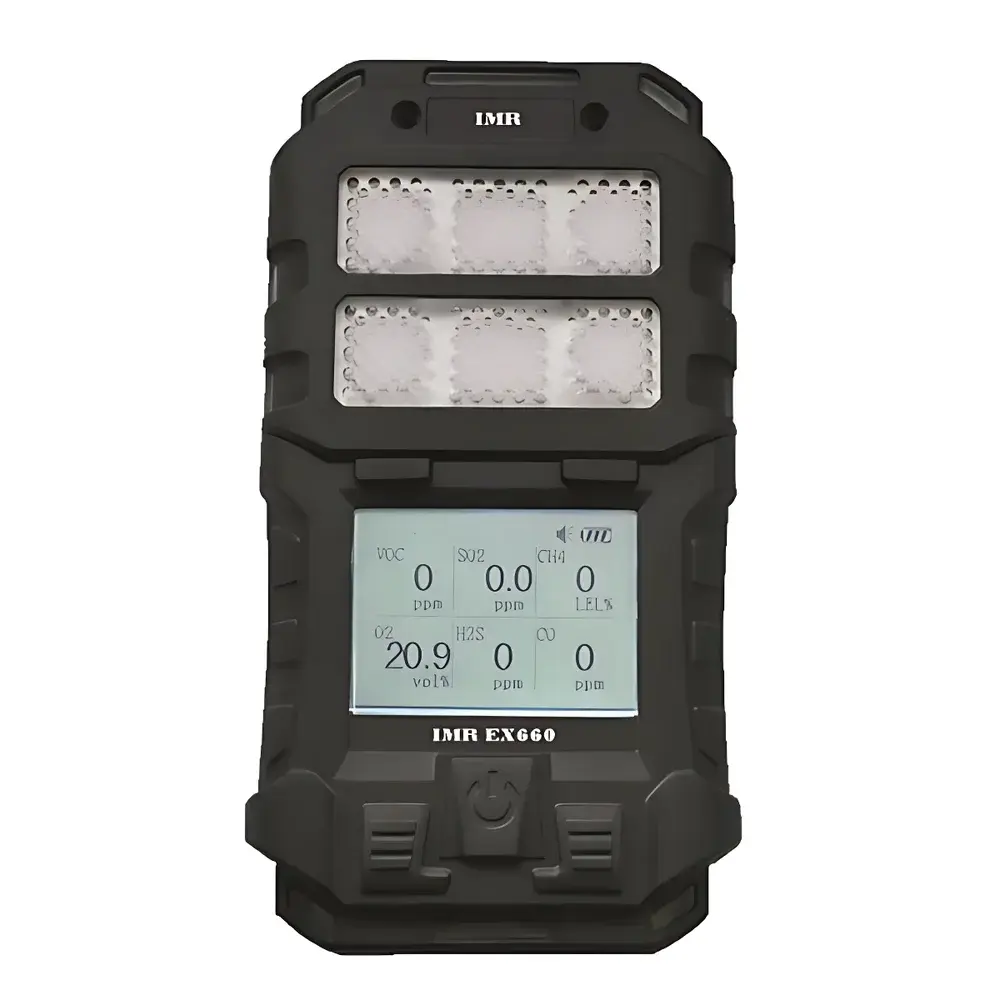
IMR IMREX660 Portable Intelligent Flue Gas Analyzer
| Brand | IMR |
|---|---|
| Origin | USA |
| Model | IMREX660 |
| Instrument Type | Portable Flue Gas Analyzer |
| Accuracy | <2% FS |
| Repeatability | <2% FS |
| Response Time (T90) | <30 s |
| Stability | <2% FS over 8 h |
| Operating Temperature | –20°C to +50°C (toxic gases) |
| Operating Humidity | <95% RH, non-condensing |
| Weight | 500 g |
| Dimensions | 168 × 91 × 45 mm |
| Data Storage Capacity | 100,000 records |
| Battery Life | Up to 30 h (rechargeable Li-ion) |
| Detection Methods | Electrochemical, Catalytic Bead, NDIR, PID, and Semiconductor Sensors |
| Gas Channels | Up to 6 simultaneous sensor modules (7 gas parameters concurrently) |
| Alarm Modes | Dual-stage audible (buzzer), visual (LED flash), and tactile (vibration) |
| Compliance | Certified per German TA-Luft emission guidelines |
Overview
The IMR IMREX660 Portable Intelligent Flue Gas Analyzer is an engineered field-deployable instrument designed for real-time, multi-component flue gas and ambient air monitoring in industrial, municipal, and occupational safety applications. It employs a modular sensor architecture integrating electrochemical cells for O₂, CO, H₂S, NO, NO₂, SO₂, NH₃, Cl₂, PH₃, HCN, and HCl; catalytic bead sensors for combustible gases (CH₄, C₃H₈, H₂); non-dispersive infrared (NDIR) for CO₂; photoionization detection (PID) for volatile organic compounds (VOCs); and optional semiconductor-based detection where applicable. The analyzer operates on the principle of selective gas-phase reaction kinetics and optical absorption, delivering trace-level quantification with high specificity and minimal cross-sensitivity. Its ruggedized housing—constructed from high-strength engineering polymer composites with overmolded anti-slip rubber—is rated IP67 for dust and water ingress protection and certified for use in hazardous locations when equipped with intrinsic safety (IS) modules. Designed for regulatory-grade emissions verification and confined-space entry safety, the IMREX660 meets foundational requirements of TA-Luft (Germany), EN standards for gas detection equipment, and supports compliance workflows aligned with OSHA 1910.146, EPA Method 204, and ISO 12039 for stationary source emissions.
Key Features
- Modular sensor architecture supporting up to six interchangeable detection modules—enabling concurrent measurement of seven gas parameters including CH₄, C₃H₈, H₂, H₂S, CO (low/high range), O₂, NH₃, Cl₂, SO₂, NO, NO₂, CO₂, PID (VOC), PH₃, HCN, and HCl.
- Dual-stage alarm system with independently configurable thresholds: pre-alarm (low) and danger-level (high), plus time-weighted average (TWA) and short-term exposure limit (STEL) alerts per OSHA and ACGIH guidelines.
- Integrated micro-pump and extendable sampling probe (100–1150 mm) optimized for stack insertion, duct sampling, and confined-space atmospheric assessment.
- Self-diagnostic firmware with automated zero calibration, span check prompts, and sensor health monitoring—including drift compensation algorithms and lifetime estimation per channel.
- Backlit graphical LCD display showing real-time concentration values, battery status, pump flow rate, sensor temperature, and system diagnostics with intuitive icon-driven navigation.
- Dedicated power management circuitry enabling continuous operation for up to 30 hours on a single charge; supports hot-swappable battery packs and USB-C charging with status feedback.
Sample Compatibility & Compliance
The IMREX660 is validated for direct sampling of flue gases, combustion exhaust streams, landfill headspace, biogas pipelines, and ambient workplace air. It accommodates variable moisture content (<95% RH, non-condensing) and particulate-laden environments via optional heated filter probes and hydrophobic membrane filtration. All sensor modules undergo factory calibration against NIST-traceable reference gases and are certified to EN 50104 (oxygen), EN 50109 (carbon monoxide), EN 45544-1/-2 (toxic gases), and IEC 61508 SIL 2 for functional safety. Optional ATEX/IECEx-certified intrinsically safe configurations (II 2G Ex ib IIC T4 Gb) are available for Zone 1/Zone 2 classified areas. The device conforms to German TA-Luft emission monitoring protocols and supports audit-ready data export for regulatory reporting under EU Directive 2010/75/EU (IED) and U.S. EPA 40 CFR Part 60.
Software & Data Management
Data acquisition and configuration are managed via IMR’s proprietary PC-based software suite (compatible with Windows 10/11), supporting USB and RS232 connectivity. The software enables full instrument setup—including alarm threshold definition, calibration logging, sensor replacement tracking, and user access control. All measurements are timestamped with GPS-tagged metadata (when external module attached) and stored in encrypted binary format with SHA-256 integrity verification. Export options include CSV, PDF reports, and XML-compliant files compatible with LIMS and enterprise EHS platforms. Audit trails comply with FDA 21 CFR Part 11 requirements for electronic records and signatures, including operator ID logging, calibration history, and change-event timestamps.
Applications
- Continuous emissions monitoring (CEM) during boiler, furnace, and incinerator commissioning and routine maintenance.
- Confined space entry certification for sewer systems, underground utility vaults, chemical storage tanks, and mining shafts.
- Leak detection and repair (LDAR) programs across petrochemical, pharmaceutical, and semiconductor manufacturing facilities.
- Biogas quality control at anaerobic digesters and landfill gas recovery sites—monitoring CH₄, CO₂, H₂S, and siloxanes (via PID).
- Emergency response by HAZMAT teams for rapid identification of toxic release events involving Cl₂, NH₃, HCN, or HCl.
- Academic and research applications requiring portable, multi-analyte gas profiling in field-based environmental studies.
FAQ
What calibration gases are required for field verification?
NIST-traceable certified gas mixtures matching the target analytes and concentration ranges—e.g., 50% LEL CH₄ in air, 25 ppm H₂S, 100 ppm CO, and 20.9% O₂ balance air—are recommended for bump testing and span calibration.
Can the IMREX660 be used for permanent installation?
No—it is designed exclusively as a portable, handheld analyzer. For fixed-site deployment, IMR offers the EX660-Fixed Series with wall-mount enclosures, 4–20 mA outputs, and Modbus RTU integration.
Does the instrument support remote data transmission?
Not natively; however, third-party Bluetooth or cellular telemetry adapters can be integrated via its RS232 port using standard ASCII protocol framing.
How often must sensors be replaced?
Electrochemical sensors typically require replacement every 24 months; catalytic beads every 36 months; NDIR and PID modules every 60 months—subject to exposure history and firmware-reported health metrics.
Is firmware upgrade capability included?
Yes—field-upgradable via USB connection using signed firmware packages distributed through IMR’s secure customer portal, with version rollback and integrity validation built into the bootloader.
Related Products







