
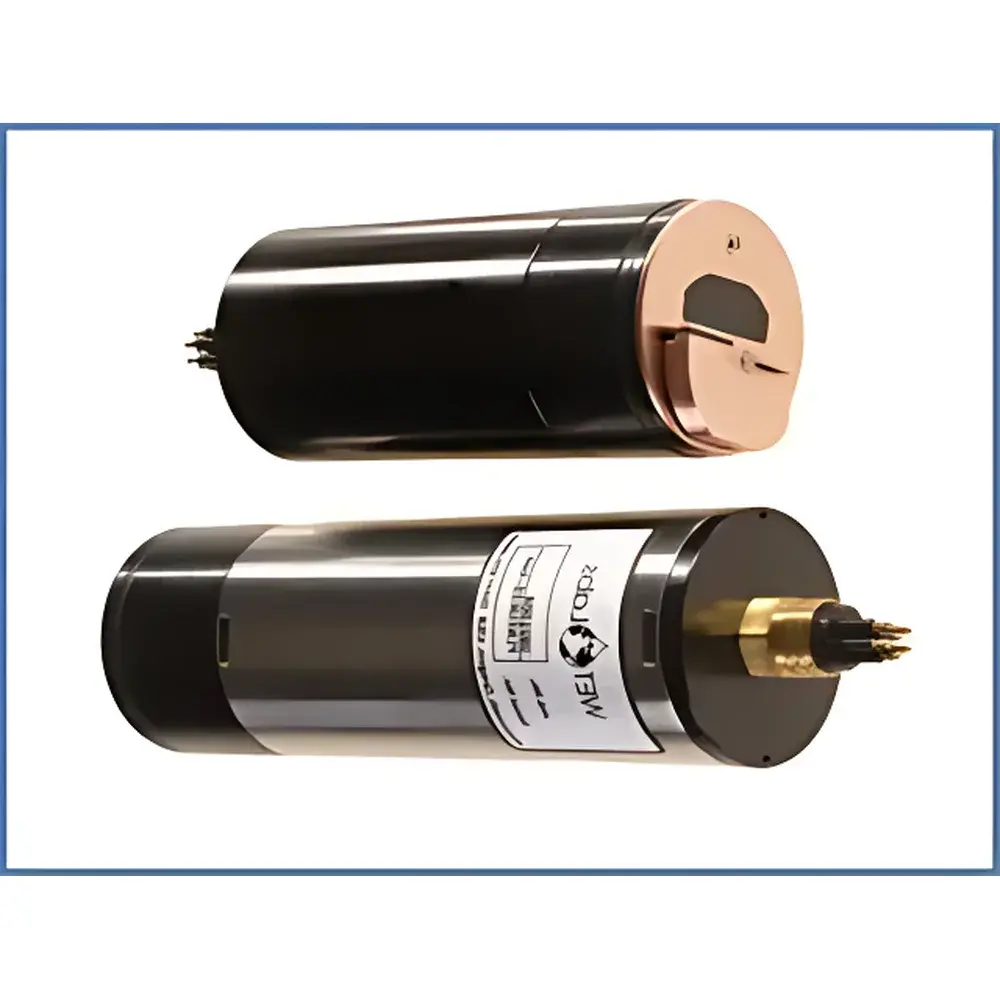
Wetlabs ECO-PC Phycocyanin Fluorometer
| Brand | Wetlabs |
|---|---|
| Origin | USA |
| Model | ECO-PC |
| Measurement Principle | Optical Fluorescence (630 nm excitation / 680 nm emission) |
| Detection Target | Phycocyanin (PC) as proxy for cyanobacterial biomass |
| Measurement Range | 0–230 µg/L PC (optional calibration for Chl-a equivalent) |
| Sensitivity | 0.03 µg/L PC |
| Housing Material | Acetal polymer (seawater-resistant) |
| Dimensions | Ø63 × 127 mm |
| Depth Rating | Standard 600 m, optional 6000 m |
| Weight | 0.4 kg (air), 0.02 kg (water) |
| Connector | SUBCONN Micro 5-pin male |
| Power Input | 7–15 VDC |
| Operating Current | 80 mA (active), 85 µA (sleep mode) |
| Sampling Rate | 8 Hz |
| Digital Output | RS-232 @ 19200 baud, 12-bit resolution |
| Analog Output | 0–5 V (user-configurable scaling) |
| Internal Data Logging | Optional, 65,000 samples |
| Internal Battery | Optional |
| Anti-fouling | Optional copper-brush wiper (programmable cycle) |
| Compliance | IP68, RoHS, CE-marked for marine environmental use |
| Interface Compatibility | Direct integration with Sea-Bird CTDs, Nortek AD2CP, and other oceanographic platforms |
Overview
The Wetlabs ECO-PC Phycocyanin Fluorometer is a submersible, field-deployable optical sensor engineered for in situ quantification of phycocyanin—a water-soluble accessory pigment predominantly expressed by cyanobacteria. Unlike broad-spectrum chlorophyll a fluorometers, the ECO-PC employs a targeted dual-wavelength fluorescence detection architecture: excitation at 630 nm (optimized for phycocyanin absorption peak) and emission detection at 680 nm (isolating the characteristic fluorescence band). This spectral selectivity enables high specificity for cyanobacterial populations—particularly bloom-forming genera such as Microcystis, Anabaena, and Planktothrix—while minimizing interference from non-cyanobacterial phytoplankton, dissolved organic matter (CDOM), or turbidity-induced scattering. Designed for long-term unattended operation in freshwater lakes, reservoirs, estuaries, coastal zones, and wastewater effluent streams, the ECO-PC delivers real-time, high-temporal-resolution data critical for early warning of harmful algal blooms (HABs), regulatory compliance monitoring, and process control in drinking water treatment facilities.
Key Features
- Optically optimized 630 nm LED excitation source with narrow spectral bandwidth and thermal stabilization for consistent quantum yield across temperature gradients (0–30 °C).
- High-quantum-efficiency silicon photodiode detector with sharp 680 nm bandpass filtering to reject Raman scatter and background fluorescence.
- Robust acetal polymer housing rated to 600 m depth (optionally 6000 m), fully compatible with seawater, brackish, and low-conductivity freshwater environments.
- Low-power architecture: 80 mA nominal draw during sampling; deep-sleep mode reduces current to 85 µA—enabling multi-month deployments on internal lithium-thionyl chloride batteries (optional).
- Programmable copper-brush anti-fouling system with user-defined wipe intervals (e.g., every 1–24 hours), mitigating biofilm accumulation without chemical biocides.
- Dual-output interface: RS-232 serial (19200 baud, ASCII/SDI-12 compatible) and analog 0–5 V output (field-calibratable for direct integration into SCADA, PLC, or legacy CTD systems such as Sea-Bird Electronics SBE 19plus or SBE 37).
- Onboard memory option stores up to 65,000 timestamped samples with UTC synchronization, supporting gap-free data capture during intermittent telemetry windows.
Sample Compatibility & Compliance
The ECO-PC operates directly in the water column without sample extraction or filtration, preserving native physiological states and eliminating flow-cell clogging risks common in pumped systems. It is validated for use in natural waters ranging from oligotrophic lakes (PC < 0.1 µg/L) to eutrophic reservoirs exceeding 200 µg/L. While not certified to ISO 10260 or ASTM D6503 for laboratory-grade validation, its optical design follows best practices outlined in EPA Method 445.0 (fluorometric determination of phycocyanin) and aligns with the performance criteria for continuous HAB monitoring specified in the U.S. EPA’s National Lakes Assessment protocols. The instrument meets CE marking requirements for electromagnetic compatibility (EN 61326-1) and environmental protection (IP68), and complies with RoHS Directive 2011/65/EU. For GLP/GMP-aligned deployments, raw fluorescence counts and calibrated concentration values are traceable via factory-provided NIST-traceable calibration certificates (available upon request).
Software & Data Management
Data acquisition is supported through Wetlabs’ proprietary ECO Manager software (Windows-based), which enables configuration of sampling parameters (interval, wiper schedule, output scaling), firmware updates, and batch download of logged datasets. All outputs include embedded metadata: UTC timestamp, instrument serial number, firmware version, battery voltage, and diagnostic flags (e.g., “wiper active”, “low signal”, “temperature out-of-range”). Export formats include CSV and NetCDF4, facilitating ingestion into time-series databases (e.g., ERDDAP, THREDDS) or statistical analysis platforms (R, Python pandas). For enterprise-scale deployments, the ECO-PC integrates natively with Ocean Networks Canada’s Oceans 2.0 platform and NOAA’s IOOS Sensor Observation Service (SOS) architecture via standardized MQTT or HTTP POST endpoints when paired with compatible telemetry gateways.
Applications
- Real-time cyanobacterial bloom detection and forecasting in drinking water source reservoirs (e.g., compliance with WHO provisional guideline values for microcystin risk assessment).
- Long-term ecological monitoring of eutrophication dynamics in lake restoration projects (e.g., tracking PC:Chl-a ratios as indicators of nitrogen limitation).
- Effluent quality assurance in municipal wastewater treatment plants—detecting upstream cyanobacterial ingress or downstream discharge impacts.
- Integration into autonomous platforms: gliders, moorings, AUVs, and fixed-point observatories requiring low-SWaP (Size, Weight, and Power) optical sensors.
- Calibration reference for satellite-derived cyanobacteria algorithms (e.g., MERIS, Sentinel-3 OLCI) through coordinated in situ match-up campaigns.
FAQ
Can the ECO-PC be used interchangeably with chlorophyll a fluorometers?
No. The ECO-PC targets phycocyanin fluorescence, not chlorophyll a. While both pigments co-occur in cyanobacteria, PC is taxonomically more specific and less affected by photoacclimation than Chl-a. Cross-calibration to Chl-a is possible but requires site-specific empirical regression and is not factory-default.
Is factory recalibration required annually?
Wetlabs recommends annual verification against a stable secondary standard (e.g., diluted phycocyanin solution in buffered glycerol) using the provided calibration kit. Full recalibration at the factory is advised every 24 months or after exposure to extreme pressure cycling (>500 dives) or mechanical shock.
Does the copper-brush wiper affect measurement accuracy during operation?
The wiper retracts fully during each measurement cycle (8 Hz sampling ensures >99% duty cycle in clean-water conditions); physical contact occurs only during scheduled maintenance intervals, with no optical path obstruction during fluorescence acquisition.
Can the ECO-PC operate autonomously without external power?
Yes—when equipped with the optional internal battery module, it supports standalone deployments up to 6 months (at 1-min sampling interval), with programmable sleep/wake cycles and low-battery alerts transmitted via serial output.
What is the typical uncertainty budget for field measurements?
At 25 °C and mid-range concentrations (10–100 µg/L), total expanded uncertainty (k=2) is ±5.2% of reading, incorporating contributions from photodiode linearity (±1.8%), LED intensity drift (±1.1%), temperature compensation residuals (±1.4%), and calibration standard uncertainty (±0.9%).
Related Products







