
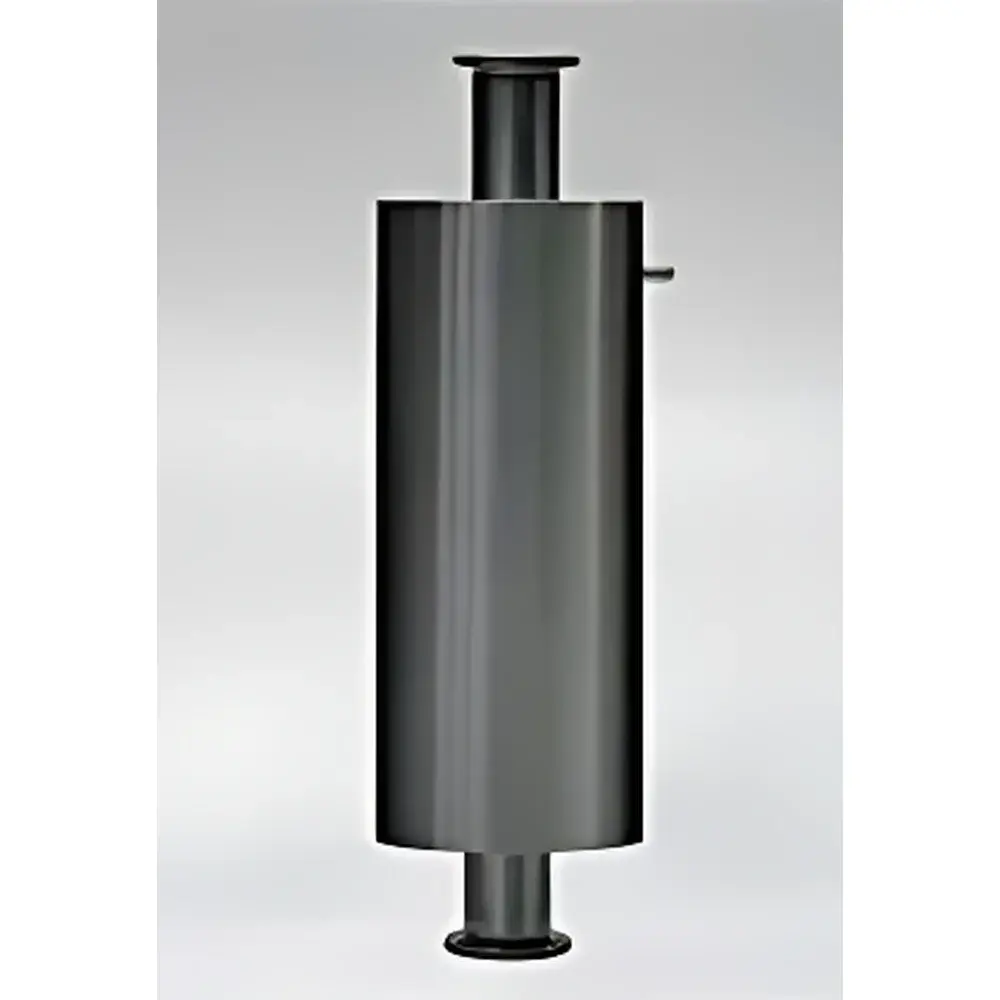
ISAP LCPI Low-Pressure Cascade Impactor for Flue Gas and Nanoparticle Sampling
| Brand | ISAP |
|---|---|
| Origin | Germany |
| Model | ISAP LCPI |
| Flow Accuracy | ±2% |
| Sampling Flow Rate | 5–60 LPM |
| Temperature Range | −50 to +310 °C |
| Cut-Point Range | 20.0 µm to 1 nm |
| Stages | Up to 11 stages (13 size fractions) or 6 stages (8 size fractions) |
| Impactor Type | PILAT/BERNER design |
| Material | Acid-resistant alloys |
| Sampling Mode | Isokinetic or constant-flow |
| Backup Filter Stage | Optional 0.001 µm (1 nm) stage |
| Collison Disk Diameter | 70 mm OD / 30 mm ID |
Overview
The ISAP LCPI Low-Pressure Cascade Impactor is a precision-engineered environmental sampling instrument designed for size-resolved collection of particulate matter (PM) from flue gases, stationary emission sources, and mobile exhaust streams. Operating on the principle of inertial impaction under low-pressure differential conditions, the LCPI adheres to the established aerodynamic design criteria of PILAT and BERNER cascade impactors—ensuring traceable, physically grounded particle classification across a continuous size spectrum. Its core function is to separate airborne particles by aerodynamic diameter through sequential jet-to-plate impaction stages, enabling quantitative mass distribution analysis from coarse (20.0 µm) down to ultrafine and nanoparticulate fractions (as low as 1 nm). The system maintains stable performance across extreme thermal environments (−50 °C to +310 °C), making it suitable for high-temperature stack sampling without active cooling or dilution—critical for preserving volatile condensable aerosols and avoiding artifacts in PM1 and nanoparticle characterization.
Key Features
- Low-pressure operation minimizes particle bounce and re-entrainment, ensuring high collection efficiency and low wall loss—particularly critical for sub-100 nm particles.
- Modular multi-stage configuration: configurable as either an 11-stage BERNER-type impactor (13 size bins) or a 6-stage PILAT-type unit (8 size bins), both with optional pre-separator and backup filter stage (0.001 µm).
- Large-diameter impaction plates (70 mm outer diameter, 30 mm inner diameter) enhance deposition uniformity and reduce edge effects, improving reproducibility during gravimetric and elemental analysis.
- Isokinetic sampling inlet option enables representative sampling from turbulent duct flows—essential for regulatory compliance with ISO 9096, EPA Method 5, and EN 13284-1.
- Acid-resistant construction (e.g., Hastelloy®, PTFE-lined components) ensures long-term stability when sampling corrosive flue gases containing SO2, HCl, NOx, or HF.
- Integrated thermal management: optional insulated jacketing supports consistent temperature control during extended field deployments; compatible with heated probe assemblies for dew-point avoidance.
- Wide flow range (5–60 LPM) accommodates diverse source velocities and dilution requirements while maintaining calibrated cut-points per stage.
Sample Compatibility & Compliance
The ISAP LCPI supports a broad spectrum of substrate materials optimized for downstream analytical techniques including Scanning Electron Microscopy (SEM), Energy-Dispersive X-ray Spectroscopy (EDS), Inductively Coupled Plasma Mass Spectrometry (ICP-MS), Ion Chromatography (IC), Particle-Induced X-ray Emission (PIXE), and Total Reflection X-ray Fluorescence (TXRF). Compatible substrates include quartz fiber filters (high-purity, low-metal background), polyimide (Kapton®) films (for TEM grid mounting), polycarbonate (PC) and polyester (PET) membranes (for pore-size-dependent retention), PTFE (Teflon®) filters (chemically inert, low extractables), PVF (Tedlar®) films (UV-stable, low adsorption), and polyurethane foam (PU) for vapor-phase co-sampling. All configurations comply with international standards for aerosol measurement—including ISO 29463 (HEPA/ULPA filter testing), ISO/TS 21368 (nanoparticle emission characterization), and ASTM D6216 (stack sampling procedures). Calibration certificates traceable to NIST or PTB standards are available upon request.
Software & Data Management
While the ISAP LCPI operates as a hardware-based physical classifier without embedded electronics, it integrates seamlessly into validated data acquisition workflows. Flow controllers, pressure transducers, and temperature sensors used in conjunction with the LCPI support digital logging compliant with FDA 21 CFR Part 11 requirements when paired with qualified third-party systems (e.g., LabVIEW-based DAQ or industrial SCADA platforms). Audit trails, electronic signatures, and secure data export (CSV, XML) are supported via compatible host software. Optional meteorological sensor integration—including wind speed/direction, RH, ambient temperature, solar irradiance, UV index, acoustic noise, and vibration monitoring—enables contextual correlation of emission profiles with ambient dispersion conditions, supporting Tier 3 air quality modeling per EU Directive 2008/50/EC.
Applications
- Regulatory stack testing for PM2.5, PM1, and nanoparticle emissions from coal-fired power plants, waste incinerators, cement kilns, and glass furnaces.
- Mobile source characterization: diesel and gasoline engine exhaust, brake wear, tire abrasion, and non-exhaust urban PM profiling.
- Process optimization in semiconductor fabrication, pharmaceutical dry powder handling, and battery electrode manufacturing where nanoscale contamination control is critical.
- Research-grade source apportionment studies using chemical speciation (e.g., EC/OC, metal fingerprints, sulfate/nitrate ratios) derived from size-fractionated filters.
- Validation of real-time particle sizers (e.g., SMPS, APS, OPC) through gravimetric and compositional reference measurements.
- Health-related aerosol science: deposition modeling in human respiratory tracts (ICRP lung model), toxicological exposure assessment, and nanoparticle translocation studies.
FAQ
What is the minimum detectable aerodynamic diameter achievable with the ISAP LCPI?
The LCPI achieves a final cut-point of 1 nm (0.001 µm) with the optional backup filter stage, enabling collection and subsequent analysis of ultrafine particles down to single-digit nanometer range.
Can the ISAP LCPI be used for isokinetic sampling in vertical stacks?
Yes—when equipped with the optional isokinetic probe assembly and real-time pitot-static flow velocity feedback, the system meets ISO 9096 and EPA Method 5 requirements for representative sampling across variable cross-sectional velocities.
Which filter substrates are recommended for ICP-MS analysis of trace metals?
Quartz fiber and PTFE (Teflon®) filters are preferred due to their ultra-low trace metal blank levels; polyimide (Kapton®) is also suitable for direct digestion-free analysis in certain protocols.
Is calibration documentation provided with each unit?
Each LCPI is supplied with a factory calibration report listing stage-specific cut-points (D50) at nominal flow rates, verified using monodisperse PSL and NaCl aerosols per ISO 27891; NIST-traceable recalibration services are available.
How does the LCPI handle condensable organic vapors during hot-stack sampling?
The heated configuration (up to +310 °C) prevents thermophoretic losses and condensation artifacts; when combined with cryo-trapping or denuder integration upstream, semi-volatile organics can be separated from particulate phases prior to impactor entry.
Related Products







