
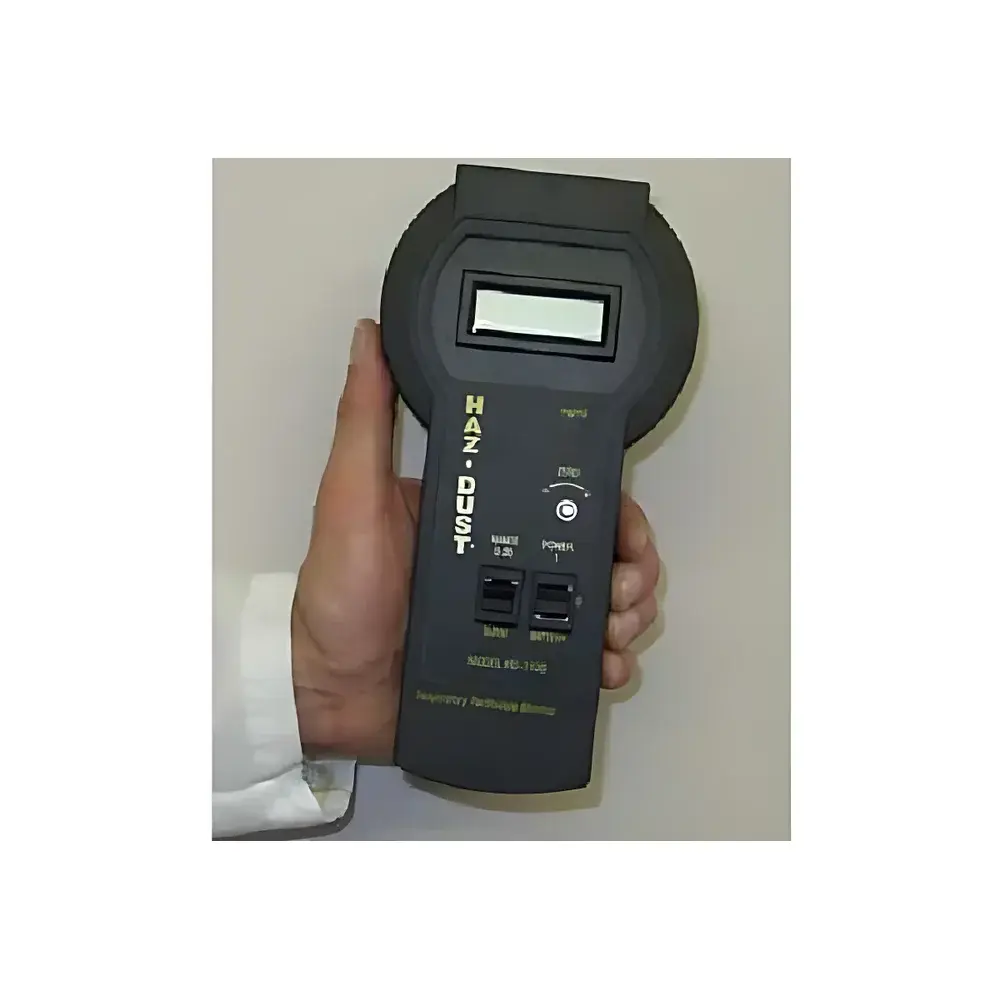
EDC HD-1100 Handheld Dust Monitor
| Brand | EDC |
|---|---|
| Origin | USA |
| Model | HD-1100 |
| Measurement Range | 0.01–20 / 200 mg/m³ |
| Resolution | 0.01 mg/m³ |
| Accuracy | ±10% |
| Relative Error | ±10% |
| Display | 3.5" LCD |
| Units | mg/m³ |
| Calibration Standard | NIOSH Method 0600 |
| Particle Size Range | 0.01–50 µm |
| Power Supply | 6 VDC NiMH Rechargeable Battery |
| Operating Time | >8 hours |
| Charging Time | 10–12 hours |
| Output Signal | 0–2 V analog |
| Max Operating Humidity | 95% non-condensing |
| Dimensions | 22.9 × 7.6 × 3.8 cm |
| Weight | 0.91 kg |
Overview
The EDC HD-1100 Handheld Dust Monitor is a portable, real-time particulate mass concentration analyzer engineered for occupational hygiene and environmental field assessments. Unlike optical particle counters or beta attenuation monitors, the HD-1100 employs a gravimetric-based photometric measurement principle—calibrated against NIOSH Method 0600—enabling direct estimation of respirable and total suspended particulate (TSP) mass concentrations in air. Its design prioritizes field robustness, operator ergonomics, and regulatory traceability, making it suitable for both personal exposure monitoring and area surveys in industrial, construction, remediation, and emergency response settings. The instrument does not require filter weighing or laboratory analysis, delivering on-site quantitative data aligned with OSHA permissible exposure limits (PELs), ACGIH TLVs®, and EPA reference methods for PM10 and TSP.
Key Features
- Real-time analog output (0–2 V) compatible with external data loggers and SCADA interfaces
- NIOSH 0600–traceable calibration protocol supporting compliance with OSHA 29 CFR 1910.1000 and EPA Method IO-4
- Dual-range measurement capability: high-sensitivity mode (0.01–20 mg/m³) and extended range (0.01–200 mg/m³), selectable via front-panel switch
- Integrated 3.5-inch backlit LCD with simultaneous display of current concentration, time-stamped min/max values, and battery status
- Ruggedized housing rated for operation at up to 95% relative humidity (non-condensing) and ambient temperatures from 0°C to 45°C
- Rechargeable 6 V NiMH battery providing >8 hours of continuous operation; full recharge in 10–12 hours
- Compact form factor (22.9 × 7.6 × 3.8 cm) and lightweight design (0.91 kg) optimized for belt-mounting and extended shift use
Sample Compatibility & Compliance
The HD-1100 is validated for quantitative assessment of airborne particulates across diverse aerosol types—including crystalline silica, lead oxide, welding fumes, coal dust, cementitious materials, pharmaceutical powders, dry chemical agents, PCB-contaminated soils, paint mists, grain dust, and nuisance dusts. Its photometric response curve is empirically matched to NIOSH 0600’s gravimetric reference, ensuring comparability with certified laboratory filter analyses. While not intrinsically safe or explosion-proof, the device meets IEC 61010-1 safety requirements for portable electrical equipment used in non-hazardous locations. It supports documentation workflows compliant with GLP, ISO/IEC 17025, and OSHA recordkeeping standards when paired with optional DL-103 data logger and Pro.1.2 software.
Software & Data Management
The optional DL-103 single-channel data logger enables time-synchronized logging at user-defined intervals (1 second to 12 hours), storing up to 21,500 data points with timestamps, TWA/STEL calculations, and min/max concentration tracking. Data export occurs via RS-232 (9600 baud) to Pro.1.2 software—a Windows-based application that generates audit-ready reports conforming to 21 CFR Part 11 requirements, including electronic signatures, change history, and calibration event logs. The software supports overlay of multiple sampling events, statistical summaries (geometric mean, standard deviation), and graphical comparison against PELs or action levels defined per OSHA, MSHA, or local jurisdictional thresholds.
Applications
- Respiratory protection program validation—determining appropriate APF and cartridge selection
- Workplace exposure assessments per OSHA 1910.1200 (HazCom) and EPA 40 CFR Part 372 (Toxics Release Inventory)
- PM10 and TSP characterization during site investigations, soil vapor intrusion studies, and brownfield remediation
- Engineering control verification—e.g., local exhaust ventilation (LEV) efficiency testing and dust collector performance audits
- Hot spot identification during demolition, abrasive blasting, trenching, and concrete cutting operations
- SARA Title III emergency response air monitoring for fugitive emissions and accidental releases
- Inhalable fraction evaluation in pharmaceutical manufacturing cleanrooms and powder handling facilities
- Construction dust management under EPA Construction General Permit (CGP) and state-specific dust ordinances
FAQ
Is the HD-1100 intrinsically safe for use in hazardous locations?
No—the HD-1100 is classified as non-explosion-proof and is intended only for use in general-purpose, non-classified environments.
Can the instrument be used for respirable crystalline silica monitoring per OSHA 1926.1153?
Yes—when operated in conjunction with NIOSH 0600–calibrated sampling protocols and documented calibration verification, it provides field-validated estimates consistent with OSHA’s respirable silica enforcement policy.
Does the HD-1100 require annual factory recalibration?
While not mandatory, EDC recommends annual verification against traceable NIST-traceable standards using the M263123-11 calibration plate and M263123-12 zeroing tool to maintain measurement integrity.
What is the minimum detectable concentration and its uncertainty at low levels?
The stated resolution is 0.01 mg/m³; however, at concentrations below 0.1 mg/m³, measurement uncertainty increases due to photometric noise—users should apply statistical confidence intervals per ISO 11014 guidelines.
Is the DL-103 data logger validated for GMP-regulated environments?
Pro.1.2 software with DL-103 supports 21 CFR Part 11 compliance features (audit trail, electronic signature, data integrity controls), though site-specific validation per Annex 11 remains the responsibility of the end-user quality unit.
Related Products







