
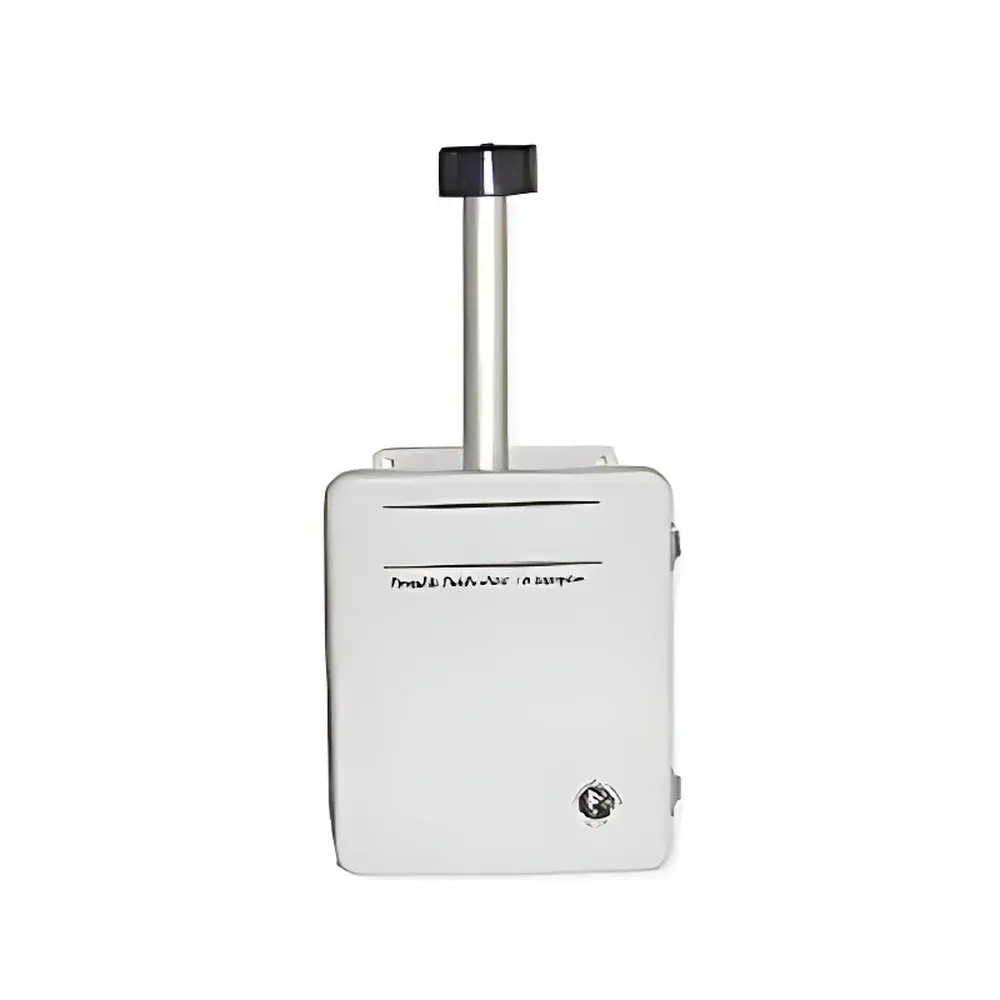
Tisch DS2.5 Portable Ambient Particulate Matter Sampler
| Brand | Tisch |
|---|---|
| Origin | USA |
| Manufacturer Status | Authorized Distributor |
| Origin Category | Imported |
| Model | DS2.5 |
| Typical Configuration | PM2.5 Sampling System |
| Pump Type | Pulse-Driven Diaphragm Pump |
| Rated Lifespan | 10,000 hours continuous operation |
| Flow Rate Range | 0–6 L/min (adjustable) |
| Default Operating Flow | 5 L/min |
| Timer Function | 7-day programmable scheduler with 24-hour real-time clock |
| Power Supply | AC/DC input + sealed rechargeable battery (12 Ah) |
| Battery Runtime | ≥12 hours at 5 L/min |
| Low-Battery Protection | automatic shutdown with visual alert |
| Low-Flow Alert | automatic shutdown with visual alert |
| Flow Control | precision electronic mass flow regulation |
| Filter Holder | standard 47 mm membrane filter cassette |
| Inlet Cut-Point | 10 µm (PM₁₀) with optional PM₂.₅ cyclone or impactor |
| Enclosure Rating | NEMA 4X (weatherproof, dust-tight, corrosion-resistant) |
| Weight | 6.8 kg (15 lbs) including battery |
| Dimensions | 24.1 × 20.3 × 27.9 cm (H×W×D) |
Overview
The Tisch DS2.5 Portable Ambient Particulate Matter Sampler is a field-deployable, low-flow gravimetric sampling system engineered for regulatory-compliant collection of PM₁₀, PM₂.₅, and total suspended particulates (TSP) in ambient air. It operates on the principle of size-selective inertial separation—using a calibrated 10 µm sharp-cut cyclone (or optional PM₂.₅ impactor) to fractionate airborne particles prior to deposition onto a standard 47 mm quartz fiber or polytetrafluoroethylene (PTFE) filter. The instrument employs a pulse-driven diaphragm pump with integrated electronic mass flow control, ensuring stable volumetric flow across variable environmental conditions—including temperature fluctuations, barometric pressure changes, and inlet loading. Designed for unattended outdoor operation, the DS2.5 meets core requirements of U.S. EPA Reference Method PS-1 and equivalent ISO 7708 and EN 12341 protocols for inhalable particle monitoring. Its compact architecture, weatherproof NEMA 4X enclosure, and integrated 12 Ah rechargeable battery enable extended deployments in remote locations—supporting long-term trend analysis, source apportionment studies, and compliance verification without infrastructure dependency.
Key Features
- Robust pulse-driven diaphragm pump rated for 10,000 hours of continuous operation—minimizing maintenance intervals and enhancing field reliability
- Precision electronic flow regulation with real-time feedback, maintaining ±2% accuracy across the full 0–6 L/min range (calibrated at 5 L/min per EPA guidance)
- Programmable 7-day scheduler with 24-hour real-time clock—enabling automated start/stop cycles aligned with diurnal patterns or regulatory sampling windows
- NEMA 4X-rated aluminum enclosure—providing IP66-level protection against rain, dust, salt spray, and UV degradation for year-round outdoor deployment
- Integrated 12 Ah sealed lead-acid battery delivering ≥12 hours of continuous operation at nominal 5 L/min flow—supported by low-battery and low-flow shutdown safeguards with LED status indicators
- Standardized 47 mm filter holder compatible with gravimetric, elemental carbon, ion chromatography, and XRF analytical workflows
- Modular inlet configuration—accepts EPA-approved PM₁₀ cyclones (e.g., BGI SCC-1.062), PM₂.₅ impactors (e.g., BGI GK2.05), or TSP samplers per method-specific validation
Sample Compatibility & Compliance
The DS2.5 supports gravimetric analysis of PM₁₀ and PM₂.₅ in accordance with U.S. EPA Methods IO-3.2, IO-4.2, and Appendix L to 40 CFR Part 50. It is compatible with quartz fiber filters (Pallflex E70-2075), PTFE membranes (Gelman Supor®), and nylon filters for subsequent chemical speciation. All flow paths are constructed from inert stainless steel and anodized aluminum to prevent adsorption artifacts. The system’s flow calibration traceability aligns with NIST-traceable rotameters or primary standards such as critical orifices or bubble meters. When operated with certified inlets and validated filter media, data generated satisfies reporting requirements under Clean Air Act Title I monitoring programs, EU Directive 2008/50/EC, and WHO Global Air Quality Guidelines. Optional audit-ready accessories include flow calibrator kits and temperature/pressure sensors compliant with ASTM D6216 and ISO 12103-1.
Software & Data Management
While the DS2.5 operates as a standalone hardware platform, its timing and flow parameters are fully documentable via printed log sheets or external data loggers (e.g., Onset HOBO UX120). For GLP/GMP-aligned deployments, users integrate the sampler into validated environmental monitoring networks using third-party SCADA-compatible controllers that record timestamped flow, battery voltage, and runtime metrics. All operational settings—including start time, duration, flow setpoint, and cycle repetition—are manually configured via front-panel controls; no proprietary firmware or cloud connectivity is required, ensuring data sovereignty and audit trail integrity. Raw gravimetric data derived from DS2.5-collected filters may be entered into EPA’s AQS database or EEA’s AirBase platform following standard QA/QC protocols, including field blank correction, humidity-controlled weighing, and duplicate sample analysis per ISO/IEC 17025.
Applications
- Ambient air quality monitoring networks—deployed across urban, rural, and background sites to quantify spatial-temporal PM gradients and support National Ambient Air Quality Standards (NAAQS) attainment demonstrations
- Source identification and apportionment—used in conjunction with receptor modeling (e.g., PMF, CMB) to differentiate contributions from traffic, biomass burning, crustal dust, industrial emissions, and secondary aerosol formation
- Volcanic and geophysical event response—tracking rapid PM excursions during eruptions or ash plume dispersion for hazard forecasting and aviation safety coordination
- Desert dust transport studies—characterizing mineralogical composition and size distribution of Saharan or Asian dust events impacting transcontinental airsheds
- Indoor air quality assessment in schools, offices, and healthcare facilities—leveraging low acoustic signature (<45 dBA) for non-disruptive sampling during occupancy
- Occupational exposure assessment—adapted for personal or area sampling in construction, mining, and manufacturing environments per OSHA Method ID-125G and NIOSH Method 0600
FAQ
Is the DS2.5 compliant with U.S. EPA reference methods for PM₂.₅ monitoring?
Yes—when equipped with an EPA-equivalent PM₂.₅ impactor (e.g., BGI GK2.05) and operated at 5 L/min with NIST-traceable flow calibration, it satisfies the performance criteria of 40 CFR Part 53 for federal reference method (FRM) equivalency testing.
Can the DS2.5 be used for TSP sampling?
Yes—by removing the size-selective inlet and installing a standard TSP nozzle (e.g., 2.54 cm diameter), the system collects total suspended particulates per EPA Method IO-1.1 and ISO 10178.
What maintenance is required between sampling campaigns?
Routine tasks include cleaning the cyclone/impactor with isopropyl alcohol, verifying flow calibration with a primary standard, inspecting O-rings and filter seals, and charging the battery—no pump servicing is needed within the first 5,000 operating hours.
Does the DS2.5 support remote data transmission?
No—it is a self-contained, non-networked instrument. However, analog voltage outputs (0–5 V) for flow and battery status can be interfaced with external dataloggers supporting Modbus RTU or SDI-12 protocols.
Is the NEMA 4X enclosure suitable for coastal or industrial environments?
Yes—the anodized aluminum housing and stainless-steel fasteners resist chloride-induced corrosion and chemical exposure typical of marine and refinery perimeter monitoring applications.
Related Products







