
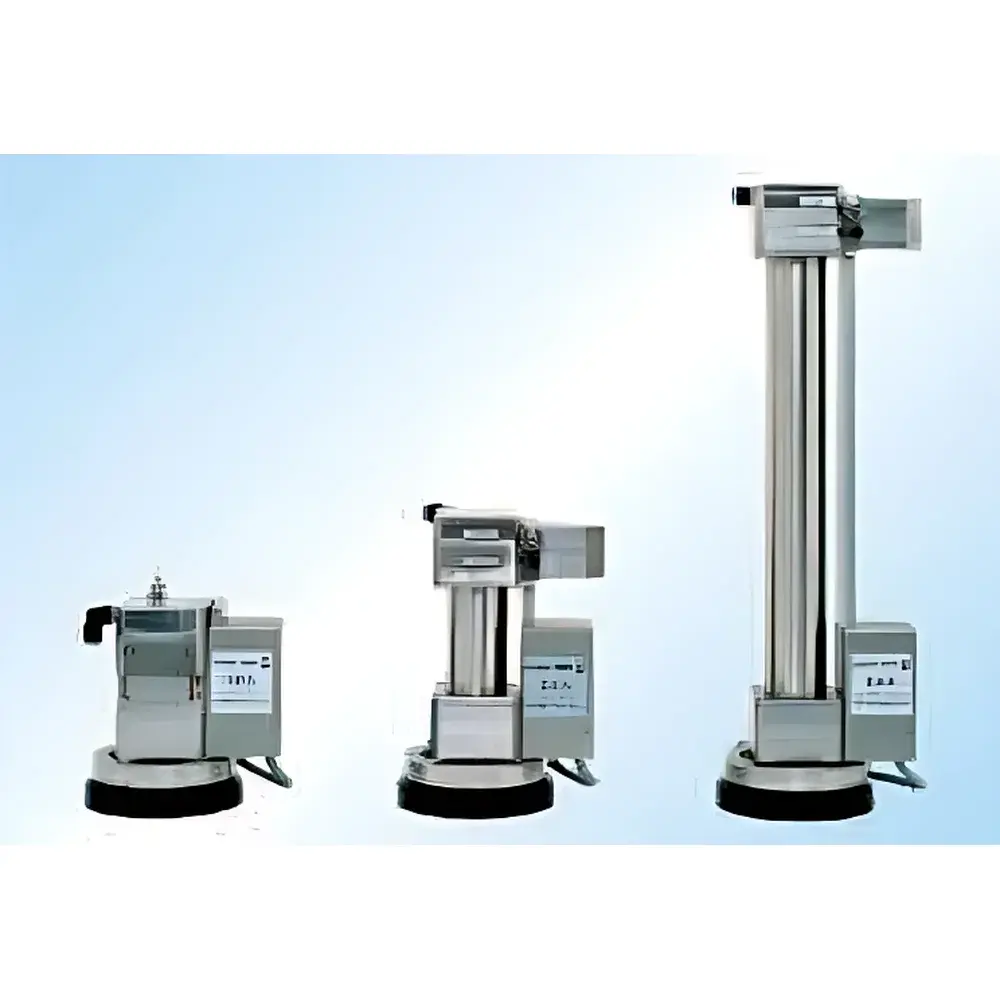
GRIMM DMA Differential Mobility Analyzer
| Brand | GRIMM |
|---|---|
| Origin | Germany |
| Model | DMA |
| Instrument Type | Aerosol Detector |
| Particle Size Range (L-DMA) | 5–350 nm (3.0 L/min sheath flow) / 10–1100 nm (20 L/min sheath flow) |
| Sheath Gas Flow | 3.0 L/min (standard), up to 150 L/min (high-flow variant) |
| Sample Flow | 0.3 L/min |
| High-Voltage Output | +5 to +10,000 V (positive inner electrode), negative polarity optional |
| Resolution | Up to 256 size channels |
| Operating Temperature | 10–35 °C |
| Relative Humidity | 0–95% RH (non-condensing) |
| Power Supply | 85–264 VAC |
| Communication | RS-232 (9-pin D-sub), ASCII protocol, 4 MB PCMCIA SRAM |
| Working Fluid | Reagent-grade 1-Butanol |
| Safety | Automatic HV shutdown upon housing opening |
| Compliance | Designed for ISO 27498, ASTM D6243, and EU PM2.5/PM10 monitoring frameworks |
Overview
The GRIMM DMA Differential Mobility Analyzer is a precision-engineered electrostatic classification instrument designed for high-resolution size-selective separation of submicron aerosol particles based on their electrical mobility. Operating on the fundamental principle of differential mobility analysis (DMA), it subjects charged aerosol particles to a precisely controlled radial electric field between a grounded outer cylinder and a positively biased central electrode. Particles with a specific charge-to-mass ratio migrate toward the narrow exit slit under laminar sheath gas flow, enabling generation of monodisperse aerosol streams or real-time scanning of particle size distributions. The U-shaped inlet and integrated laminar flow conditioner minimize diffusion losses and ensure stable, reproducible classification performance across its operational range. When coupled with a Condensation Particle Counter (CPC) or Faraday Cup Electrometer (FCE), the system forms a Scanning Mobility Particle Sizer (SMPS) platform capable of quantitative size-resolved aerosol characterization from 5 nm to 1100 nm — essential for atmospheric research, nanoparticle toxicology, cleanroom validation, and regulatory emissions monitoring.
Key Features
- Two interchangeable DMA configurations: L-DMA (5–350 nm at 3.0 L/min sheath flow; 11–1110 nm at 20 L/min) and M-DMA (10–1100 nm standard range), optimized via electrode length adjustment (492 mm vs. 230 mm)
- Robust high-voltage architecture: 5–10,000 V DC output with polarity reversal option; automatic shutdown upon housing access per IEC 61010-1 safety requirements
- Laminar-flow-optimized geometry: U-inlet design and top-mounted flow straightener reduce particle deposition and enhance transmission efficiency >85% for 10–100 nm particles
- Sheath gas control: Precision pressure-difference sensing through calibrated nozzles ensures insensitivity to mechanical vibration and ambient pressure fluctuations (±50 mbar tolerance)
- Integrated environmental sensors: Onboard temperature, pressure, and dual nozzle differential pressure monitoring support GLP-compliant data traceability
- High-throughput capability: Optional high-flow configuration supports 75–150 L/min operation for industrial source testing and monodisperse aerosol generation (e.g., 23–41 nm reference aerosols)
Sample Compatibility & Compliance
The GRIMM DMA accepts ambient air, diluted stack emissions, laboratory-generated aerosols (e.g., NaCl, DEHS, silver nanoparticles), and bioaerosol suspensions following appropriate charging (e.g., bipolar diffusion charging via Kr-85 or soft X-ray sources). It complies with core metrological standards for aerosol instrumentation including ISO 27498 (aerosol measurement terminology), ASTM D6243 (electrical mobility spectrometry), and EN 16450 (ambient air quality — continuous measurement systems). Its architecture supports 21 CFR Part 11-compliant audit trails when integrated with validated SMPS control software, and meets GMP/GLP environmental monitoring requirements for pharmaceutical cleanrooms and semiconductor fabrication facilities.
Software & Data Management
The DMA is operated via ASCII-based serial communication (RS-232, 9-pin D-sub) using industry-standard SMPS control protocols. Firmware supports voltage ramping, step-scan, and dwell-mode acquisition, enabling full spectral reconstruction with up to 256 logarithmically spaced size bins. Raw mobility voltage data and synchronized CPC/FCE counts are logged to internal 4 MB PCMCIA SRAM or external PC storage. Analog inputs accommodate co-located meteorological or gas sensor signals (e.g., RH, T, NO₂, O₃) for contextual environmental correlation. Export formats include CSV and netCDF, compatible with Python-based aerosol analysis libraries (e.g., PyAero, SMPSpy) and commercial tools such as Igor Pro and MATLAB.
Applications
- Atmospheric science: Real-time nucleation mode (3–20 nm) and Aitken mode (20–100 nm) particle growth studies
- Occupational health: Nanoparticle exposure assessment in battery manufacturing, catalysis R&D, and additive manufacturing environments
- Regulatory compliance: PM₁, PM₂.₅, and ultrafine particle (UFP) monitoring per EU Directive 2008/50/EC and US EPA research-grade protocols
- Instrument calibration: Generation of traceable monodisperse reference aerosols for CPC, optical particle sizers, and filter efficiency testers
- Material science: In-process characterization of engineered nanomaterials during spray pyrolysis, flame synthesis, and laser ablation
FAQ
What particle charging method is recommended for optimal DMA performance?
Bipolar diffusion charging using a 85Kr source or soft X-ray charger is standard; unipolar charging may be used for specialized applications requiring defined charge states.
Can the GRIMM DMA operate continuously in high-humidity environments?
Yes — it is rated for 0–95% RH non-condensing; however, butanol working fluid saturation must be maintained, and inlet drying (e.g., Nafion dryer) is recommended above 80% RH to prevent condensation in the classifier column.
Is the high-flow (75–150 L/min) DMA variant compatible with standard SMPS software?
Yes — firmware and communication protocols remain identical; only calibration constants and voltage–size mapping tables require revalidation per flow rate.
How is traceability ensured for regulatory reporting?
Each unit ships with factory calibration certificates traceable to PTB (Physikalisch-Technische Bundesanstalt); optional annual recalibration includes NIST-traceable mobility calibration using certified polystyrene latex spheres.
Does the DMA require periodic maintenance beyond butanol replenishment?
Yes — quarterly inspection of electrode surfaces for contamination, annual verification of HV insulation resistance (>1012 Ω), and biannual replacement of butanol drain pump tubing are recommended per GRIMM Service Bulletin DMA-SV-2023.
Related Products







