
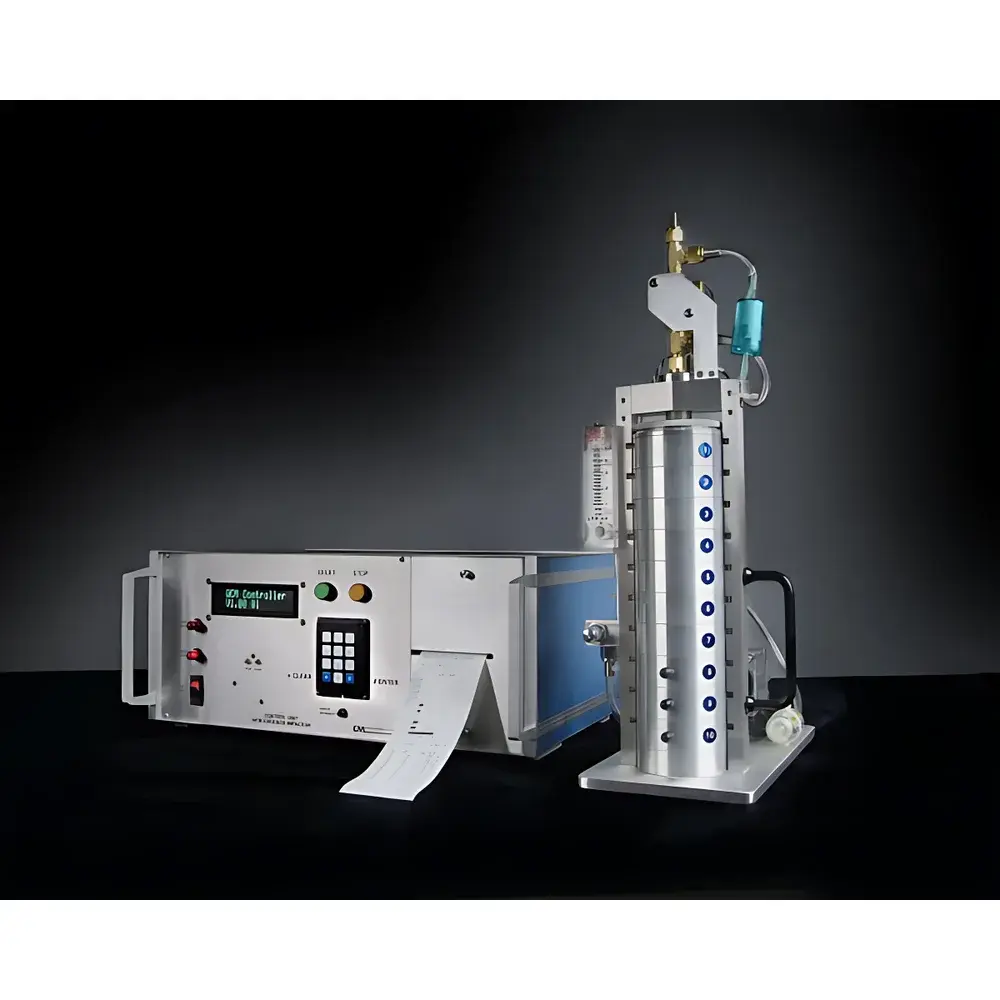
EDC CMI PC-2HX Quartz Crystal Microbalance Aerosol Particle Analyzer
| Brand | EDC |
|---|---|
| Origin | USA |
| Manufacturer Type | Authorized Distributor |
| Product Origin | Imported |
| Model | PC-2HX |
| Instrument Type | Aerosol Size Distribution and Mass Concentration Analyzer |
| Measurement Principle | Inertial Impaction with QCM Gravimetric Detection |
| Size Range | 0.1–25 µm (10-stage cascade impactor configuration) |
| Flow Rate | 2.0 L/min (PC-2HX variant) |
| Mass Sensitivity | 1 ng/Hz |
| Detection Limit | ~5 µg/m³ (typical) |
| Minimum Detectable Particle Diameter | 100 nm |
| Output | Real-time size-resolved mass concentration (µg/m³ per stage), PM₁ / PM₂.₅ / PM₁₀ equivalent calculation, timestamped histogram export |
| Interface | RS-232 / USB to PC |
| Sample Substrate | Removable QCM crystals or aluminum collection plates for SEM/EDS analysis |
Overview
The EDC CMI PC-2HX Quartz Crystal Microbalance Aerosol Particle Analyzer is a precision-engineered, cascade-type inertial impactor system integrating high-sensitivity quartz crystal microbalance (QCM) sensors for real-time, gravimetric determination of aerosol size distribution and mass concentration. Based on the fundamental principle of aerodynamic particle separation—where particles are classified by inertia onto discrete collection stages under controlled laminar flow—the instrument delivers quantitative, stage-resolved mass deposition data directly from resonant frequency shifts of calibrated AT-cut quartz crystals (1 MHz fundamental frequency). Each stage corresponds to a defined aerodynamic cut-point, enabling reconstruction of the full aerosol mass size distribution from 100 nm to 25 µm. Unlike optical or beta-attenuation methods, QCM-based measurement provides traceable, absolute mass loading without reliance on particle density or refractive index assumptions—making it particularly suitable for heterogeneous, hygroscopic, or irregularly shaped aerosols encountered in occupational hygiene, toxicology, and atmospheric science.
Key Features
- 10-stage cascade impactor with precisely engineered nozzle diameters and jet-to-plate distances, optimized for NIOSH/ISO 7708-compliant aerodynamic sizing.
- High-stability QCM sensors with 1 ng/Hz mass resolution, temperature-compensated oscillators, and low-drift electronics for long-duration field deployment.
- Real-time calculation of regulatory-relevant metrics: PM₁, PM₂.₅, and PM₁₀ mass concentrations derived directly from stage-resolved deposition profiles.
- Automated sampling control with programmable duration (1 min–24 h), integrated flow calibration via thermal mass flow sensor (±1.5% accuracy).
- Removable stainless-steel or aluminum collection substrates compatible with post-sampling electron microscopy (SEM), energy-dispersive X-ray spectroscopy (EDS), and Raman mapping.
- Onboard data logging with timestamped histograms, cumulative mass plots, and CSV export via RS-232 or USB interface.
- Ruggedized chassis with shock-mounted electronics, conformal coating, and IP54-rated enclosure for mobile laboratory and airborne platform integration.
Sample Compatibility & Compliance
The PC-2HX accepts a broad spectrum of aerosol types—including combustion-derived soot, mineral dust, biological particles (spores, endotoxins), pharmaceutical dry powder aerosols, radioactive particulates, and industrial process emissions—without requiring chemical derivatization or optical calibration. Its mechanical classification mechanism ensures robust performance across variable humidity (10–90% RH non-condensing) and ambient temperature (−10°C to +45°C). The system complies with ASTM D6246 (Standard Practice for Sampling and Analysis of Respirable Particulate Matter), ISO 10993-12 (biological evaluation of medical devices), and supports GLP/GMP documentation workflows through audit-trail-capable software. For regulated environments, raw QCM frequency shift data and flow logs meet FDA 21 CFR Part 11 requirements when used with validated third-party acquisition software.
Software & Data Management
Data acquisition and analysis are supported via EDC’s proprietary QCM-Analyzer Suite (Windows-based), which provides real-time visualization of frequency decay curves, automatic baseline correction, and ISO-standardized size binning algorithms. Export formats include .csv, .xlsx, and .xml for integration with MATLAB, Python (pandas/scipy), or statistical platforms such as JMP or SAS. The software maintains full metadata provenance: instrument ID, operator ID, calibration certificate traceability (NIST-traceable flow and mass standards), and environmental parameters logged at 1 Hz. Optional API access enables integration into centralized environmental monitoring networks or IoT-enabled facility management systems.
Applications
- Atmospheric research: Volcanic plume characterization (e.g., Kīlauea SO₂-associated aerosols), wildfire smoke profiling (submicron carbonaceous fraction quantification), and boundary-layer aerosol transport modeling.
- Inhalation toxicology: Dose–response assessment of engineered nanomaterials, diesel exhaust particles, and therapeutic aerosols in nose-only or whole-body exposure chambers.
- Nuclear safety: Real-time monitoring of respirable radionuclide-bearing aerosols (e.g., 239PuO₂, 137CsCl) in containment zones and decommissioning facilities.
- Pharmaceutical development: Cascade impactor testing of metered-dose inhalers (MDIs) and dry powder inhalers (DPIs) per USP & Ph. Eur. guidelines.
- Occupational health: Workplace exposure assessment in semiconductor cleanrooms, battery manufacturing, and abrasive blasting operations.
- Aerospace instrumentation: Integration into NASA ER-2 and U-2 high-altitude platforms for stratospheric aerosol layer mapping during volcanic events.
FAQ
How does the PC-2HX differ from optical particle sizers?
Unlike light-scattering instruments, the PC-2HX measures true deposited mass per aerodynamic size bin—eliminating uncertainties from particle shape, refractive index, and hygroscopic growth.
Can the QCM crystals be reused after analysis?
Yes—crystals may be cleaned ultrasonically in IPA or oxygen plasma, then re-calibrated using certified mass standards; lifetime exceeds 500 sampling cycles under proper handling.
Is the system compliant with EPA Method PS-11 or ISO 29463?
While not a certified reference method itself, the PC-2HX meets the physical sampling criteria of ISO 29463-3 (high-efficiency filters) and serves as a primary gravimetric validation tool for filter-based PM monitors.
What maintenance is required for field deployment?
Bi-weekly flow verification with a primary calibrator, quarterly nozzle inspection under microscope, and annual oscillator recalibration at EDC-certified service centers.
Does the system support remote operation?
Yes—via optional Ethernet module and Modbus TCP protocol, enabling integration into SCADA systems for unattended monitoring in remote observatories or industrial stacks.







