
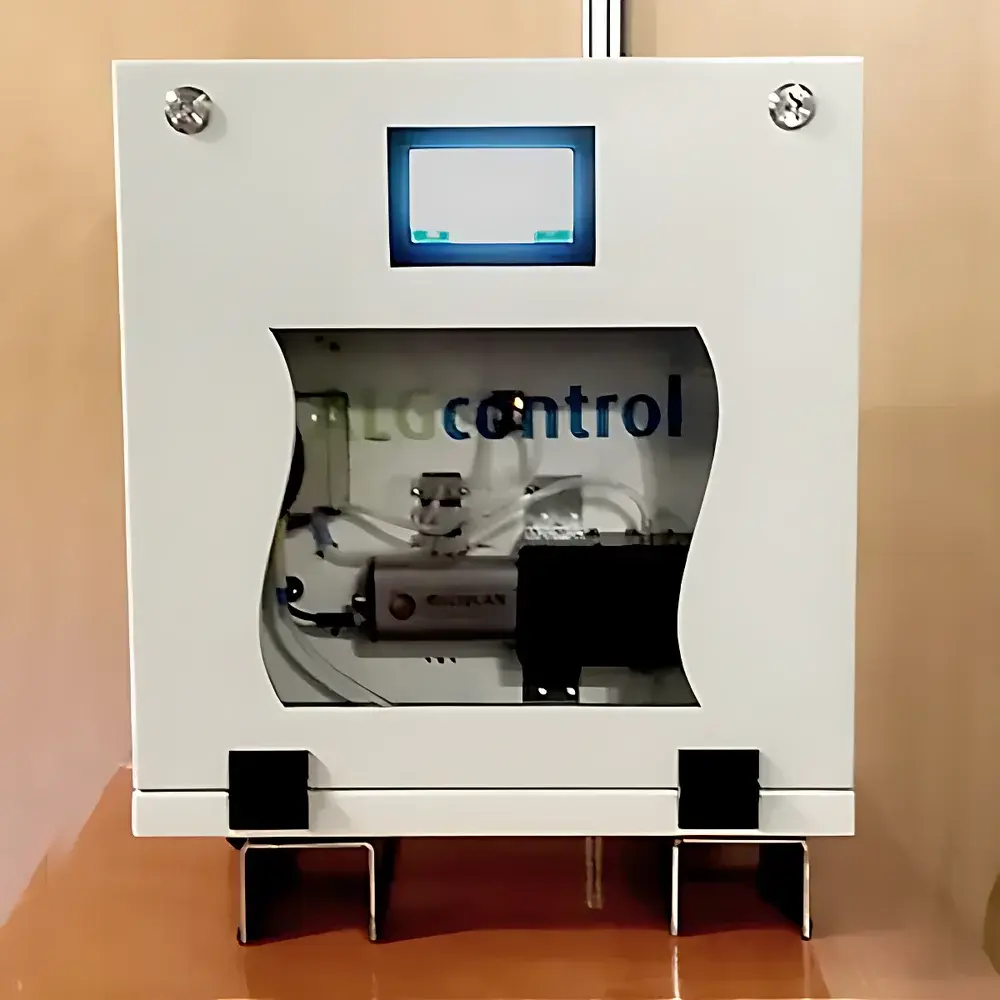
microLAN ALGcontrol Online Algal Fluorescence Monitor
| Brand | microLAN |
|---|---|
| Origin | Netherlands |
| Model | ALGcontrol |
| Measurement Parameters | Chlorophyll a (Chl-a), Dissolved Organic Matter (DOM), Turbidity |
| Wavelengths | 365, 450, 525, 570, 590, 615, 710 nm |
| Chl-a Range | 0–200 µg/L |
| Chl-a Resolution | 0.2 µg/L |
| Turbidity Range | 0–400 NTU |
| Detector | DTGS with 24-bit ADC sampling |
| Interface | LAN, CAN-Bus, RS232, RS485, Modbus TCP/RTU |
| Analog Outputs | 2 × 4–20 mA |
| Power Supply | 24 VDC |
| Power Consumption | 45 W |
| Enclosure Material | Aluminum |
| IP Rating | IP54 (optional IP65) |
| Dimensions (H×W×D) | 450 × 450 × 260 mm |
| Operating Sample Temp. | 10–35 °C |
| Ambient Temp. | 15–30 °C |
| Sample Flow Rate | 2–10 L/h |
| Cleaning System | Automated NaOCl-based (≤0.05% active chlorine) |
| OS | Embedded Linux |
| Software | SQL-based PC software with audit-ready data logging |
Overview
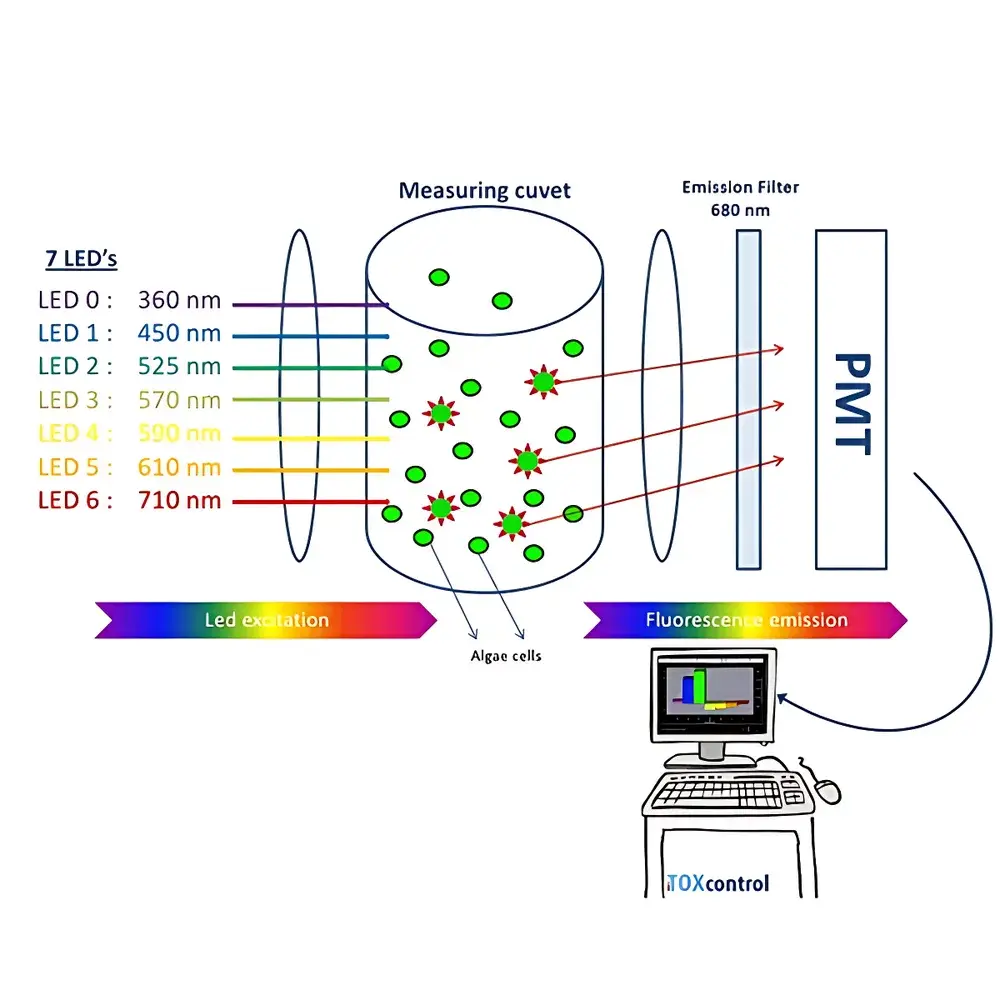
The microLAN ALGcontrol Online Algal Fluorescence Monitor is an advanced, field-deployable fluorometric sensor system engineered for continuous, real-time quantification of phytoplankton biomass and composition in natural and engineered water systems. It operates on the principle of multi-wavelength excitation fluorescence spectroscopy: seven precisely calibrated LEDs (365, 450, 525, 570, 590, 615, and 710 nm) sequentially illuminate water samples, inducing chlorophyll a (Chl-a) fluorescence—primarily at ~680 nm—while simultaneously capturing spectral response signatures. Unlike single-excitation sensors, the ALGcontrol leverages the distinct excitation-emission profiles of different algal taxonomic groups (e.g., cyanobacteria, green algae, diatoms) to differentiate functional groups based on their intrinsic photosynthetic pigment architecture. Crucially, it integrates dual-compensation logic: 365 nm fluorescence corrects for dissolved organic matter (DOM) interference, while 710 nm scattering signal compensates for turbidity-induced attenuation—enabling robust Chl-a quantification even in optically complex waters such as eutrophic reservoirs or estuarine transitions.
Key Features
- Seven-wavelength LED excitation array enabling taxon-sensitive fluorescence fingerprinting and quantitative Chl-a differentiation between cyanobacteria and eukaryotic algae
- Real-time DOM and turbidity compensation algorithms embedded in firmware—no post-processing required
- Automated electrochemical cleaning cycle using low-concentration sodium hypochlorite solution (≤0.05% active chlorine), validated for >4-week unattended operation
- Integrated Linux-based control unit with 7-inch capacitive touchscreen GUI, supporting direct configuration, trend visualization, and alarm management
- Dual 4–20 mA analog outputs configurable per parameter (Chl-a, DOM, turbidity) with NIST-traceable calibration mapping
- Modular I/O architecture: supports optional pH, DO, ORP, and secondary turbidity sensors via standardized 4–20 mA or digital inputs
- Compliant with industrial communication protocols including Modbus TCP, Modbus RTU, and CAN-Bus—designed for seamless integration into SCADA, DCS, or iTOXcontrol toxicity monitoring platforms
Sample Compatibility & Compliance
The ALGcontrol is validated for continuous monitoring of raw surface water, drinking water intakes, reservoirs, rivers, lakes, and coastal marine environments. Its optical design accommodates suspended solids up to 400 NTU without mechanical clogging, provided sample flow remains within 2–10 L/h and particulates are non-abrasive. The instrument meets CE marking requirements and conforms to EN 61326-1 (EMC for measurement equipment) and EN 61000-6-2/6-4. Data integrity workflows align with GLP and GMP principles: all measurements include timestamped metadata (sensor ID, temperature, pressure, calibration status), and raw fluorescence spectra are stored locally with optional SQL database export. While not FDA 21 CFR Part 11 certified out-of-the-box, the embedded Linux OS supports third-party audit-trail modules for regulated utilities requiring electronic record validation.
Software & Data Management
The ALGcontrol ships with microLAN’s proprietary PC-based software suite, built on a relational SQL database backend. This platform enables long-term historical trending, cross-parameter correlation analysis (e.g., Chl-a vs. DOM vs. temperature), and automated report generation compliant with ISO 5667-3 and ASTM D5257. All data—including full excitation spectra, compensation coefficients, and cleaning event logs—are time-stamped and cryptographically hashed to ensure immutability. Remote access is supported via secure LAN or optional UMTS/ISDN modem; firmware updates and configuration changes can be deployed over-the-air without physical intervention. The system supports configurable alarm thresholds (e.g., Chl-a > 15 µg/L triggering cyanobacterial bloom alert), with relay outputs and email/SMS notifications via external gateways.
Applications
- Early-warning detection of cyanobacterial blooms in drinking water reservoirs, particularly for microcystin-prone Microcystis and Planktothrix species via cyanophycin-associated Chl-a signature enhancement
- Process control in wastewater treatment plants—monitoring algal carryover in tertiary effluent or photobioreactor optimization
- Long-term ecological assessment in lake restoration projects, correlating Chl-a dynamics with nutrient loading and thermal stratification
- Integration with iTOXcontrol systems to correlate algal stress responses (e.g., fluorescence quenching) with real-time toxicity endpoints
- Regulatory compliance reporting under EU Water Framework Directive (WFD) Annex V metrics for phytoplankton abundance and community structure
FAQ
Does the ALGcontrol require periodic recalibration?
Yes—microLAN recommends field calibration every 3–6 months using traceable Chl-a standard suspensions (e.g., Ankistrodesmus falcatus or NIST SRM 1952). The system stores calibration history and deviation logs for audit purposes.
Can it distinguish between viable and non-viable algal cells?
No—the ALGcontrol measures total Chl-a fluorescence, which includes both intact and degraded pigment. It does not assess cellular viability; complementary assays (e.g., flow cytometry or ATP luminescence) are required for physiological status.
Is the 710 nm channel used solely for turbidity correction?
Primarily yes—but the 710 nm signal also contributes to baseline drift compensation in high-DOM matrices where inner-filter effects dominate at shorter wavelengths.
What maintenance is required beyond automated cleaning?
Annual verification of LED intensity stability and DTGS detector linearity is advised; microLAN provides factory service contracts with ISO/IEC 17025-accredited calibration certificates.
How does the system handle air bubbles or transient flow interruptions?
The flow cell incorporates an integrated bubble trap and pressure sensor; sustained zero-flow conditions (>60 s) trigger automatic purge mode and log event flags to prevent false-negative readings.
Related Products







