
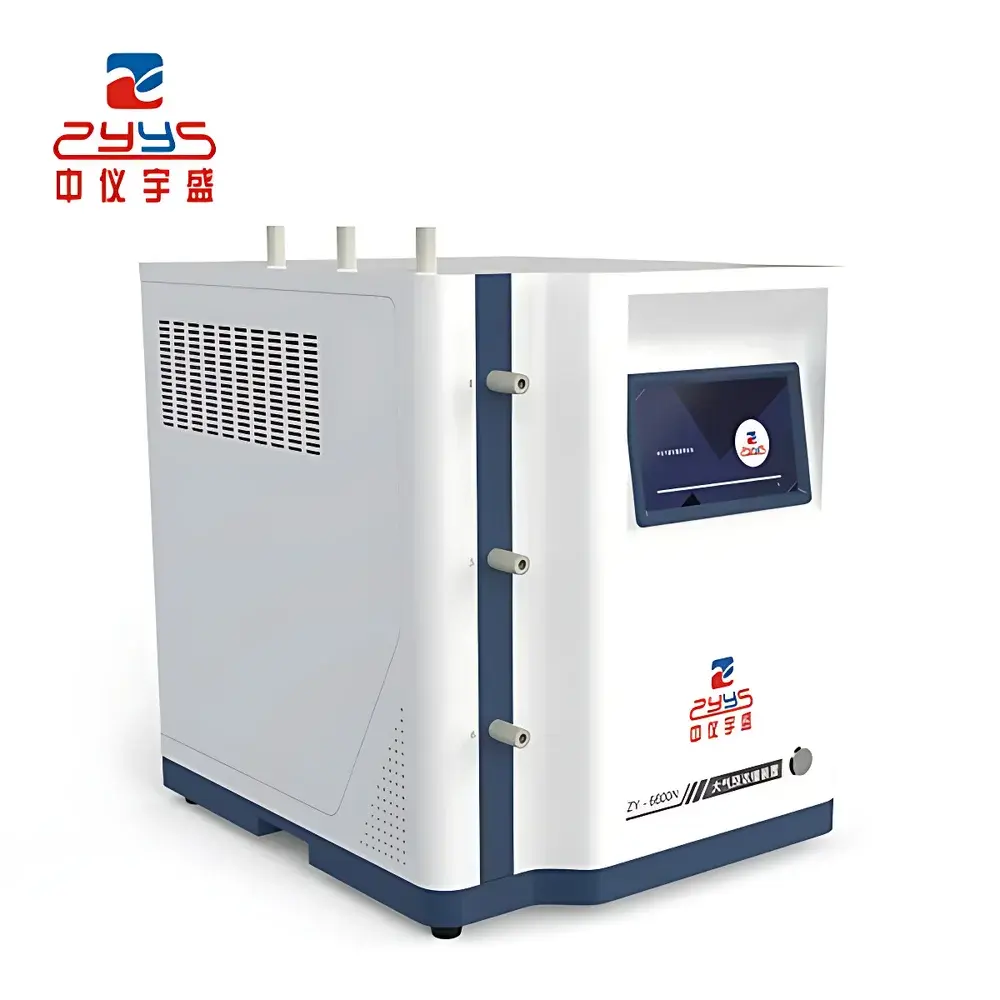
Zhongyi Yusheng ZY-6600N Atmospheric Pre-concentrator
| Brand | Zhongyi Yusheng |
|---|---|
| Origin | Beijing, China |
| Manufacturer | Zhongyi Yusheng Technology Co., Ltd. |
| Model | ZY-6600N |
| Type | Atmospheric Pre-concentrator |
| Sample Interface | Compatible with Tedlar® bags, SUMMA® canisters, and glass sampling bottles |
| Cooling System | Solid-state thermoelectric (Peltier) cryo-trap |
| Control | 7-inch capacitive touchscreen with embedded microprocessor |
| Heating Zones | Three independently controlled zones (desorption chamber, injection valve, transfer line) |
| Automation | Time-programmable adsorption–desorption–injection–bakeout sequence |
| Vacuum Source | Integrated adjustable diaphragm vacuum pump |
| Surface Treatment | SilcoNert®- or Sulfinert®-equivalent deactivation on all wetted surfaces |
| Compliance | Designed to support GB/T 14678–1993 |
| Software Integration | GC trigger output (TTL), external start input, optional RS232/USB for instrument synchronization |
Overview
The Zhongyi Yusheng ZY-6600N Atmospheric Pre-concentrator is a laboratory-grade thermal desorption pre-concentration system engineered for trace-level volatile organic compound (VOC) and reduced sulfur compound (RSC) analysis in ambient air matrices. It operates on the principle of cryogenic trapping followed by rapid thermal desorption, enabling quantitative enrichment of analytes from large-volume air samples (typically 0.1–5 L) prior to introduction into gas chromatography (GC) systems. The instrument is specifically designed to meet the procedural requirements of GB/T 14678–1993 — “Ambient Air Quality — Determination of Hydrogen Sulfide, Methanethiol, Dimethyl Sulfide, and Dimethyl Disulfide” — and supports method development aligned with international frameworks including EPA TO-14A, TO-15, and ISO 16017-1. Its architecture integrates solid-state Peltier cooling, triple-zone independent temperature control, and fully programmable sequence logic to ensure reproducible analyte focusing and minimal breakthrough across diverse sample containers.
Key Features
- Six-position sample carousel accommodating Tedlar® bags, electropolished SUMMA® canisters (6L/1L), and 10–100 mL inert glass sampling vials — eliminating manual repositioning during batch analysis
- Quick-connect, O-ring-sealed sample interfaces with leak-tight integrity verified at ≤1×10⁻⁸ atm·mL/s (He)
- Integrated, continuously variable diaphragm vacuum pump delivering stable flow rates from 50 to 500 mL/min with pressure feedback regulation
- Triple-zone heating system: desorption oven (up to 400 °C), injection valve (up to 300 °C), and transfer line (up to 250 °C), each with ±0.5 °C stability and real-time PID control
- Peltier-based cryo-trap capable of reaching –40 °C within 90 seconds and achieving rapid thermal desorption ramp rates >1000 °C/min
- Automated sequence programming for adsorption, cryo-focusing, thermal desorption, post-desorption bakeout, and carrier-gas reverse purge of all critical flow paths
- 7-inch industrial-grade capacitive touchscreen with localized English UI, onboard method storage (≥100 methods), and event-logged system diagnostics
- Inert flow path: all stainless-steel tubing, valves, and fittings passivated via silanization or equivalent surface deactivation to minimize analyte adsorption and memory effects
- Hardware-level GC synchronization: TTL-compatible trigger outputs and external start inputs enable precise timing coordination with third-party GCs (Agilent, Thermo, Shimadzu, PerkinElmer)
Sample Compatibility & Compliance
The ZY-6600N accepts standard ambient air sampling media without adapter modification: 1–10 L Tedlar® bags (with integrated septum ports), 6 L or 1 L SUMMA®-type electropolished canisters, and 10–100 mL evacuated glass vials fitted with PTFE-lined septa. All internal surfaces contacting sample gas — including trap bed frits, valve rotors, and transfer lines — undergo rigorous inertization per ASTM D6196 Annex A3 protocols. The system supports full auditability for GLP/GMP environments: method parameters, run logs, temperature profiles, and error codes are timestamped and stored locally. While not certified to ISO/IEC 17025 or FDA 21 CFR Part 11 out-of-the-box, its deterministic sequence execution, hardware interlocks, and non-volatile event logging provide foundational traceability required for regulated VOC monitoring workflows.
Software & Data Management
Operation is managed entirely through the embedded microprocessor interface — no external PC required. Method files define trap temperature, desorption ramp profile, valve switching times, bakeout duration, and GC handshake parameters. Each run generates a CSV-formatted log containing start time, zone temperatures, vacuum pressure, trap current draw, and fault flags. Optional USB export enables integration with LIMS or custom post-processing scripts. For laboratories operating under electronic record requirements, the system supports manual export of raw logs for archival; future firmware updates may introduce encrypted audit trails and user-access tiers.
Applications
The ZY-6600N serves as a core front-end for environmental air quality labs performing regulatory monitoring of odorants and toxic VOCs. Primary use cases include: quantification of hydrogen sulfide and low-molecular-weight thiols in landfill/biogas emissions; screening of mercaptans and sulfides in wastewater treatment off-gases; verification of ambient background levels near petrochemical facilities; and method validation studies supporting ISO 16017-1-compliant indoor air assessments. Its compatibility with both bag and canister sampling extends utility to mobile monitoring campaigns and multi-site collaborative studies where container interchangeability is essential.
FAQ
Does the ZY-6600N support unattended overnight operation?
Yes — fully programmable sequences, automatic trap regeneration, and thermal safety cutoffs enable continuous batch processing without operator intervention.
Can it be used with GC-MS systems?
Yes — its fast desorption kinetics, narrow bandwidth injection, and low dead volume interface are optimized for coupling with quadrupole and time-of-flight GC-MS platforms.
Is calibration verification supported?
The system includes dedicated ports for dynamic spiking with certified gas standards; users implement calibration routines per EPA Method TO-15 Section 8.3 guidelines.
What maintenance intervals are recommended?
Peltier modules require no scheduled replacement; vacuum pump diaphragms should be inspected every 6 months or after 500 cycles; trap beds are consumables with typical service life of 200–500 injections depending on matrix cleanliness.
Is remote monitoring possible?
Current firmware supports local USB data dump only; Ethernet or Wi-Fi connectivity is not built-in but may be added via external industrial IoT gateways using Modbus RTU over RS485 (available upon request).



