
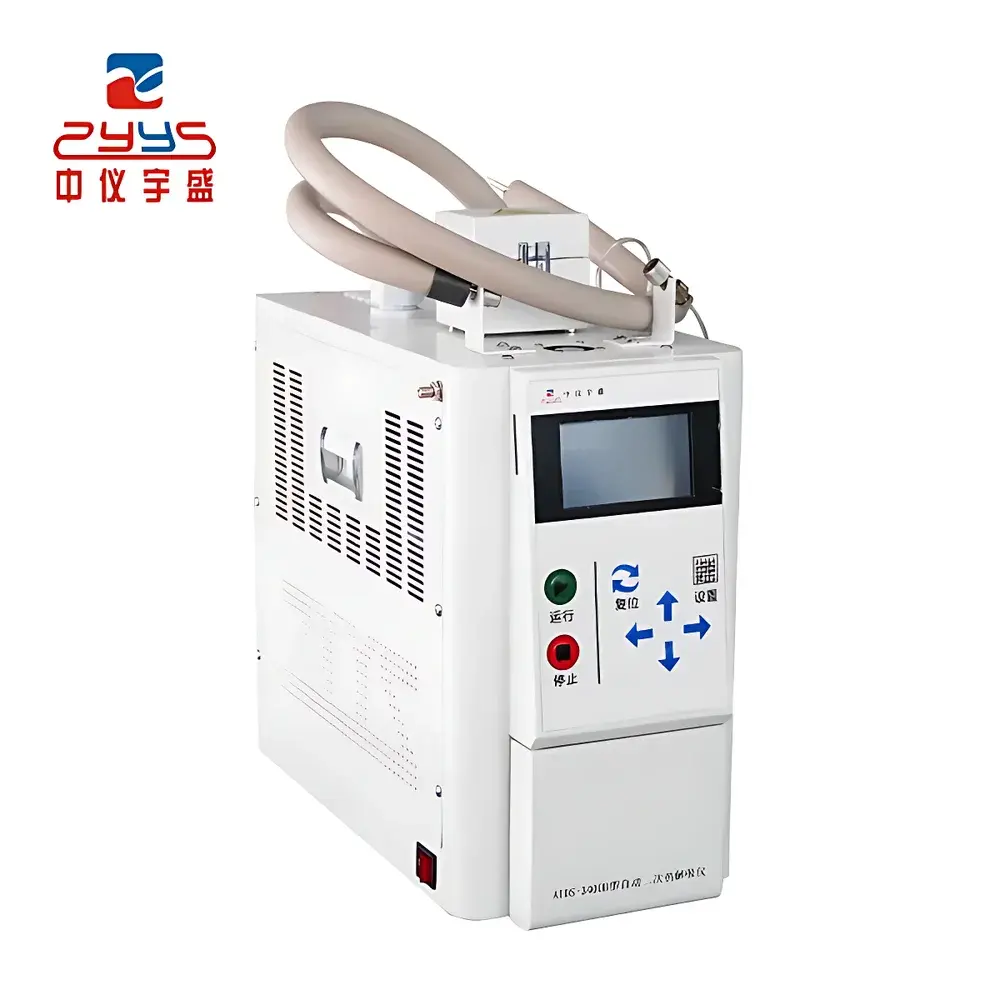
Zhongyi Yusheng ATDS-3400B Automated Two-Stage Thermal Desorber
| Brand | Zhongyi Yusheng |
|---|---|
| Origin | Beijing, China |
| Manufacturer Type | Direct Manufacturer |
| Instrument Type | Two-Stage Thermal Desorber |
| Automation Level | Semi-Automatic |
| Primary Desorption Temperature Range | Ambient to 400 °C |
| Secondary Desorption Temperature Range | Ambient to 400 °C |
| Valve Injection Zone Temperature Range | Ambient to 220 °C (1 °C increments) |
| Transfer Line Temperature Range | Ambient to 260 °C (1 °C increments) |
| Cryo-Focusing Trap Temperature Range | Down to −30 °C |
| Temperature Control Accuracy | ±0.1 °C |
| Analyte Recovery Rate | >98% |
| Sample Position Capacity | 1 |
Overview
The Zhongyi Yusheng ATDS-3400B Automated Two-Stage Thermal Desorber is a semi-automated, benchtop thermal desorption system engineered for high-fidelity quantitative analysis of volatile and semi-volatile organic compounds (VOCs and SVOCs) in air, indoor environments, vehicle cabins, and industrial emission samples. It operates on the principle of two-stage thermal desorption—first releasing analytes from sorbent tubes under controlled heating (primary desorption), followed by cryogenic focusing in a cooled trap and rapid thermal transfer (secondary desorption) directly into the injection port of a gas chromatograph (GC) or GC–MS system. This architecture minimizes band broadening, enhances sensitivity, and ensures reproducible peak shapes essential for compliance with regulatory methods requiring trace-level detection and accurate calibration.
Key Features
- Semi-automated workflow with integrated microprocessor control and intuitive 7-inch color touchscreen interface for method setup, real-time status monitoring, and time-programmed sequence execution.
- Independent four-zone temperature control: primary desorption oven, secondary desorption chamber, valve manifold, and transfer line—each adjustable in 1 °C increments across specified ranges (ambient to 400 °C for desorption zones; ambient to 260 °C for transfer line; down to −30 °C for cryo-trap).
- High-precision temperature regulation (±0.1 °C) across all heated zones, critical for method reproducibility and retention time stability in regulated analyses.
- Integrated cryo-focusing capability using electronic Peltier cooling, enabling sharp, narrow analyte bands prior to GC injection—essential for resolving co-eluting VOCs and achieving sub-ppbv detection limits.
- Automated sequence functions include desorption, carrier gas purge, cold trap focusing, rapid flash desorption, GC trigger synchronization (via TTL or contact closure), and post-run back-flushing of the valve and transfer line to eliminate carryover.
- Onboard calibration support: built-in standard vapor generation mode allows preparation of certified reference mixtures directly on-sorbent tube for linear range verification and working curve generation per ISO 16000-6 and EPA TO-17 protocols.
- Modular design supports optional low-temperature or ambient-temperature secondary desorption configurations, accommodating diverse analyte volatility profiles and method requirements.
- Universal GC interface compatibility: pre-configured hardware adapters and pressure-tight fittings for seamless integration with Agilent, Thermo Fisher, Shimadzu, PerkinElmer, and domestic GC/GC–MS platforms.
Sample Compatibility & Compliance
The ATDS-3400B is validated for use with standard 6 mm OD stainless steel or quartz sorbent tubes (e.g., Tenax TA, Carbopack B/C, Carboxen 1000) and supports both single-tube and multi-tube formats via optional accessories. Its performance aligns with internationally recognized environmental and occupational health standards, including but not limited to: ASTM D6196-22 (selection of sorbents), ISO 16000-6:2011 (indoor air VOC analysis), EPA Method TO-17 (determination of VOCs in air), HJ 644–2013 and HJ 734–2014 (China’s national standards for ambient and stationary source VOC monitoring), GB/T 18883–2002 (indoor air quality), and GB 50325–2020 (civil building indoor pollution control). All temperature ramping, hold times, and gas flow parameters are fully programmable to meet exact method specifications, supporting audit-ready operation in GLP and ISO/IEC 17025 environments.
Software & Data Management
The instrument operates via embedded firmware with no external PC dependency for basic operation. Method files—including temperature profiles, timing sequences, GC trigger logic, and system diagnostics—are stored internally and exportable via USB for archival or cross-platform validation. While native software does not provide full LIMS integration or 21 CFR Part 11-compliant electronic signatures, its deterministic time-based control architecture enables full traceability of run parameters, error logs, and calibration events—facilitating manual audit trails required under GMP-aligned environmental testing workflows. Optional third-party chromatography data systems (CDS) can be synchronized via hardware triggers for coordinated acquisition and reporting.
Applications
- Environmental air monitoring: ambient VOCs, benzene/toluene/ethylbenzene/xylene (BTEX), aldehydes, and halogenated hydrocarbons per HJ 583–2010 and HJ 734–2014.
- Indoor air quality assessment: formaldehyde, terpenes, plasticizers, and fragrance compounds in residential, commercial, and school buildings (GB/T 18883–2002, GB 50325–2020).
- Automotive cabin emissions testing: off-gassing from dashboards, seats, adhesives, and insulation materials (HJ/T 400–2007).
- Industrial hygiene and workplace exposure evaluation: monitoring of solvents, monomers, and process intermediates in manufacturing facilities.
- Method development and validation labs requiring flexible, repeatable thermal desorption conditions for sorbent tube optimization and recovery studies.
FAQ
What sample formats is the ATDS-3400B compatible with?
It accepts standard 6 mm outer diameter stainless steel or quartz sorbent tubes, including single-bed and multi-bed configurations (e.g., Tenax TA + Carbopack B + Carboxen 1000). Custom tube holders are available upon request.
Does the system support full automation for unattended operation?
The ATDS-3400B is semi-automatic: it executes pre-programmed sequences autonomously but requires manual tube loading/unloading due to its single-sample position design. For high-throughput labs, integration with robotic autosamplers is not natively supported.
How is carryover prevented between analyses?
The system performs automated back-flushing of the injection valve and transfer line with inert carrier gas after each run, and includes a dedicated cleaning cycle for the cold trap. Recovery validation data (>98%) confirms minimal memory effects across compound classes.
Can the ATDS-3400B be used with GC–MS systems?
Yes—it delivers sharp, focused analyte pulses compatible with both quadrupole and time-of-flight GC–MS platforms. Synchronization is achieved via TTL pulse output or dry-contact relay, ensuring precise timing of MS acquisition windows.
Is cryogenic trapping mandatory for all applications?
No—the secondary desorption stage can operate at ambient or elevated temperatures depending on analyte volatility. The −30 °C cryo-trap is recommended for C2–C12 VOCs requiring maximum sensitivity and resolution; higher-boiling SVOCs may utilize hot-desorption-only protocols.
Related Products





