
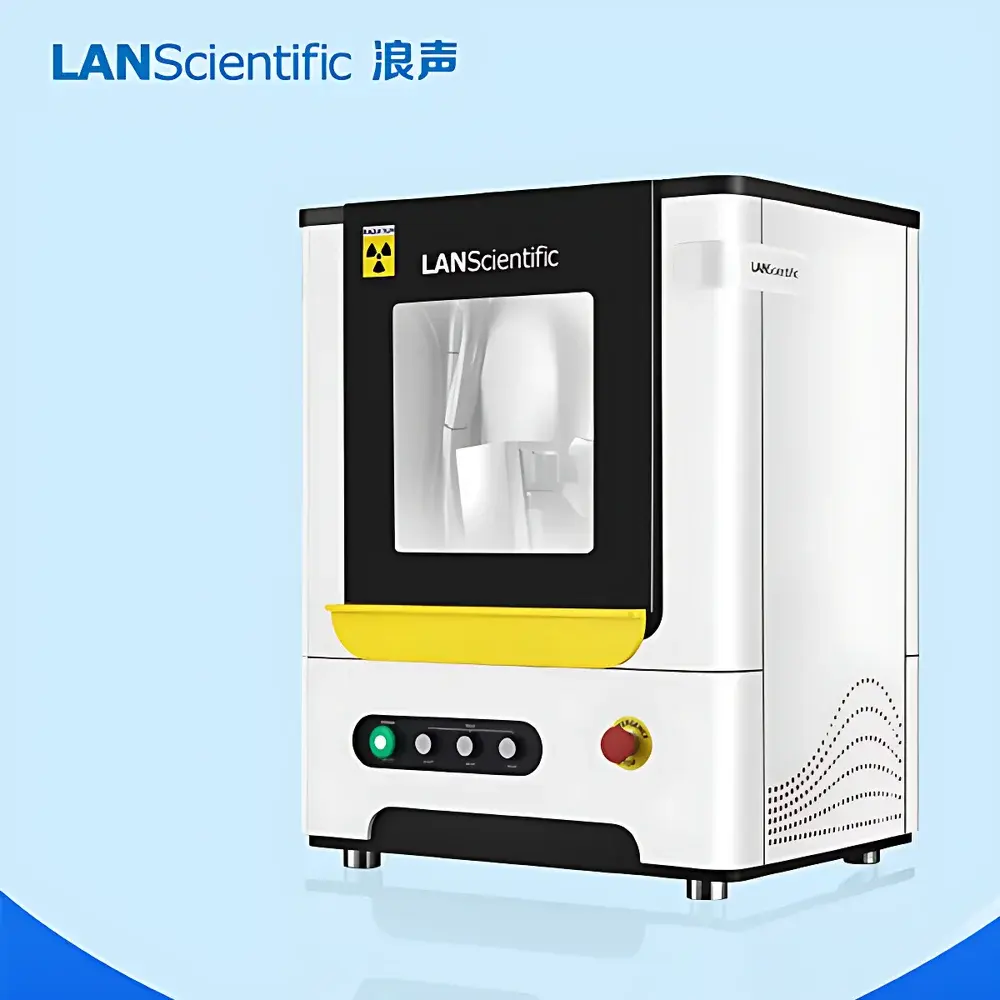
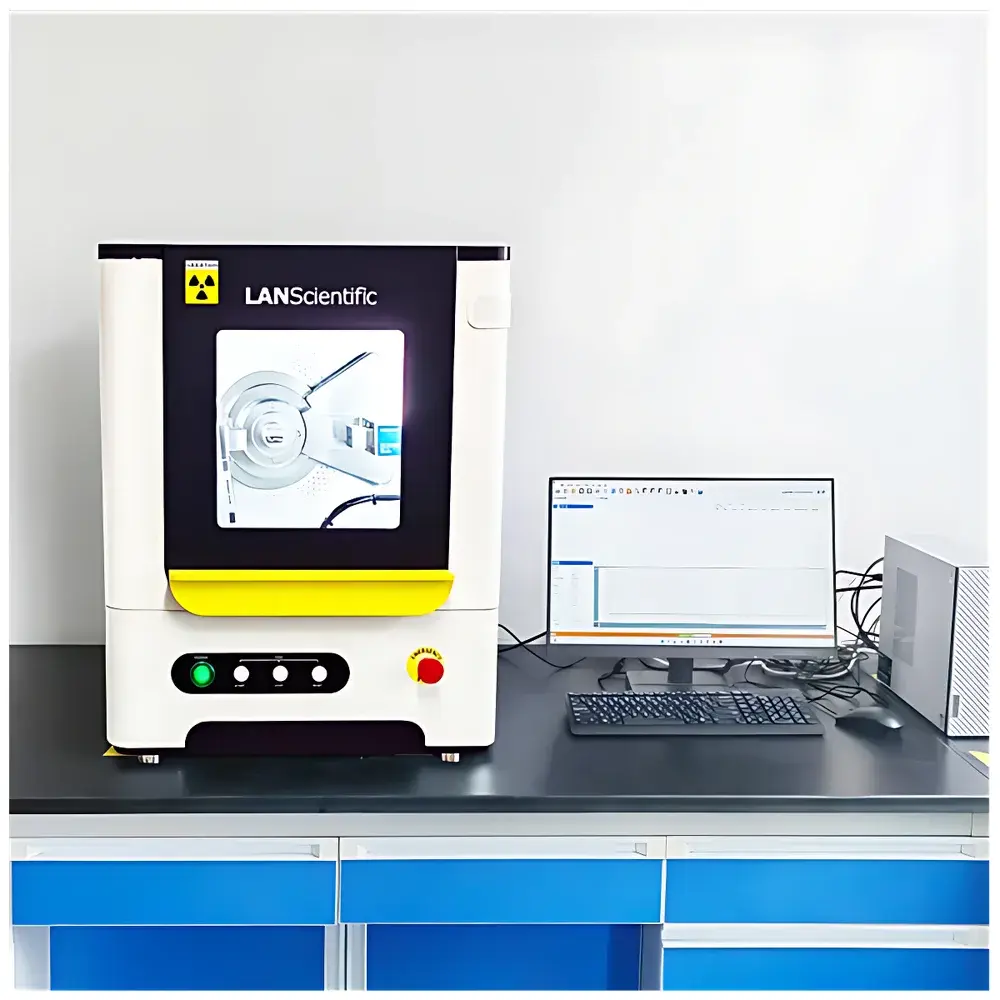
LANScientific FRINGE EV Desktop Powder X-ray Diffractometer
| Brand | LANScientific |
|---|---|
| Origin | Jiangsu, China |
| Manufacturer Type | Original Equipment Manufacturer (OEM) |
| Instrument Type | Powder X-ray Diffractometer |
| Geometry | Bragg-Brentano θ–2θ reflection mode |
| Detector | Digital Pulse Processing Counter (DPPC), ≥1×10⁷ counts per second (CPS) |
| Power | kW-class microfocus X-ray source (exact rating per configuration) |
| Compliance | CE-marked, IEC 61000-6-3/6-4, IEC 62471 (LED/X-ray safety) |
| Sample Handling | Motorized sample stage with integrated Soller collimator, air-spring assisted large-window hinged door |
Overview
The LANScientific FRINGE EV is a benchtop powder X-ray diffractometer engineered for high-fidelity crystallographic analysis in constrained laboratory environments. It operates on the Bragg-Brentano θ–2θ reflection geometry, where monochromatic X-rays—generated by a kW-class microfocus sealed-tube source—impinge upon a stationary or rotating sample mounted at the goniometer center. Diffraction occurs when incident radiation satisfies Bragg’s law (nλ = 2d sinθ), and scattered beams are collected by a high-throughput Digital Pulse Processing Counter (DPPC) detector. Unlike conventional scintillation or gas-proportional detectors, the DPPC simultaneously delivers angular-resolved diffraction intensity data and energy-dispersive spectral information without requiring secondary monochromators, enabling rapid phase identification and elemental correlation. The system’s compact footprint, air-spring-assisted large-window access door, and vibration-damped optical path make it suitable for installation in shared labs, mobile analytical platforms, and quality control suites where space, stability, and operational continuity are critical.
Key Features
- kW-class microfocus X-ray source delivering stable tube output and extended anode lifetime under continuous operation
- Integrated Soller collimator assembly with zero moving parts—eliminating mechanical drift and enhancing long-term angular reproducibility
- DPPC detector with ≥1×10⁷ CPS counting capacity and real-time pulse-height discrimination for simultaneous XRD + EDX data acquisition
- Motorized sample stage supporting flat-plate, capillary, and thin-film configurations; compatible with optional heating/cooling stages (−10 °C to 1000 °C)
- Full interlock safety architecture: dual redundant door sensors, automatic beam shutter activation upon lid opening, and visual/audible chamber status feedback on touchscreen interface
- Benchtop form factor (W × D × H ≈ 650 × 580 × 420 mm) with minimal floor footprint and no external chiller or high-voltage cabinet requirements
Sample Compatibility & Compliance
The FRINGE EV accepts standard powder samples (≥10 mg, particle size < 10 µm), solid slabs (up to 50 mm diameter), and thin films (< 5 µm thickness) without reconfiguration. Its fixed divergence and anti-scatter optics minimize background noise across low-angle (2θ ≥ 3°) and high-resolution (Δ2θ ≤ 0.02° FWHM) scans. The instrument complies with IEC 61010-1 (safety of electrical equipment), IEC 62471 (photobiological safety), and EU Directive 2011/65/EU (RoHS). Data integrity meets GLP/GMP-aligned audit trail requirements via CrystalX software, supporting 21 CFR Part 11-compliant electronic signatures and user-level permission management. All firmware and calibration files are digitally signed and version-controlled.
Software & Data Management
CrystalX is the native analysis suite, built on a modular architecture supporting automated workflow execution—from scan acquisition to Rietveld refinement. Upon completion of a scan, the software performs real-time phase identification against ICDD PDF-4+ (2024 edition) and reports quantitative phase abundances using reference intensity ratio (RIR) or full-pattern fitting methods. Batch processing enables comparative crystallinity index calculation (e.g., % crystalline vs. amorphous content in LiCoO₂ cathodes), lattice parameter refinement, and microstrain analysis via Williamson-Hall or Warren-Averbach deconvolution. Raw data export follows CIF, XYE, and HDF5 standards; metadata embedding includes instrument parameters, environmental logs (temperature/humidity), and operator credentials.
Applications
The FRINGE EV serves as a primary characterization tool for lithium-ion battery material development, including cathode (NMC, LFP, LNMO), anode (graphite, silicon composites), and solid electrolyte (LLZO, LATP) systems. It supports routine QC of batch-to-batch phase purity, detection of parasitic side products (e.g., NiO impurity in Ni-rich NMC), and in-situ/operando studies when coupled with electrochemical cells. Beyond energy materials, it is deployed in pharmaceutical polymorph screening (USP , ISO 13121), mineralogical quantification (ASTM D516, D7348), metallurgical phase mapping (ISO 17873), and semiconductor thin-film stress analysis (ASTM F394). Its portability enables field-deployable analysis in mining exploration labs and construction material testing centers.
FAQ
What X-ray tube voltage and current ranges does the FRINGE EV support?
Standard configuration uses a Cu-target microfocus tube operating at 40–50 kV and 1–2 mA; custom Mo- or Co-source variants available upon request.
Is the DPPC detector capable of energy-dispersive spectroscopy (EDS) without hardware modification?
Yes—the DPPC provides pulse-height-analyzed spectra concurrently with diffraction data, enabling elemental fingerprinting of crystalline phases without adding a separate EDS detector.
Can CrystalX perform Rietveld refinement on multi-phase battery cathode mixtures?
Yes—CrystalX includes GSAS-II integration and supports constrained multi-phase Rietveld modeling with user-defined site occupancy, anisotropic displacement parameters, and microstructural broadening functions.
Does the system meet regulatory requirements for pharmaceutical GMP laboratories?
When deployed with validated CrystalX v3.2+ and documented IQ/OQ/PQ protocols, the FRINGE EV satisfies FDA 21 CFR Part 11, EU Annex 11, and ICH Q5E data integrity expectations.
What maintenance intervals are recommended for the X-ray tube and detector?
Tube lifetime exceeds 10,000 hours under typical usage; DPPC requires no periodic recalibration—only annual verification using NIST-traceable Si SRM 640e reference material.





