
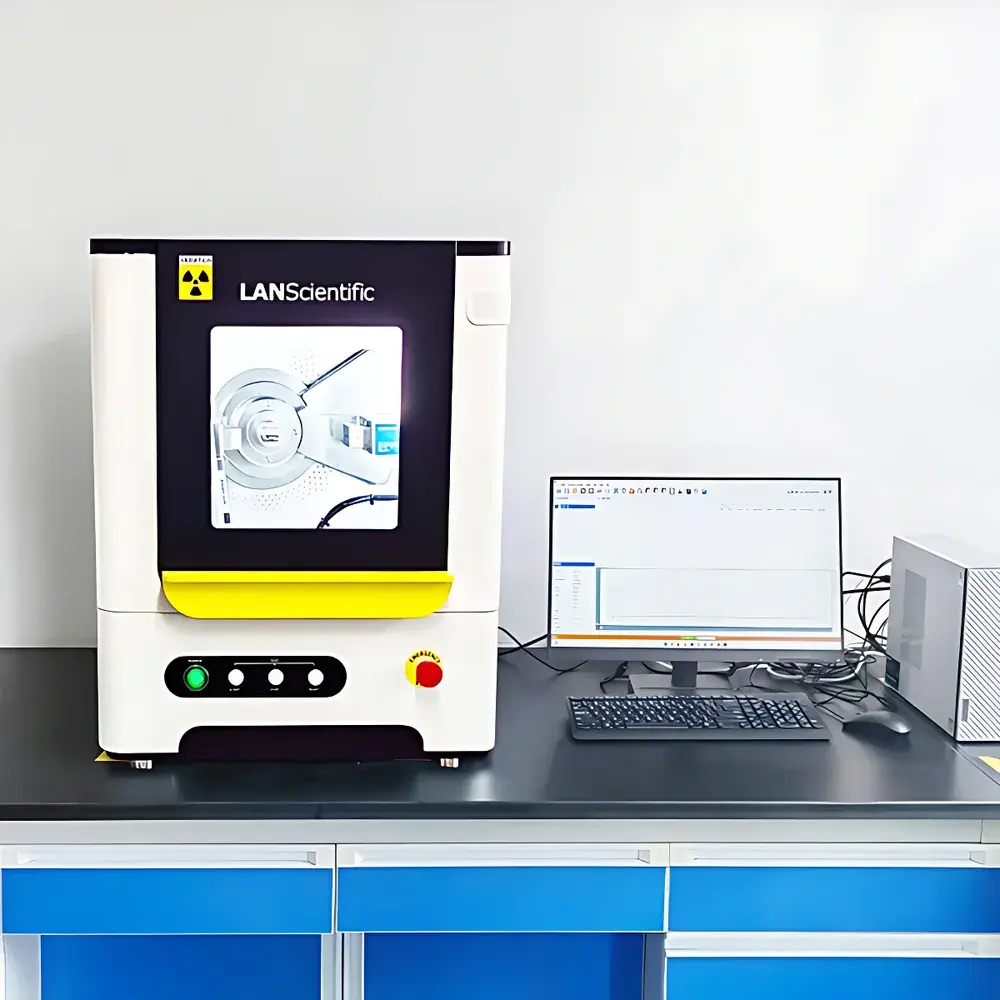
LANScientific FRINGE EV Desktop X-ray Diffractometer for Pharmaceutical Crystallinity Analysis
| Brand | LANScientific |
|---|---|
| Origin | Jiangsu, China |
| Manufacturer Type | Original Equipment Manufacturer (OEM) |
| Instrument Type | Powder X-ray Diffractometer |
| Geometry | Bragg-Brentano θ–2θ reflection mode |
| Power | kW-class microfocus X-ray source (rated output ≥ 1.2 kW) |
| Detector | Digital Pulse Processing Counter (DPPC) with throughput ≥ 1×10⁷ counts per second (CPS) |
| Slit System | Integrated fixed Soller slits (no moving adjustable components) |
| Sample Stage | Motorized goniometer with ±0.001° angular reproducibility |
| Safety | Interlocked full-enclosure sample chamber with real-time door status monitoring and automatic beam shutdown |
| Software | CrystalX™ automated phase identification & quantification suite with Rietveld refinement, crystallinity index calculation, and ASTM E1426-compliant data reporting |
Overview
The LANScientific FRINGE EV is a benchtop powder X-ray diffractometer engineered for high-fidelity crystalline phase characterization in pharmaceutical development and quality control laboratories. Operating on the Bragg-Brentano θ–2θ reflection geometry, it utilizes a kW-class microfocus X-ray source to generate monochromatic Cu Kα radiation (λ = 1.5418 Å), which interacts with crystalline lattices according to Bragg’s law (nλ = 2d sinθ). Diffraction patterns are captured by a high-throughput Digital Pulse Processing Counter (DPPC) detector—eliminating the need for secondary monochromators while simultaneously acquiring energy-dispersive spectral data for elemental verification. Designed for ISO/IEC 17025-compliant environments, the FRINGE EV delivers repeatable angular resolution (< 0.02° FWHM at Si (111)), enabling precise lattice parameter determination, polymorph discrimination, and amorphous content quantification per USP and Ph. Eur. 2.9.32.
Key Features
- kW-class microfocus X-ray tube with stable thermal management—enabling high-intensity diffraction from low-concentration APIs and excipients without beam-induced degradation
- Integrated fixed Soller slits—eliminating mechanical drift and alignment sensitivity; certified for mobile deployment on ISO 17025-accredited field laboratories and vehicle-mounted analytical platforms
- DPPC detector architecture—providing ≥1×10⁷ CPS counting rate, pulse-height discrimination, and simultaneous acquisition of diffraction intensity and energy-dispersive spectra for correlative phase–element analysis
- Full-enclosure interlocked sample chamber—equipped with redundant safety circuits, real-time door position feedback, and automatic beam termination upon lid opening per IEC 61010-1 and FDA 21 CFR Part 11 requirements
- Air-spring assisted large-window lift door—optimized for ergonomic access and minimal desktop footprint (W × D × H: 620 × 580 × 410 mm), compatible with standard laboratory workbenches and cleanroom carts
Sample Compatibility & Compliance
The FRINGE EV accommodates diverse pharmaceutical solid-state forms: free-flowing powders (including micronized APIs), pressed pellets, thin-film coatings on tablets, and intact dosage forms via side-loading geometry. It supports quantitative phase analysis per ASTM E1426 (Standard Test Method for Determining Phase Fractions in Steel Using X-Ray Diffraction), crystallinity assessment aligned with USP (Crystallinity), and polymorphic purity evaluation per ICH Q5A(R2). All hardware and firmware comply with electromagnetic compatibility (EMC) directive 2014/30/EU and low-voltage directive 2014/35/EU. Data audit trails, electronic signatures, and secure user-role permissions in CrystalX™ satisfy FDA 21 CFR Part 11 and EU Annex 11 validation prerequisites.
Software & Data Management
CrystalX™ software provides fully automated workflow execution—from instrument initialization and scan parameter selection to real-time background subtraction, peak search, and ICDD PDF-4+ database matching. Its embedded Rietveld refinement engine supports quantitative phase analysis (QPA) with uncertainty propagation per GUM (JCGM 100:2008). Raw data (.raw, .xye) and processed reports (.pdf, .xlsx) are stored in timestamped, immutable archives with SHA-256 hash verification. The system logs all operator actions, parameter changes, and calibration events in a tamper-evident audit trail compliant with GLP and GMP documentation standards.
Applications
- Pharmaceutical polymorph screening and stability-indicating crystallinity monitoring across accelerated stability studies
- Excipient–API interaction assessment during formulation development
- Batch-to-batch consistency verification of active pharmaceutical ingredients per ICH Q5D
- Residual solvent and hydrate quantification in lyophilized products
- Patent-supporting crystal structure solution and refinement (with optional single-crystal module integration)
- Raw material identity testing (IDT) against pharmacopoeial reference standards
FAQ
Does the FRINGE EV meet regulatory requirements for GMP-compliant pharmaceutical analysis?
Yes—hardware safety systems, software audit trails, electronic signature capability, and calibration traceability align with FDA 21 CFR Part 11, EU Annex 11, and WHO TRS 992 Annex 5.
Can CrystalX™ perform quantitative analysis without user intervention?
Yes—the software executes fully automated phase identification, Rietveld-based quantification, and crystallinity index calculation upon initiation of a measurement sequence.
Is the DPPC detector capable of elemental analysis?
Yes—it acquires energy-dispersive X-ray spectra concurrently with diffraction data, enabling rapid verification of elemental composition alongside phase identification.
What sample preparation methods are validated for pharmaceuticals?
Validated protocols include gentle back-loading of loose powders, zero-pressure capillary mounting, and non-destructive tablet surface scanning using the optional grazing-incidence attachment.
How is angular calibration maintained over time?
The system performs daily self-calibration using NIST-traceable silicon reference (SRM 640e) and stores calibration coefficients with version-controlled metadata in the instrument log.
Related Products






