
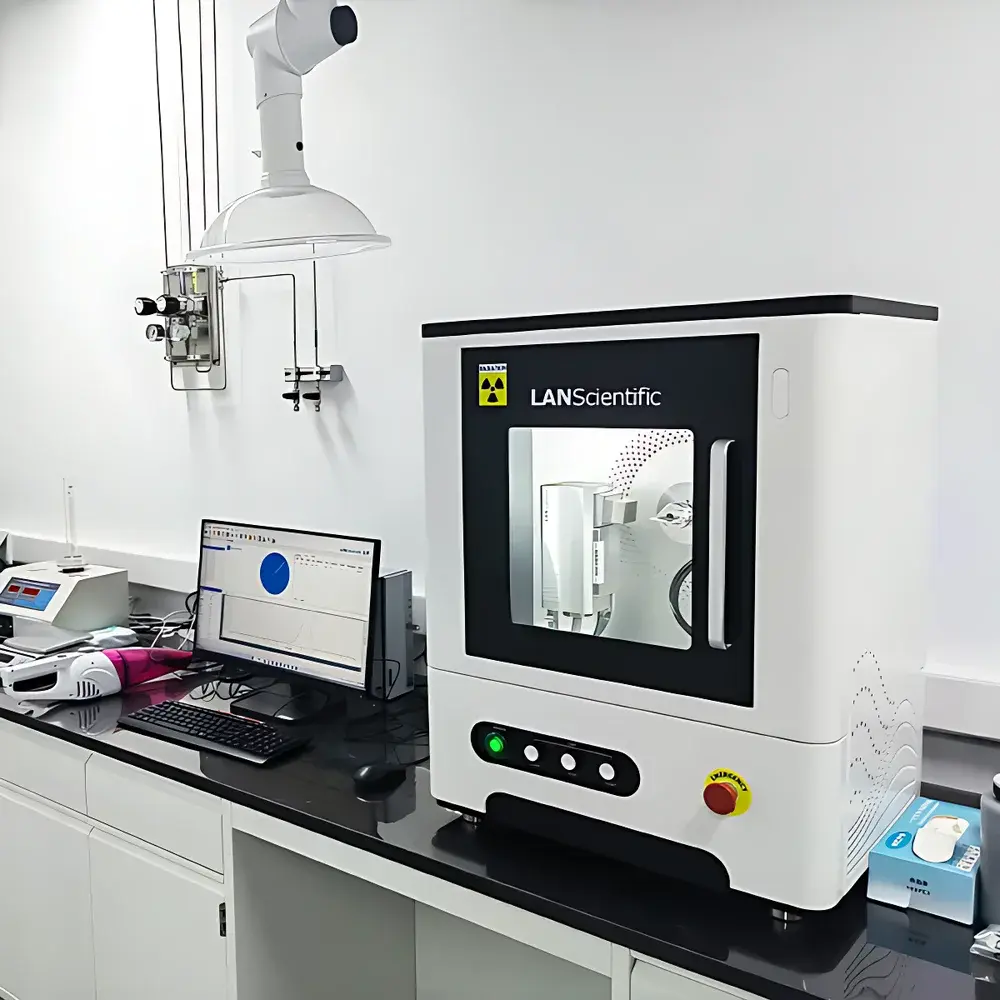
LANScientific FRINGE EV Desktop Powder X-ray Diffractometer
| Brand | LANScientific |
|---|---|
| Origin | Jiangsu, China |
| Manufacturer Type | Manufacturer |
| Product Category | Domestic |
| Model | FRINGE EV |
| Instrument Type | Powder X-ray Diffractometer |
| Power | kW-class (rated for continuous operation in desktop configuration) |
| Detector | Digital Pulse Processing Counter (DPPC), ≥1×10⁷ counts per second (CPS) |
| Geometry | Bragg–Brentano θ–2θ reflection mode |
| Sample Stage | Motorized goniometer with fixed center-of-rotation |
| Slit System | Integrated Soller collimators (no moving adjustment parts) |
| Safety | Interlocked sample chamber with auto-shutdown, door-closed status indicator |
| Software | CrystalX — automated phase identification, quantitative Rietveld refinement, crystallinity index calculation, and EDS-enabled hybrid XRD/EDS data correlation |
Overview
The LANScientific FRINGE EV is a compact, high-performance desktop powder X-ray diffractometer engineered for rigorous materials characterization in research, quality control, and regulatory environments. It operates on the Bragg–Brentano θ–2θ reflection geometry, where monochromatic Cu Kα radiation (λ = 1.5418 Å) is directed onto a stationary or rotating sample stage positioned at the goniometer center. When incident X-rays satisfy Bragg’s law (nλ = 2d sinθ), constructive interference generates diffraction peaks at discrete angular positions, which are resolved by a high-throughput Digital Pulse Processing Counter (DPPC) detector. Unlike conventional scintillation or proportional counters, the DPPC delivers simultaneous XRD pattern acquisition and energy-dispersive spectral (EDS) information—enabling elemental context without requiring secondary monochromators or separate EDS hardware. The system’s kW-class X-ray source ensures sufficient photon flux for rapid data collection across low-absorbing and moderately attenuating matrices—including silicates, oxides, sulfides, carbonates, and alloyed metals—common in geological, metallurgical, and industrial mineral applications.
Key Features
- Compact desktop architecture with air-spring assisted large-window lift door—minimizes footprint while enabling unobstructed sample access and full visual alignment verification.
- Integrated Soller collimator assembly—mechanically fixed, zero-maintenance design enhances long-term angular reproducibility and supports vibration-tolerant deployment, including mobile laboratory platforms.
- DPPC detector with ≥1×10⁷ CPS counting capacity—eliminates pulse pile-up artifacts at high count rates and provides intrinsic energy discrimination for concurrent XRD/EDS fingerprinting.
- Automated safety interlock system—X-ray emission ceases immediately upon chamber door opening; real-time status feedback is displayed on the GUI with audible and visual alerts.
- Rugged goniometer with precision-ground bearings and closed-loop stepper motor control—ensures sub-0.001° angular positioning accuracy and repeatability over extended operational cycles.
Sample Compatibility & Compliance
The FRINGE EV accommodates diverse sample forms: pressed powders (≥10 mg), bulk solids (up to Ø32 mm × 10 mm), thin films (on Si wafers or glass substrates), and irregular mineral fragments mounted in low-background sample holders. Its optical path and detector calibration comply with ISO 17873:2014 (X-ray diffraction — Determination of phase composition) and ASTM E975 (Standard Practice for X-ray Diffraction Analysis of Metals and Alloys). Data acquisition and processing workflows support GLP/GMP traceability requirements, including audit trails, user authentication, electronic signatures, and raw-data immutability—all configurable under FDA 21 CFR Part 11 compliance mode within CrystalX software.
Software & Data Management
CrystalX is a validated, Windows-based analytical suite built on a modular architecture. It integrates real-time data acquisition, automatic peak search, ICDD PDF-4+ database matching (with confidence index scoring), semi-quantitative phase analysis via Reference Intensity Ratio (RIR), and full-pattern Rietveld refinement using GSAS-II or TOPAS engines. The software supports batch processing of multi-sample sequences, crystallinity index calculation (e.g., for clay minerals or polymorphic pharmaceuticals), and export of CIF, XYE, CSV, and XML formats compatible with third-party modeling tools. All processing parameters, instrument logs, and metadata are embedded in each project file, ensuring full FAIR (Findable, Accessible, Interoperable, Reusable) data principles.
Applications
The FRINGE EV serves as a primary analytical tool for mineralogical phase identification in exploration geochemistry, ore processing optimization, and tailings characterization. It enables quantitative monitoring of polymorphic transitions in battery cathode materials (e.g., LiCoO₂ ↔ LiNi₀.₈Co₀.₁₅Al₀.₀₅O₂), crystallinity assessment in cement clinkers and supplementary cementitious materials (SCMs), phase purity verification in catalyst supports (γ-Al₂O₃, zeolites), and residual stress evaluation in sintered metal components. Academic labs use it for teaching crystallography fundamentals, while QC laboratories deploy it for USP and Ph. Eur. 2.9.30-compliant excipient identity testing.
FAQ
Is the FRINGE EV suitable for regulatory submissions in pharmaceutical or construction material testing?
Yes—when operated in 21 CFR Part 11-compliant mode with enabled audit trail, electronic signatures, and secure user roles, its CrystalX-generated reports meet documentation standards for FDA, EMA, and ISO/IEC 17025-accredited laboratories.
Can the DPPC detector distinguish between overlapping diffraction peaks and elemental fluorescence signals?
Yes—the DPPC performs real-time pulse height analysis, allowing separation of characteristic X-ray lines (e.g., Fe Kα vs. Mn Kα) from diffraction events, facilitating hybrid XRD/EDS correlation without hardware reconfiguration.
What maintenance is required for the integrated Soller collimator system?
None—the collimator is permanently aligned and sealed; no user-accessible adjustments or periodic recalibration are necessary, contributing to >99.5% uptime in continuous operation scenarios.
Does the system support external sample changers or environmental stages?
Yes—via optional RS-485 and Ethernet interfaces, the goniometer and detector can be synchronized with robotic autosamplers or temperature-controlled stages (−10 °C to +600 °C) for in situ studies.
How is data integrity ensured during long-duration acquisitions (e.g., time-resolved mineral hydration)?
CrystalX implements cyclic checksum validation, automatic backup to network storage, and timestamped raw frame logging—each scan retains full detector gain, HV bias, and slit configuration metadata for forensic reproducibility.



