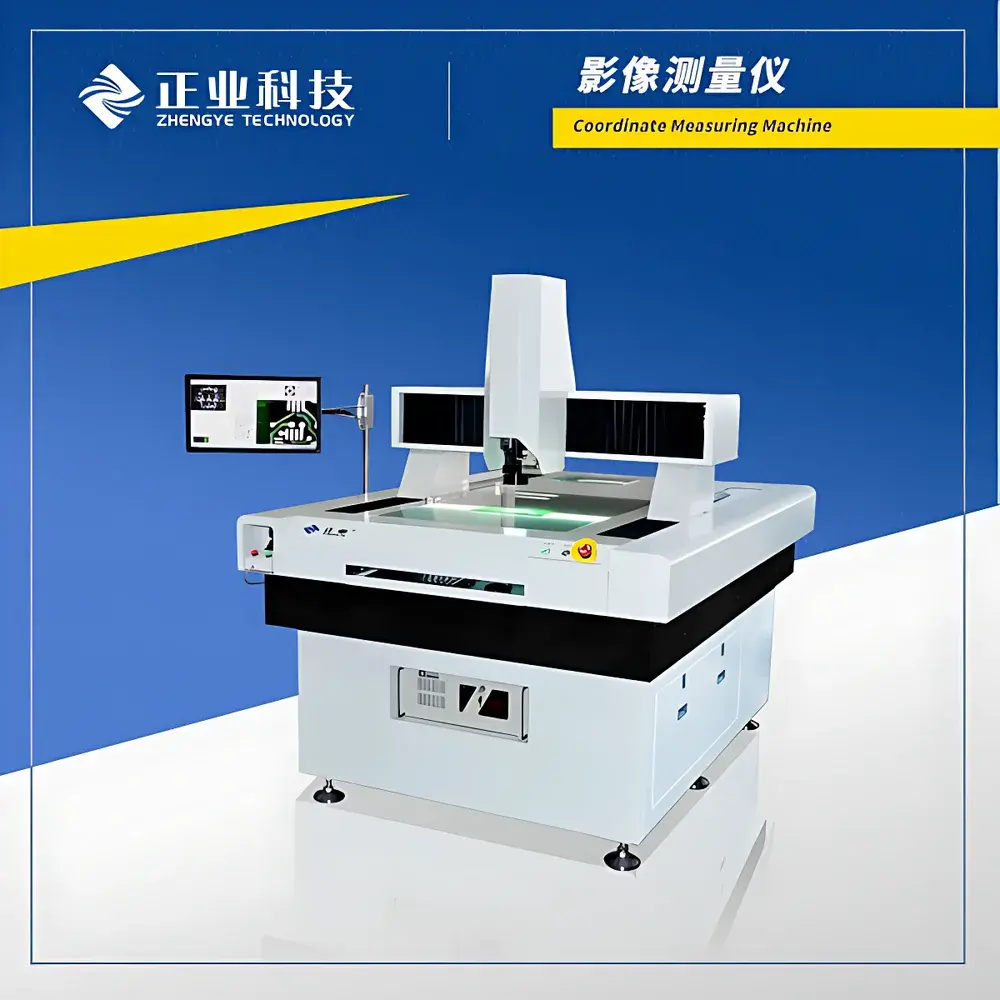
ASIDA 8070 Advanced Image Measuring System
| Brand | ASIDA |
|---|---|
| Model | 8070 |
| Measurement Range (X×Y×Z) | 800 mm × 700 mm × 200 mm |
| Granite Base & Column | Grade-0 Natural Granite |
| Motion System | Air-bearing Guideways (X/Y), Panasonic Servo Motors |
| Optical Magnification | 0.75×–5× Objective + 1× Eyepiece → Total 30×–230× |
| Encoders | ≤0.001 mm Resolution |
| Linear Accuracy | ≤(3 + L/200) µm (L in mm) |
| Repeatability | ≤±0.003 mm |
| Illumination | Ring-type LED Cold Light Source |
| Software | AISDA VMA 3.00.01 (Trilingual: Simplified Chinese, Traditional Chinese, English) |
| Output Formats | DXF, Excel, Word |
| Compliance | Designed for ISO 10360-2 & GB/T 16857.2 compliant geometric metrology workflows |
| Environmental Requirements | 20 ±2 °C, 45–75% RH, Vibration <0.002 g (<15 Hz) |
| Optional Accessories | NAVITAR Metrology Lens, Renishaw TP20 Trigger Probe Kit, KEYENCE LJ-V Series Laser Displacement Sensor |
Overview
The ASIDA 8070 Advanced Image Measuring System is a high-precision, motorized coordinate measuring instrument engineered for non-contact two-dimensional dimensional metrology of mechanical parts, stamped components, PCBs, molds, and precision machined surfaces. Operating on the principle of digital optical imaging and pixel-based edge detection, the system captures high-resolution monochrome or color images via a telecentric optical path and computes geometric features—including points, lines, circles, arcs, rectangles, ellipses, and conic sections—based on sub-pixel interpolation algorithms. With optional tactile probing (e.g., Renishaw TP20), the platform extends to 3D height measurement and surface profile analysis, supporting both contour tracing and step-height evaluation. The system’s rigid Grade-0 natural granite frame, air-bearing guideways, and thermally stable LED illumination collectively ensure long-term metrological integrity under controlled laboratory or QC floor conditions.
Key Features
- Structural stability: Monolithic Grade-0 granite base and column provide exceptional thermal inertia and vibration damping, minimizing drift during extended measurement cycles.
- Precision motion control: X/Y axes employ frictionless air-bearing linear guideways with granite rails; Z-axis uses precision ground ball screws driven by Panasonic servo motors with closed-loop position feedback.
- Optical performance: Telecentric zoom lens (0.75×–5×) paired with 1× eyepiece delivers calibrated total magnification from 30× to 230×; working distance maintained at 82 mm to accommodate tall fixtures and multi-layer assemblies.
- Thermal neutrality: Uniform ring-type cold LED illumination eliminates heat-induced stage expansion and avoids specimen warping—critical for thin metal sheets, polymer films, and ceramic substrates.
- Sub-micron resolution: High-stability glass scale encoders with ≤0.001 mm resolution and real-time interpolation enable traceable length measurements per ISO 10360-2 Annex B protocols.
- Robust software architecture: AISDA VMA 3.00.01 implements NIST-traceable calibration routines, auto-focus algorithms, and GD&T evaluation modules (including true position, concentricity, parallelism, and flatness).
Sample Compatibility & Compliance
The ASIDA 8070 accommodates specimens up to 850 mm × 750 mm on its reinforced optical glass stage (load capacity: 30 kg), making it suitable for large-format PCBs, automotive gaskets, injection-molded housings, and sheet-metal stampings. Its open-stage design permits integration with custom fixturing, vacuum chucks, or temperature-controlled sample holders. All measurement algorithms comply with ISO 1101 (Geometrical Product Specifications), ISO 5459 (Datum Systems), and GB/T 16857.2 (Coordinate Measuring Machines — Acceptance and Reverification Tests). When configured with certified tactile probes and validated calibration artifacts, the system supports GLP/GMP documentation requirements and audit-ready measurement records aligned with FDA 21 CFR Part 11 data integrity principles.
Software & Data Management
AISDA VMA 3.00.01 provides a modular, Windows-based interface supporting trilingual operation (Simplified Chinese, Traditional Chinese, English) without language-dependent UI logic. Core capabilities include batch program generation via teach-mode or CAD-based feature recognition, statistical process control (SPC) charting with Cp/Cpk calculation, and full GD&T reporting per ASME Y14.5–2018. Measurement data exports natively to industry-standard formats: DXF for CAD comparison, Excel (.xlsx) for SPC integration, and Word (.docx) for inspection reports. Audit trails log operator ID, timestamp, calibration status, and software version for each report. The platform supports network deployment across local area networks, enabling centralized calibration management and remote supervision via encrypted RDP sessions.
Applications
- Electronics manufacturing: SMT stencil aperture verification, PCB fiducial alignment, connector pin pitch and coplanarity assessment.
- Automotive supply chain: Gasket hole pattern validation, brake caliper mounting bolt circle diameter (BCD), weld seam width and offset quantification.
- Medical device QA: Catheter hub geometry, syringe barrel wall thickness uniformity, orthopedic implant slot symmetry.
- Tool & die shops: Mold cavity depth profiling, EDM electrode wear analysis, insert location repeatability verification.
- Academic research labs: Microfabricated MEMS structure characterization, thin-film substrate flatness mapping, additive manufacturing part dimensional fidelity assessment.
FAQ
What is the maximum allowable part height for measurement without probe extension?
The standard Z-axis travel is 200 mm with a fixed working distance of 82 mm; parts exceeding 118 mm in height require either stage lowering or optional extended-focus optics.
Does the system support automated edge detection on reflective or low-contrast surfaces?
Yes—VMA 3.00.01 includes adaptive thresholding, multi-scale gradient operators, and user-configurable lighting angle presets (top, coaxial, backlit) to enhance edge contrast for metals, anodized aluminum, and matte plastics.
Can measurement programs be exported and reused across multiple ASIDA units?
Yes—programs are stored as XML-based project files with embedded calibration metadata; cross-unit compatibility requires identical hardware configuration and firmware revision.
Is ISO/IEC 17025 accreditation support available?
While the instrument itself is not accredited, ASIDA provides full technical documentation packages—including uncertainty budgets, MSA studies (Gage R&R), and traceable calibration certificates—for integration into accredited laboratory quality systems.
What maintenance intervals are recommended for long-term accuracy retention?
Annual recalibration of optical magnification and encoder linearity is advised; biannual cleaning of air bearing filters and quarterly verification of environmental chamber stability (temperature/humidity/vibration) are required per ISO 10360-2 Clause 7.3.