
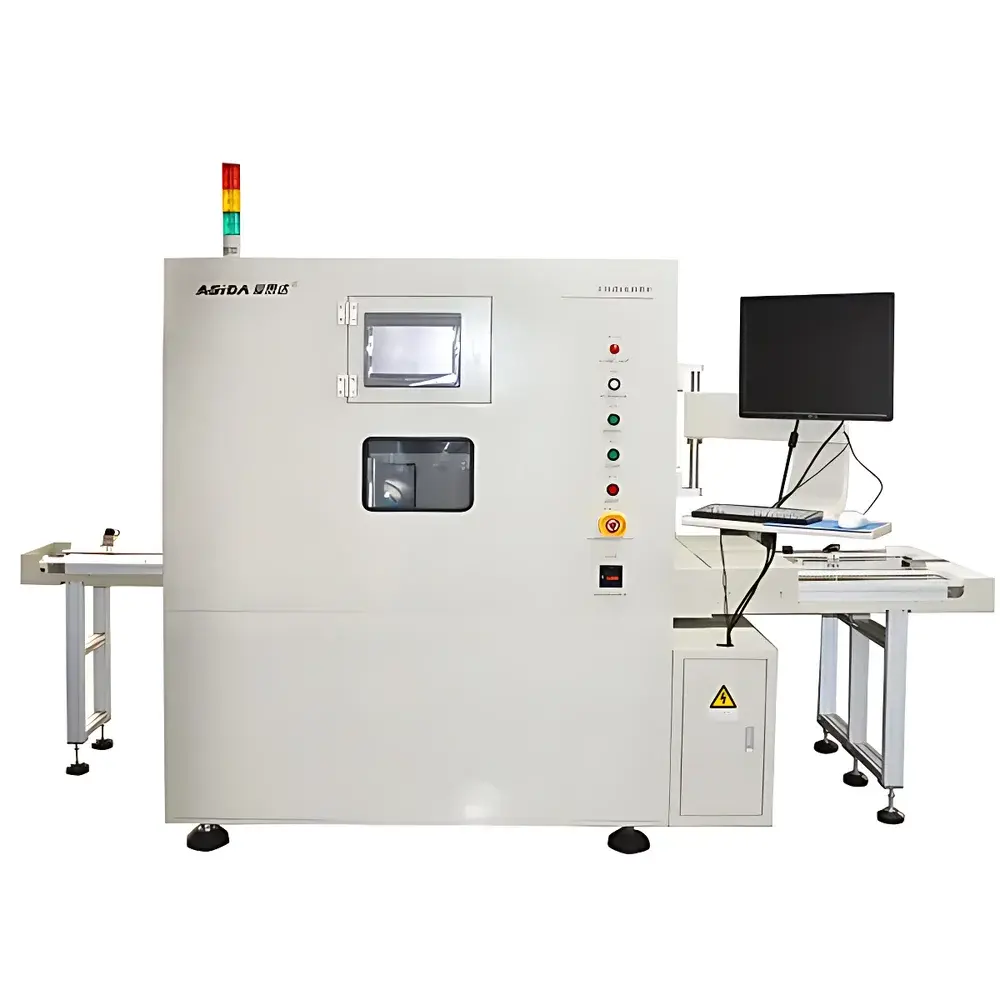
Astroda XG5200D Online Automated X-ray Inspection System for Stacked Lithium-ion Power Batteries
| Brand | Astroda |
|---|---|
| Model | XG5200D |
| X-ray Tube Voltage | Up to 110 kV |
| X-ray Tube Current | Up to 450 µA |
| Focal Spot Size | 5 µm |
| Cooling Method | Forced Air Cooling |
| Image Intensifier Field of View | 4″ / 6″ |
| Spatial Resolution | 80 lp/cm |
| Camera Resolution | 752 × 480 pixels |
| Repeatability Accuracy | ±60 µm |
| Throughput | ≥6 parts per minute (at non-tab corner regions) |
| False Positive Rate | ≤2% |
| False Negative Rate | 0.0% |
| Pass Rate Consistency | ≥99.5% |
| Radiation Leakage | ≤1 µSv/hr (compliant with international radiation safety standards) |
Overview
The Astroda XG5200D is an industrial-grade, online automated X-ray radiographic inspection system engineered specifically for quality assurance of stacked-structure lithium-ion power batteries used in electric vehicles (EVs), energy storage systems (ESS), and high-reliability portable power applications. It operates on the principle of transmission X-ray imaging: a high-stability microfocus X-ray source (up to 110 kV, 450 µA) emits penetrating radiation through the battery assembly; transmitted photons are captured by a high-sensitivity image intensifier (4″/6″ FOV) coupled with a progressive-scan CCD camera (752 × 480 pixels). The resulting digital radiographs are processed in real time using deterministic image analysis algorithms to quantify structural features—including electrode alignment, separator integrity, tab welding consistency, foil wrinkling, foreign object presence, and internal void distribution—enabling objective pass/fail classification per predefined acceptance criteria.
Key Features
- Fully automated inline inspection architecture designed for seamless integration into high-speed battery module assembly lines—equipped with standardized mechanical interfaces (e.g., conveyor belt synchronization, PLC I/O signals, Ethernet/IP support) for bidirectional communication with upstream and downstream stations.
- Real-time multi-point imaging: Simultaneous acquisition and display of radiographic views from multiple critical zones (e.g., top/bottom corners, center stack region, tab junction areas) within a single software interface—supporting side-by-side comparative analysis without manual frame navigation.
- Embedded hardware health monitoring: Continuous logging of X-ray tube voltage/current stability, detector gain drift, thermal sensor readings, interlock status, and motion actuator feedback—visualized via color-coded status indicators and trend graphs in the HMI.
- Triple-layer radiation safety architecture: Interlocked access doors, real-time dose rate monitoring with automatic beam shutdown upon threshold breach, and fully shielded cabinet construction validated to meet IEC 61331-1:2014 and GBZ 138–2022 requirements—surface dose rate consistently maintained at ≤1 µSv/hr under all operational conditions.
- Deterministic defect classification engine: Rule-based measurement logic calibrated against reference standards traceable to NIST-certified phantoms—supports configurable tolerance bands for dimensional metrics (e.g., electrode overhang, gap width, weld penetration depth) and binary decision trees for categorical anomalies (e.g., “foil fold”, “separator shift”, “particle inclusion”).
Sample Compatibility & Compliance
The XG5200D accommodates standard prismatic stacked battery formats ranging from 200 mm × 150 mm × 25 mm to 400 mm × 300 mm × 50 mm, including both dry-room-assembled and pre-sealed pouch variants. It supports dual-mode operation—static high-resolution mode (for R&D validation and FA labs) and dynamic line-speed mode (optimized for production throughput). All image acquisition, processing, and reporting workflows comply with ISO 17025 documentation requirements for testing laboratories. Audit trails—including operator ID, timestamp, raw DICOM image hash, measurement parameter sets, and final disposition—meet FDA 21 CFR Part 11 electronic record integrity mandates when deployed in GMP-regulated environments.
Software & Data Management
The proprietary AstroVision™ inspection suite provides a Windows-based GUI with role-based access control (admin/operator/auditor profiles), configurable recipe management, and integrated statistical process control (SPC) dashboards. Raw radiographs are stored in DICOM 3.0 format with embedded metadata (exposure parameters, geometry calibration coefficients, QA test logs). Measurement data exports to CSV or SQL Server databases; SPC charts (X̄-R, Cpk, Ppk) auto-generate daily summary reports. Software revision history, configuration change logs, and user action records are retained for ≥36 months—fully supporting GLP/GMP audit readiness and root-cause investigation workflows.
Applications
- Final assembly verification of stacked cathode/anode/separator layers prior to module encapsulation.
- Detection of micro-defects invisible to optical or ultrasonic methods—including sub-50 µm metallic particles, localized delamination at current collector interfaces, and subtle misalignment between stacked foils.
- Quantitative validation of thermal compression effects on electrode density uniformity across large-format cells.
- Process capability assessment during new product introduction (NPI), supporting APQP Stage 3 PPAP submissions with statistically valid measurement system analysis (MSA) reports.
- Root-cause analysis support for field failure investigations—correlating radiographic anomaly signatures with electrochemical performance degradation trends.
FAQ
Does the XG5200D support custom defect detection rules for proprietary battery designs?
Yes—AstroVision™ allows users to define geometric measurement zones, set dimensional tolerances, and construct hierarchical logic trees for multi-condition defect classification without code modification.
Can the system be validated for ISO 13485 medical device manufacturing environments?
While primarily deployed in automotive/industrial sectors, its DICOM compliance, full audit trail, and electronic signature capabilities enable adaptation to ISO 13485 QMS requirements with site-specific IQ/OQ/PQ protocols.
What maintenance intervals are recommended for the X-ray tube and imaging chain?
Scheduled preventive maintenance includes quarterly focal spot size verification, biannual detector gain recalibration, and annual full-system dosimetry survey—documented in the included Maintenance Logbook per ISO 9001 clause 7.1.5.



