
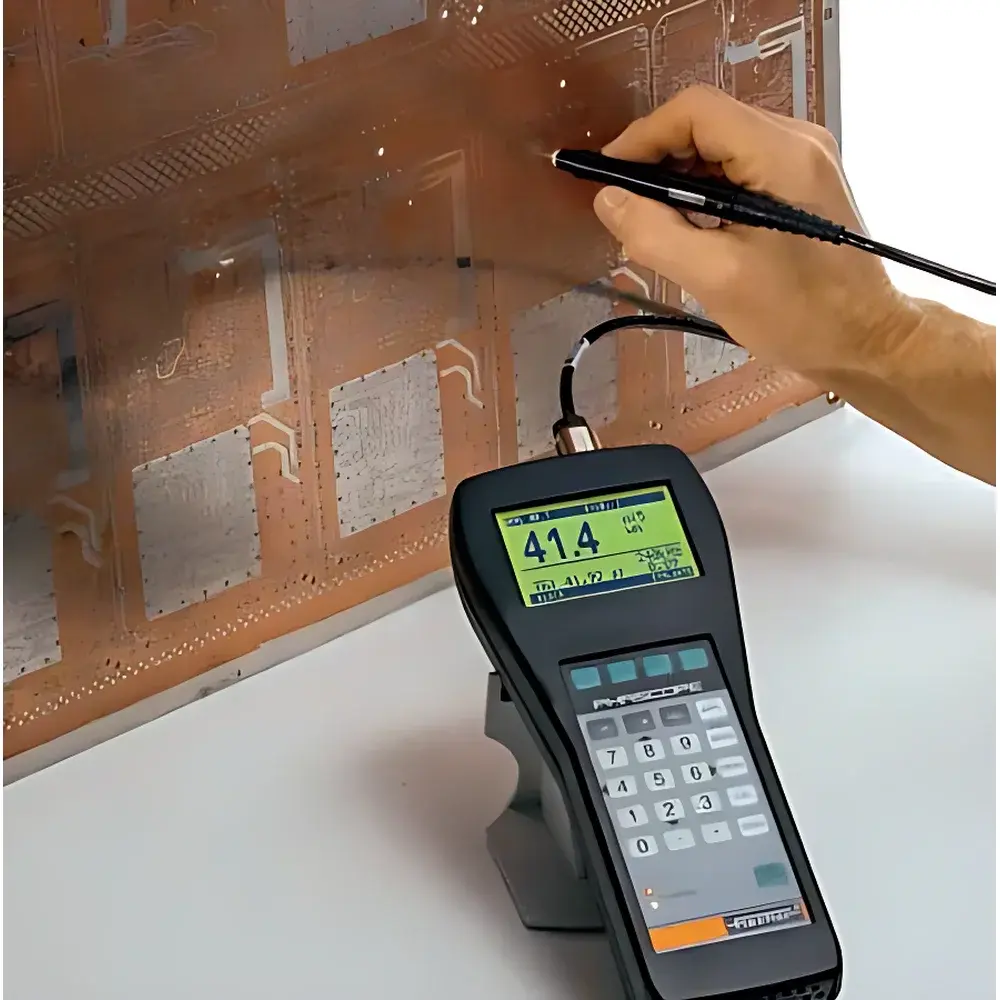
Fischer PHASCOPE PMP10 PCB Copper Thickness Gauge
| Origin | Germany |
|---|---|
| Manufacturer Type | Authorized Distributor |
| Origin Category | Imported |
| Model | Fischer PHASCOPE PMP10 |
| Price | Upon Request |
| Measurement Principle | Phase-Sensitive Eddy Current |
| Compliance | DIN EN ISO 21968 |
| Probe Options | ESD20Cu (60/240 kHz), ESL080 (via-hole Cu), ESD20Ni, ESD20Zn, ESD2.4 |
| Software | FISCHER DataCenter v5.x |
| Data Capacity | 20,000 measurements, 4,000 data sets, 100 application configurations |
| Display Resolution | 3-level precision |
| Operating Modes | Manual, Continuous, External Trigger |
| Analysis Modes | Scientific, Statistical, Limit Check, Analog Simulation |
| Security | Password Protection, Keypad Lock |
| Power Management | Auto-Shutdown |
Overview
The Fischer PHASCOPE PMP10 PCB Copper Thickness Gauge is a handheld, phase-sensitive eddy current thickness measurement system engineered for non-destructive, high-reproducibility quantification of conductive coatings—including copper in plated through-holes (PTHs)—on printed circuit boards and diverse metallic or non-conductive substrates. Unlike optical or destructive cross-sectioning methods, the PMP10 leverages the physical relationship between eddy current phase shift and coating thickness to deliver rapid, contact-based measurements without surface preparation. Its core architecture supports multi-frequency operation (60 kHz and 240 kHz), enabling selective discrimination of copper layers on insulating dielectrics (e.g., FR-4) while minimizing substrate interference—a critical requirement for IPC-6012 and IPC-4552B-compliant PCB quality assurance. The instrument is fully compliant with DIN EN ISO 21968, ensuring traceable, standardized measurement procedures aligned with international metrological practice.
Key Features
- Phase-sensitive eddy current technology optimized for thin, high-conductivity copper layers—especially in narrow-diameter vias (≥0.2 mm) and microvias.
- Dedicated probe ESL080 designed for axial insertion into PCB through-holes, enabling direct wall-thickness measurement of electroplated copper without sectioning.
- Multi-frequency capability (60 kHz / 240 kHz) allows differentiation between bulk copper and interfacial layers (e.g., copper over nickel underplate) on multilayer boards.
- Robust handheld ergonomics with IP54-rated enclosure, suitable for use in production cleanrooms and QC laboratories.
- On-device storage capacity of up to 20,000 individual measurements across 4,000 data groups, each assignable to specific lot, panel ID, or process step.
- Three operational modes: manual single-shot, continuous real-time monitoring, and external trigger synchronization with automated handling systems (e.g., conveyor-linked inspection stations).
- Configurable display modes—including scientific notation, statistical summary (mean, σ, Cp/Cpk), pass/fail limit checking, and analog bar-graph simulation—for immediate operator feedback.
Sample Compatibility & Compliance
The PHASCOPE PMP10 accommodates a broad range of substrate-coating combinations encountered in PCB fabrication and metal finishing. It measures copper thickness on non-conductive bases (FR-4, polyimide, ceramic), as well as zinc, nickel, and aluminum on ferrous and non-ferrous metals—including small parts with complex geometry. Probe ESD2.4 enables high-resolution measurement on areas as small as 2.4 mm²; ESD20Cu and ESD20Ni support frequency-selective analysis for layered systems. All measurement protocols adhere to DIN EN ISO 21968, which specifies calibration traceability, uncertainty evaluation, and environmental conditioning requirements for eddy current gauges. The system supports GLP/GMP documentation workflows via audit-trail-enabled software export and is compatible with FDA 21 CFR Part 11–compliant validation packages when deployed in regulated electronics manufacturing environments.
Software & Data Management
FISCHER DataCenter software (v5.x) serves as the central hub for configuration, data acquisition, statistical analysis, and report generation. It enables bidirectional communication with the PMP10 via USB or Bluetooth, supporting full dataset synchronization, probe calibration management, and user-defined application templates. Statistical functions include histogram plotting, trend charting over time, capability analysis (Cp, Cpk, Pp, Ppk), and SPC control charting (X̄/R, X̄/S). Reports are exportable in PDF, CSV, and XML formats—with configurable headers, company logos, and signature fields—to meet internal QA standards or customer-facing certification requirements (e.g., AS9100, IATF 16949). Audit logs record all configuration changes, calibration events, and user actions—ensuring full data integrity and regulatory readiness.
Applications
- Verification of minimum copper thickness in plated through-holes per IPC-6012 Class 2/3 specifications.
- In-process monitoring of electroplating bath performance during PCB panel plating.
- Final QA release testing for HDI and rigid-flex assemblies prior to solder mask application.
- Root-cause analysis of via failure modes linked to insufficient copper plating uniformity.
- Coating thickness validation on leadframes, connectors, and EMI shielding components.
- Calibration verification of inline XRF or beta-backscatter systems using reference standards.
FAQ
Can the PMP10 measure copper thickness inside blind vias?
No—the ESL080 probe requires axial access to the via; blind vias must be measured post-lamination via cross-sectioning or alternative methods such as FIB-SEM.
Is calibration required before each use?
Daily verification with certified reference standards is recommended; full calibration is performed periodically per ISO/IEC 17025-accredited procedures.
Does the system support automated data upload to MES or SAP QM modules?
Yes—DataCenter supports ODBC connectivity and custom API integration for seamless transfer of measurement records into enterprise quality management systems.
What is the typical measurement uncertainty for 25 µm copper on FR-4?
Under controlled lab conditions (23 °C ±1 °C, RH <60%), expanded uncertainty (k=2) is ≤±0.8 µm, as verified against NIST-traceable foil standards.
Are probe replacements field-serviceable?
Yes—probes are modular and user-swappable; firmware auto-detects probe type and loads corresponding calibration coefficients.



