
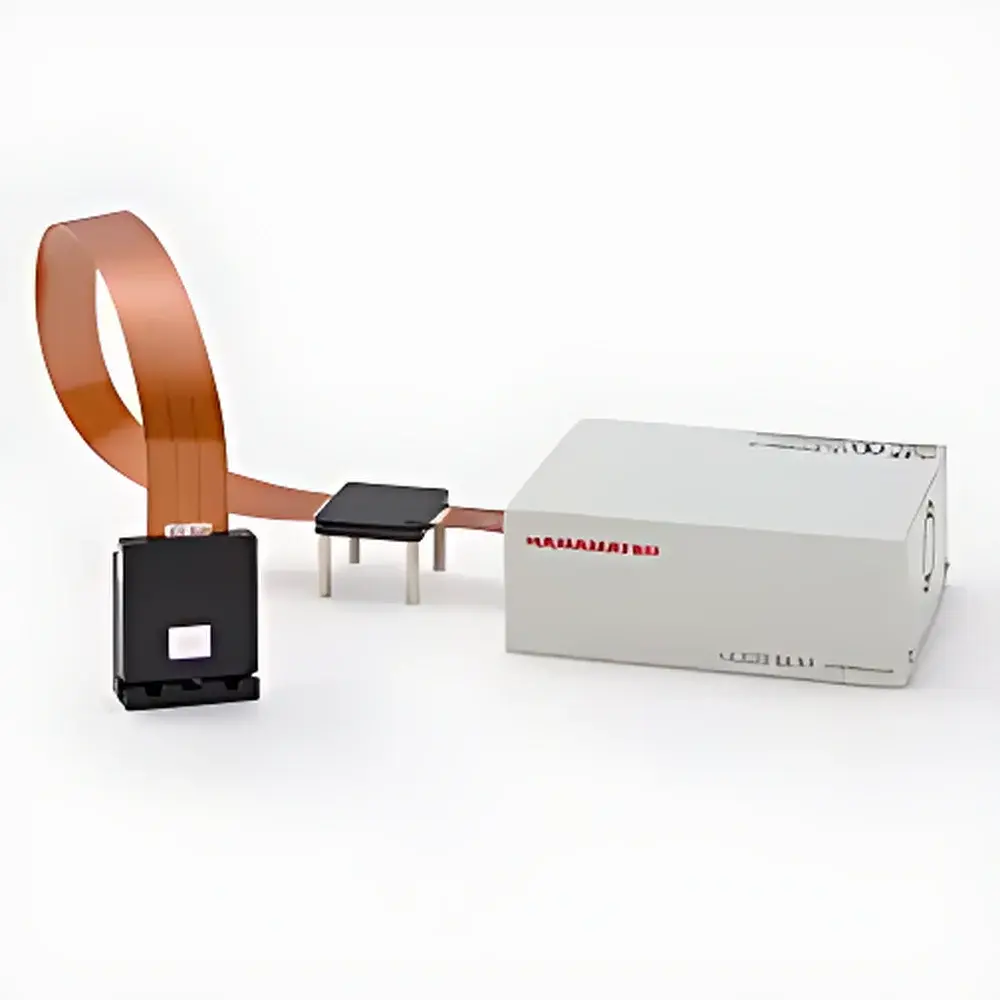
Hamamatsu LCOS-SLM X15213-16R
| Brand | Hamamatsu |
|---|---|
| Origin | Japan |
| Manufacturer Type | Original Equipment Manufacturer (OEM) |
| Import Status | Imported |
| Model | X15213-16R |
| Pricing | Available upon Request |
| Pixel Pitch | 12.5 µm |
| Active Area | 15.9 × 12.8 mm |
| Resolution | 1272 × 1024 pixels (SXGA) |
| Fill Factor | 96% |
| DVI Interface | DVI-D compliant |
| USB Control Interface | USB-B 2.0 High-Speed |
| DVI Frame Rate | 60 Hz |
| Input Gray Levels | 256 (8-bit) |
| Rise Time | 11 ms |
| Fall Time | 34 ms |
| Operating Wavelength Range | 510 ± 50 nm |
| Optical Efficiency (at λ = 532 nm) | 97% |
| Maximum Spatial Frequency | 40 lp/mm |
| Modulation Type | Reflective, Pure-Phase |
Overview
The Hamamatsu LCOS-SLM X15213-16R is a high-performance reflective liquid crystal on silicon (LCoS) spatial light modulator engineered for precision wavefront control in advanced optical systems. Operating within the visible spectrum—specifically optimized for wavelengths centered at 532 nm (±50 nm bandwidth)—this device implements pure-phase modulation via voltage-driven nematic liquid crystal alignment on a monolithic silicon backplane. Unlike transmissive SLMs or segmented deformable mirrors, the X15213-16R achieves diffraction-limited phase fidelity through continuous, analog pixel-level control across its full 1272 × 1024 active array. Its design prioritizes optical throughput and minimal parasitic amplitude modulation, enabling applications where high diffraction efficiency (>90% typical), low speckle noise, and stable phase linearity are critical—such as adaptive optics, holographic beam shaping, optical trapping, and ultrafast pulse front manipulation.
Key Features
- Pure-phase modulation architecture: Engineered to suppress unintended amplitude modulation (<0.5% RMS deviation under calibrated conditions), ensuring high-fidelity wavefront synthesis.
- High optical efficiency: 97% measured utilization at 532 nm—achieved through anti-reflection coatings, optimized LC layer thickness, and >96% pixel fill factor minimizing inter-pixel diffraction artifacts.
- Robust high-power compatibility: Designed for continuous-wave and pulsed laser operation up to 5 W/cm² average irradiance (510–560 nm), with thermally stable silicon substrate and low-absorption LC formulation.
- DVI-native interface: Seamless integration with standard laboratory PCs via DVI-D output; no proprietary frame grabbers or GPU drivers required—enables plug-and-play deployment in real-time optical feedback loops.
- Real-time phase calibration support: Onboard correction algorithms compensate for pixel-to-pixel nonlinearity, LC hysteresis, and static wavefront aberrations induced by the silicon substrate, delivering <±0.02π phase error across full dynamic range.
- Low temporal latency: 11 ms rise time and 34 ms fall time ensure stable phase settling within two video frames at 60 Hz refresh rate—critical for closed-loop adaptive optics and dynamic holography.
Sample Compatibility & Compliance
The X15213-16R is compatible with collimated free-space illumination over its full 15.9 × 12.8 mm active aperture. It supports incident angles from −15° to +15° (relative to surface normal) without measurable degradation in phase uniformity or diffraction efficiency. The device complies with IEC 61000-6-3 (EMC emission standards) and IEC 61000-6-2 (immunity requirements) for laboratory instrumentation. While not certified for medical or aerospace use out-of-the-box, its hardware architecture meets baseline requirements for integration into ISO/IEC 17025-accredited optical metrology setups. Firmware and host software support audit trails for GLP/GMP-aligned workflows when used with validated PC control environments (e.g., Windows 10 LTSB with deterministic timing extensions).
Software & Data Management
Hamamatsu provides the SLM Controller Software Suite (v3.2+), a Windows-based application supporting DVI signal generation, phase map import (TIFF, BMP, binary), and real-time parameter adjustment—including gamma correction tables, spatial filtering masks, and multi-zone phase offset mapping. The USB-B 2.0 interface enables bidirectional communication for firmware updates, status monitoring (temperature, sync lock, error flags), and external trigger synchronization (TTL input/output). API libraries (C++, Python 3.7+, MATLAB R2020b+) allow integration into custom LabVIEW, Python-based automation frameworks, or MATLAB-based iterative hologram optimization pipelines. All phase data exports adhere to IEEE 1596-compliant metadata tagging for traceability in regulated research environments.
Applications
- Dynamic holographic optical tweezers for multi-particle manipulation in biophysics
- Wavefront correction in confocal and multiphoton microscopy systems
- Programmable diffractive optical elements (DOEs) for structured illumination and beam splitting
- Ultrafast pulse shaping via spectral phase modulation in Ti:sapphire amplifier chains
- Calibration reference for Shack–Hartmann sensor arrays and interferometric wavefront sensors
- Optical encryption and information encoding using complex amplitude modulation schemes
FAQ
Is the X15213-16R suitable for ultraviolet or infrared wavelengths?
No—the device is optimized for 510–560 nm operation. UV exposure degrades LC alignment layers; IR wavelengths induce thermal loading beyond the specified absorption profile.
Can multiple X15213-16R units be synchronized?
Yes—via external TTL trigger input and frame-sync output signals; sub-millisecond inter-unit jitter is achievable with proper cabling and clock distribution.
Does the unit require temperature stabilization?
Ambient operation between 15–30°C is sufficient for ≤0.05π phase drift/hour; for long-duration experiments (>8 h), active cooling of the rear heatsink is recommended.
What is the warranty and service coverage?
Hamamatsu offers a 24-month limited warranty covering material and workmanship defects; extended calibration services are available through authorized regional service centers.
Is FDA 21 CFR Part 11 compliance supported?
The hardware itself does not include electronic signature or audit trail features—but when integrated with validated third-party control software meeting Part 11 requirements, full compliance is attainable in regulated pharmaceutical or clinical optics applications.



