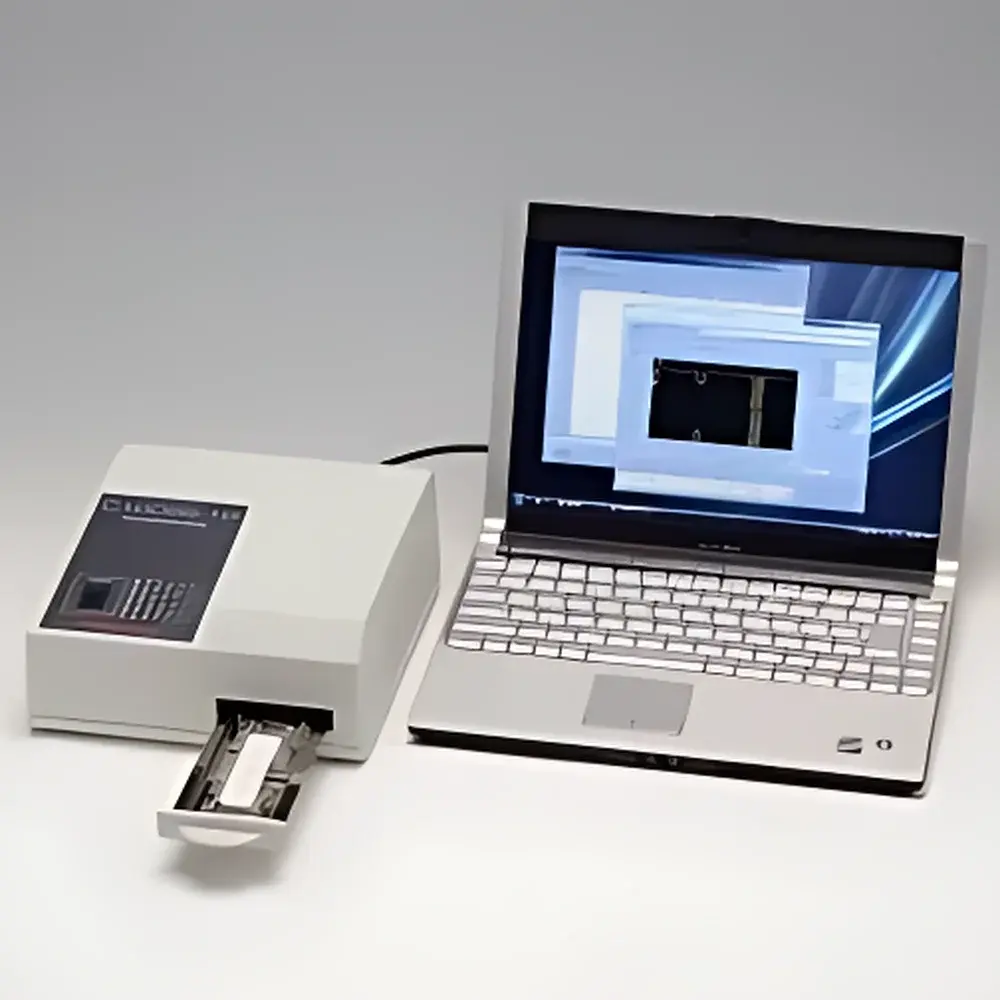
Hamamatsu C10066-10 Absorbance-Based Immunochromatographic Reader
| Brand | Hamamatsu |
|---|---|
| Origin | Japan |
| Manufacturer Type | Original Equipment Manufacturer (OEM) |
| Product Origin | Imported |
| Model | C10066-10 |
| Pricing | Upon Request |
Overview
The Hamamatsu C10066-10 Absorbance-Based Immunochromatographic Reader is a dedicated optical detection instrument engineered for quantitative analysis of lateral flow immunoassays (LFIA). It operates on the principle of visible-light absorbance measurement—specifically optimized for red and blue chromogenic labels commonly used in colloidal gold, dye-conjugated, or polymer nanoparticle–based test lines. Unlike qualitative visual interpretation, the C10066-10 delivers objective, digitized signal intensity values (absorbance units) across defined test and control line regions, enabling precise quantification of analyte concentration via calibration curves. Its optical architecture integrates a stable LED light source, precision-aligned imaging optics, and a high-sensitivity linear CCD sensor with fixed spectral response in the 450–700 nm range—ensuring reproducible measurements independent of ambient lighting or operator subjectivity. Designed for benchtop deployment in regulated R&D laboratories, it supports method development, assay validation, and early-stage diagnostic kit characterization under controlled environmental conditions.
Key Features
- High-precision absorbance quantification of red- and blue-dominant immunochromatographic test lines, with linearity maintained across clinically relevant signal ranges
- Integrated linear CCD sensor with uniform pixel response and low dark-current noise, ensuring consistent signal-to-noise ratio across repeated measurements
- Fixed-wavelength illumination system optimized for common conjugate absorption maxima (e.g., ~520 nm for colloidal gold, ~630 nm for red dyes)
- Automated region-of-interest (ROI) detection for test and control lines, minimizing user-dependent positioning errors
- Direct CSV output format compatible with Microsoft Excel, LibreOffice Calc, and statistical analysis platforms (e.g., GraphPad Prism, R)
- Compact benchtop footprint (W × D × H: 180 × 220 × 120 mm) with no moving parts—designed for long-term stability and minimal maintenance
- Calibration traceability supported via optional reference strips with certified optical density values
Sample Compatibility & Compliance
The C10066-10 is validated for use with standard nitrocellulose-based lateral flow strips (width: 3–5 mm; length: ≤100 mm), including those incorporating colloidal gold, carbon nanoparticles, latex beads, or organic dyes. It accommodates both single- and dual-line formats (test + control), with automatic baseline correction to compensate for strip background heterogeneity. While not intended for in vitro diagnostic (IVD) use without additional validation, the instrument supports assay development workflows aligned with ISO 13485 design controls and CLSI EP17-A2 guidelines for limit-of-detection studies. Data export functionality enables integration into GLP-compliant documentation systems; audit trails and electronic signatures require external LIMS or ELN configuration.
Software & Data Management
The device operates via embedded firmware—no host PC required for basic acquisition. Measurement data (absorbance values per line, timestamp, operator ID field) are exported as plain-text CSV files with UTF-8 encoding and comma delimiters. Each file includes metadata headers specifying instrument model, firmware version, measurement date/time (ISO 8601), and user-defined sample IDs. No proprietary software installation is needed; raw outputs are directly importable into spreadsheet applications for calibration curve fitting (linear, 4PL, or 5PL regression), time-series plotting, and statistical summary (mean, SD, CV%). For enterprise environments, CSV ingestion pipelines can be configured to feed results into validated laboratory information management systems (LIMS) compliant with FDA 21 CFR Part 11 requirements—provided appropriate access controls and electronic record retention policies are implemented externally.
Applications
- Quantitative optimization of antibody-antigen binding kinetics during LFIA reagent development
- Batch-to-batch consistency testing of conjugate performance and membrane lot qualification
- Stability assessment of rapid test kits under accelerated aging conditions (e.g., 40°C/75% RH)
- Limit-of-detection (LoD) and limit-of-quantitation (LoQ) determination per ICH Q2(R2) principles
- Reference method support for comparative studies against ELISA or chemiluminescence platforms
- Training and standardization of visual reading protocols using objective intensity benchmarks
FAQ
Does the C10066-10 support fluorescence-based lateral flow assays?
No. The C10066-10 is strictly an absorbance reader optimized for visible-light chromophores. Fluorescent labels require excitation sources and emission-filtered detection, which are outside its optical design scope.
Can measurement data be exported in XML or PDF format?
No. Export is limited to CSV only. Conversion to other formats must be performed externally using compatible software tools.
Is the instrument suitable for GMP manufacturing environments?
It may be deployed in GMP settings for R&D or process support, but formal qualification (IQ/OQ/PQ) must be performed by the end user per their internal validation protocols. Hamamatsu provides technical specifications and calibration guidance—not regulatory certification.
What is the recommended recalibration frequency?
Hamamatsu recommends annual verification using traceable optical density standards. More frequent checks are advised if used in high-throughput or temperature-variable lab environments.
Are firmware updates available?
Yes—firmware revisions are distributed via Hamamatsu’s secure customer portal upon registration and are installed via USB memory device.