
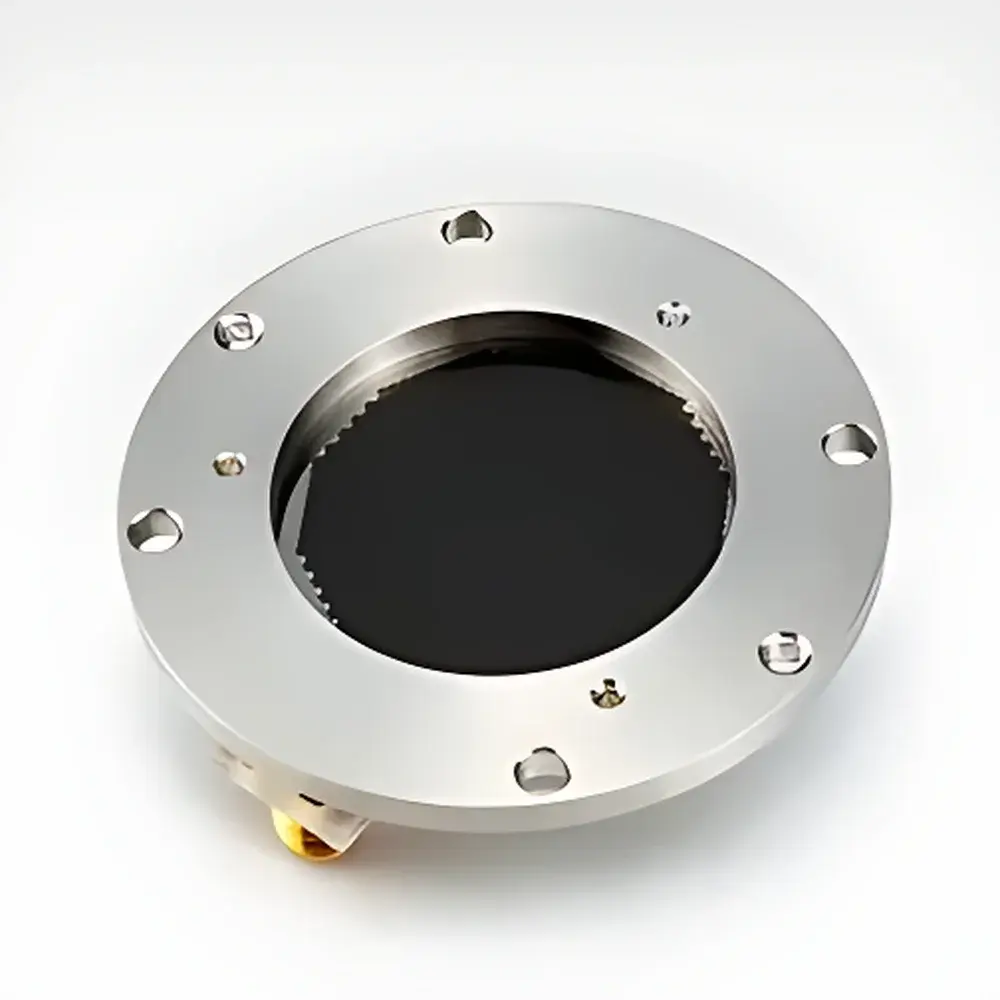
Hamamatsu Microchannel Plate (MCP) F13446-11
| Brand | Hamamatsu |
|---|---|
| Origin | Japan |
| Manufacturer Type | Original Equipment Manufacturer (OEM) |
| Import Status | Imported |
| Model | F13446-11 |
| Voltage Range | −5 kV to +5 kV |
| Geometry | Circular, Removable |
| MCP Stages | Dual-stage (2-stage) |
| Outer Diameter | 50 mm |
| Active Area Diameter | 27 mm |
| Fast Time Response | Yes |
| Open Area Ratio (OAR) | Standard (optional funnel-type large-OAR variant available) |
Overview
The Hamamatsu Microchannel Plate (MCP) F13446-11 is a high-performance, dual-stage electron multiplier engineered for time-critical detection in time-of-flight (TOF) mass spectrometry systems. Based on Hamamatsu’s proprietary lead-glass microchannel technology, this MCP operates under high-voltage bias (−5 kV to +5 kV), enabling flexible configuration for both positive ion, negative ion, and electron detection modes. Its optimized channel geometry and low-resistivity bulk material deliver sub-nanosecond temporal response and minimal time jitter—critical parameters for high-resolution TOF-MS where mass accuracy and peak fidelity depend directly on signal arrival timing reproducibility. The F13446-11 is designed as a drop-in replacement or integration component for OEM instrument builders and research-grade TOF platforms requiring stable, low-noise gain with long-term operational consistency.
Key Features
- Dual-stage (2-stage) MCP architecture for enhanced gain stability and reduced ion feedback compared to single-stage configurations
- Circular, removable mechanical design with 50 mm outer diameter and 27 mm active detection area—compatible with standard vacuum flange mounts (e.g., CF-35/CF-50)
- High-voltage operability from −5 kV to +5 kV, supporting polarity-switchable detection schemes without hardware modification
- Engineered for ultra-low time jitter (< 100 ps FWHM typical under optimal biasing), essential for sub-picosecond time resolution in reflectron and orthogonal acceleration TOF systems
- Robust glass substrate and sealed edge construction ensure mechanical integrity and resistance to outgassing in UHV environments (≤1 × 10⁻⁹ mbar)
- Optional large open-area-ratio (OAR) funnel-type MCP variants available for applications demanding higher quantum detection efficiency (QDE) at low-energy particle incidence
Sample Compatibility & Compliance
The F13446-11 is compatible with pulsed ion sources (e.g., laser desorption, MALDI, laser ablation) and continuous-beam configurations when paired with appropriate gating electronics. It supports detection of ions across a broad mass range (m/z 1–10,000+) and electrons with kinetic energies ≥1 eV. As a component-level device, it complies with ISO 9001 manufacturing controls and meets RoHS Directive 2011/65/EU requirements. While not a standalone instrument, its integration into final TOF-MS systems may support compliance with IEC 61000-6-3 (EMC emission standards) and ASTM E2588–22 (standard practice for calibration of time-of-flight mass spectrometers), contingent upon full-system validation per GLP/GMP or ISO/IEC 17025 protocols.
Software & Data Management
As a passive detector component, the F13446-11 does not include embedded firmware or onboard software. Its performance is managed via external high-voltage power supplies (e.g., Stanford Research Systems PS350 or equivalent) and synchronized with time-to-digital converters (TDCs) or fast digitizers (≥1 GS/s sampling rate). Signal output is analog pulse train compatible with standard NIM/TTL timing interfaces. When integrated into validated analytical platforms, raw pulse data can be logged with audit-trail-capable acquisition software compliant with FDA 21 CFR Part 11 (e.g., Thermo Fisher Xcalibur v3.0+, Waters MassLynx v4.2+), provided system-level electronic signatures, user access control, and data integrity safeguards are implemented by the host instrument manufacturer.
Applications
- Time-of-flight mass spectrometry (TOF-MS), especially orthogonal acceleration (oa-TOF) and reflectron-based instruments
- Secondary ion mass spectrometry (SIMS) for surface imaging and depth profiling
- Ultrafast electron spectroscopy and photoelectron time-of-flight (PETOF) setups
- Neutron detection via boron- or lithium-coated conversion layers coupled to MCP stacks
- Spaceborne and ground-based plasma diagnostics requiring radiation-hardened, low-outgassing detectors
FAQ
Is the F13446-11 suitable for ultra-high vacuum (UHV) systems?
Yes—the MCP is baked-compatible up to 250 °C and exhibits ≤1 × 10⁻¹² Torr·L/s total outgassing rate after proper conditioning, making it suitable for UHV TOF-MS chambers.
Can this MCP be used for both positive and negative ion detection?
Yes—its symmetric voltage tolerance (−5 kV to +5 kV) allows configurable bias polarity to optimize secondary electron yield for either ion polarity.
What is the typical gain lifetime under continuous operation?
At nominal gain (10⁶–10⁷), accelerated lifetime testing shows >1 C/cm² total charge extraction before 50% gain degradation, consistent with industry-standard MCP endurance specifications.
Does Hamamatsu provide mounting fixtures or HV feedthroughs with this part?
No—F13446-11 is supplied as a bare MCP assembly; mechanical holders, ceramic insulators, and HV feedthroughs must be sourced separately per system integration requirements.
Is there documentation available for vacuum compatibility and outgassing data?
Yes—Hamamatsu provides a certified Material Outgassing Report (per ASTM E595) and vacuum bakeout protocol upon request for qualified customers.




