
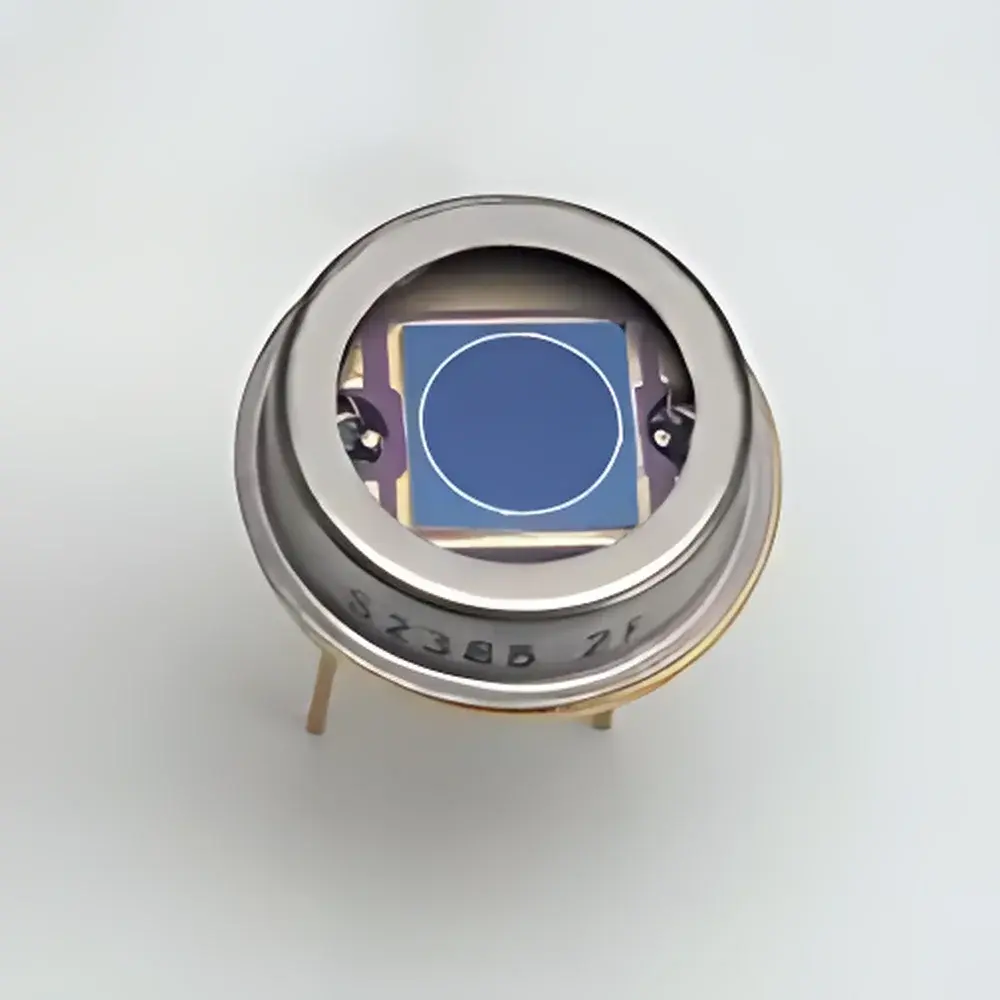
Hamamatsu Silicon Avalanche Photodiode (APD) Series S
| Brand | Hamamatsu |
|---|---|
| Origin | Japan |
| Manufacturer Type | Original Equipment Manufacturer (OEM) |
| Import Status | Imported |
| Model Series | S |
| Component Category | Optical Component |
| Spectral Range | 200–1150 nm |
| Active Area Options | Ø0.2 to Ø10 mm |
| Package Types | Metal, Ceramic, Plastic |
| Typical Gain | 50–200 (bias-dependent) |
| Rise Time | <0.5 ns to ~15 ns (model-dependent) |
| Breakdown Voltage | 120–400 V |
| Capacitance | As low as 0.12 pF (S8664-02K) |
| Bandwidth | Up to 700 MHz (S8664-02K) |
Overview
The Hamamatsu Silicon Avalanche Photodiode (APD) Series S represents a family of high-speed, internally gain-enhanced photodetectors engineered for ultra-low-light detection in demanding scientific and industrial applications. Unlike standard PIN photodiodes, these devices operate under reverse bias near or above the breakdown voltage—enabling impact ionization and controlled avalanche multiplication of photogenerated carriers. This internal gain mechanism delivers superior signal-to-noise ratio (SNR) at bandwidths unattainable with external amplification alone, making them ideal for time-resolved measurements, photon counting, LIDAR receiver modules, fluorescence lifetime spectroscopy, and quantum optics setups where detection efficiency, temporal resolution, and spectral fidelity are critical.
Key Features
- High internal gain (M = 50–200) with stable, temperature-compensated operation across multiple variants (e.g., S6045 series)
- Ultrafast response: rise times down to 0.5 ns and bandwidths up to 700 MHz (S8664-02K), optimized via minimized junction capacitance and tailored guard-ring design
- Broad spectral coverage from deep UV (200 nm) to near-infrared (1150 nm), with model-specific optimization for short-wave (S5344/S5345), visible–NIR (S2384/S2385/S3884), or low-capacitance UV–VIS (S8664 series)
- Multiple active area options (Ø0.2 mm to Ø10 mm) supporting trade-offs between sensitivity, speed, and spatial resolution
- Robust packaging in hermetically sealed metal, ceramic, or plastic housings—qualified for long-term stability in vacuum, cryogenic, or high-humidity environments
- Low dark current (<0.1 nA typical at M=100, 25°C) and excellent linearity over 4–5 decades of incident optical power
Sample Compatibility & Compliance
The Series S APDs are compatible with standard optical breadboards, fiber-coupled mounts (FC/PC, SMA), and OEM detector modules. All devices comply with RoHS Directive 2011/65/EU and meet JEDEC J-STD-020 moisture sensitivity level (MSL) requirements for surface-mount variants. Selected models (e.g., S6045-04/05/06) feature integrated thermistor networks enabling real-time bias compensation—supporting GLP-compliant calibration workflows in regulated analytical labs. While not certified to IEC 61000-4-x EMC standards out-of-box, they are routinely integrated into systems meeting ISO/IEC 17025-accredited test configurations for photometric validation per CIE S 023/E:2020 and ASTM E308-22.
Software & Data Management
Hamamatsu provides comprehensive technical documentation—including SPICE-compatible equivalent circuit models, spectral responsivity curves (in CSV and .mat formats), and bias sweep characterization data—for integration into LabVIEW, MATLAB, or Python-based acquisition pipelines. The company’s free Light Measurement Handbook and Photodetector Selection Guide support traceable system-level SNR modeling. For OEM integrators, Hamamatsu offers NDA-protected SDKs enabling closed-loop temperature and gain stabilization via analog feedback or digital I²C control—facilitating FDA 21 CFR Part 11–compliant audit trails when deployed in medical device or pharmaceutical QC instrumentation.
Applications
- Time-correlated single-photon counting (TCSPC) in confocal microscopy and FLIM
- Pulsed laser ranging and 3D scanning LIDAR receivers (905 nm and 1064 nm systems)
- UV-VIS spectrophotometry requiring sub-picoampere current resolution
- Quantum key distribution (QKD) receiver front-ends operating in gated mode
- Particle sizing via dynamic light scattering (DLS) with nanosecond timing resolution
- OEM integration into mass spectrometry ion detectors and radiation monitoring systems
FAQ
What is the typical operating bias voltage range for Series S APDs?
Operating voltage depends on model and desired gain; most require 70–95% of the specified breakdown voltage (e.g., 105–142 V for S2384, 280–380 V for S8664-02K). Precision, low-noise HV supplies with ripple <1 mVpp are recommended.
Can these APDs be used in photon-counting mode?
Yes—when operated in Geiger mode with active quenching (requires external circuitry), several models (notably S8664 series) achieve count rates >10⁶ cps with afterpulse probability <1% at room temperature.
Do Hamamatsu APDs require thermoelectric cooling?
Cooling is optional but strongly advised for low-dark-current applications (e.g., TCSPC, astronomy). Standard TO-8 metal packages support Peltier integration; some ceramic variants include integrated TEC drivers.
How is gain calibrated and maintained over time?
Gain is bias- and temperature-dependent. Hamamatsu provides gain vs. voltage/temperature lookup tables and recommends periodic verification using a NIST-traceable LED pulser (e.g., Hamamatsu C13572 series) per ISO/IEC 17025 calibration intervals.





