
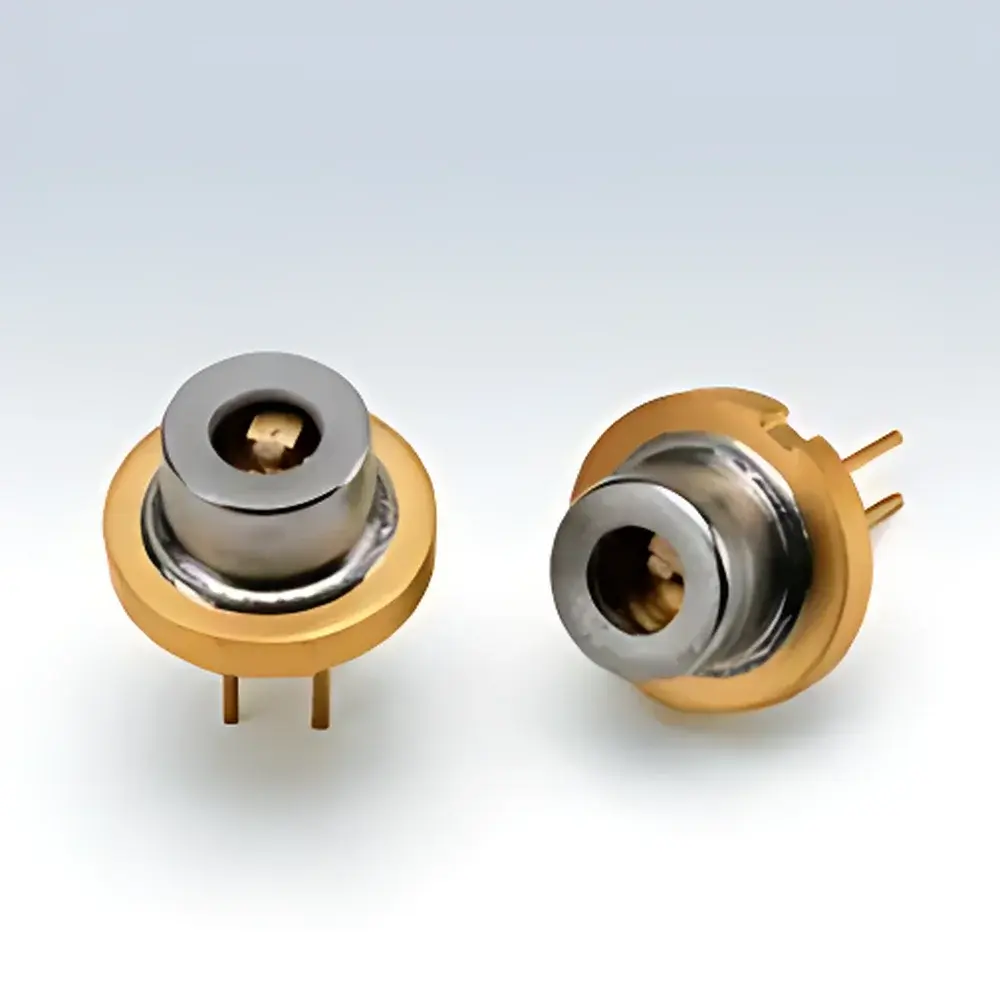
Hamamatsu L-Series Pulsed Laser Diodes
| Brand | Hamamatsu |
|---|---|
| Origin | Japan |
| Manufacturer Type | Original Equipment Manufacturer (OEM) |
| Import Status | Imported |
| Model Series | L-Series |
| Core Technology | Semiconductor Laser Diode |
| Typical Peak Emission Wavelengths | 870 nm & 905 nm |
| Typical Pulse Output Power Range | 11–90 W |
| Emission Aperture Area | 70–350 µm² |
| Package Types | Ø5.6 mm and Ø9.0 mm TO-Can (CD-type) |
Overview
Hamamatsu L-Series pulsed laser diodes are high-reliability, OEM-grade semiconductor light sources engineered for time-of-flight (ToF) optical sensing applications requiring short-duration, high-peak-power optical pulses. These devices operate on the principle of current-driven carrier injection in III–V compound semiconductor heterostructures (typically AlGaAs-based), generating nanosecond-scale optical pulses under controlled forward-biased current pulses. Unlike continuous-wave (CW) laser diodes, the L-Series is optimized for pulsed operation—enabling peak optical powers up to 90 W while maintaining low duty cycles (<0.1%), thereby minimizing thermal load and ensuring long-term operational stability. Their spectral output is centered at either 870 nm or 905 nm—wavelengths selected for optimal atmospheric transmission, silicon photodetector responsivity, and eye-safety compliance (IEC 60825-1 Class 1 or Class 1M under specified pulse conditions). These characteristics make them foundational components in industrial LiDAR systems, automotive ADAS sensors, industrial safety curtains, and perimeter intrusion detection platforms.
Key Features
- High peak optical power output: 11 W to 90 W (typical, under defined pulse conditions: e.g., 100 ns pulse width, 10 kHz repetition rate)
- Dual-wavelength options: 870 nm (optimized for high-speed Si PIN/APD detection) and 905 nm (enhanced atmospheric penetration and reduced solar background interference)
- Controlled emission aperture geometry: active region dimensions range from 70 µm to 350 µm, enabling tailored beam divergence and coupling efficiency into collimation optics
- Robust hermetic packaging: industry-standard Ø5.6 mm and Ø9.0 mm TO-can (CD-type) housings with integrated thermistor and monitor photodiode options for closed-loop drive control
- OEM-focused design: compatible with standard pulsed laser driver circuits; no integrated driver or TEC—designed for system-level thermal and electrical integration
- High pulse-to-pulse reproducibility: <±3% RMS power variation over 1,000-hour accelerated life testing at rated operating conditions
Sample Compatibility & Compliance
The L-Series is suitable for integration into optomechanical assemblies requiring precise spatial and temporal alignment—including fiber-coupled modules, free-space collimated transmitters, and multi-element array configurations. Devices comply with RoHS Directive 2011/65/EU and REACH Regulation (EC) No. 1907/2006. Optical safety classification is determined by system-level implementation per IEC 60825-1:2014; individual diodes are rated as Class 3B or Class 4 light sources when operated outside engineered safety enclosures—but achieve Class 1 or Class 1M when embedded in properly designed host systems meeting accessible emission limit (AEL) requirements. No FDA 510(k) clearance or CE medical device marking is applicable, as these are component-level emitters—not finished medical or diagnostic instruments.
Software & Data Management
As bare semiconductor emitters, L-Series diodes do not include embedded firmware, onboard memory, or digital communication interfaces. System-level integration requires external pulse generation hardware (e.g., FPGA-controlled laser drivers) and synchronization logic. Hamamatsu provides comprehensive datasheets, absolute maximum ratings tables, pulse I–V curves, near-field/far-field intensity profiles, and lifetime projection models (based on Arrhenius-activated degradation analysis) in PDF and SPICE-compatible formats. All technical documentation adheres to ISO/IEC 17025 traceable metrology practices where applicable, and supports GLP-compliant validation protocols for industrial qualification testing.
Applications
- Time-of-flight (ToF) LiDAR for autonomous mobile robots (AMRs), warehouse logistics scanners, and agricultural terrain mapping
- Automotive short- to mid-range object detection (SRR/MRR) in ADAS architectures compliant with ISO 26262 functional safety requirements
- Industrial machine vision: high-speed presence/absence detection in motion-controlled assembly lines
- Security and surveillance: active illumination for gated imaging, perimeter breach detection, and fog-penetrating surveillance systems
- Scientific instrumentation: pump sources for time-resolved fluorescence lifetime measurement (FLIM) and laser-induced breakdown spectroscopy (LIBS) trigger timing
FAQ
Are these laser diodes supplied with integrated drivers or cooling solutions?
No. The L-Series consists solely of bare semiconductor chips mounted in TO-can packages. Integration of laser drivers, thermoelectric coolers (TECs), or collimation optics must be performed at the system level.
What pulse width and repetition rate ranges are supported?
Devices are characterized for pulse widths from 50 ns to 200 ns and repetition rates up to 100 kHz. Absolute limits depend on thermal management—see Hamamatsu Application Note AP-002 “Pulsed Operation Guidelines” for derating curves.
Is wavelength binning available for tighter spectral tolerance?
Yes. Hamamatsu offers optional wavelength sorting (±2 nm binning at 870 nm and ±3 nm at 905 nm) for applications requiring spectral uniformity across multi-diode arrays.
Do you provide reliability test reports or MTTF data?
Yes. Accelerated life test reports (per JESD22-A108) and mean time to failure (MTTF) projections—calculated using Arrhenius modeling at junction temperatures of 25°C, 50°C, and 75°C—are included in the OEM support package upon NDA execution.
Can these diodes be operated in CW mode?
Not recommended. Continuous operation exceeds thermal design limits and risks rapid degradation. These devices are qualified exclusively for pulsed operation under defined duty cycle constraints.





