
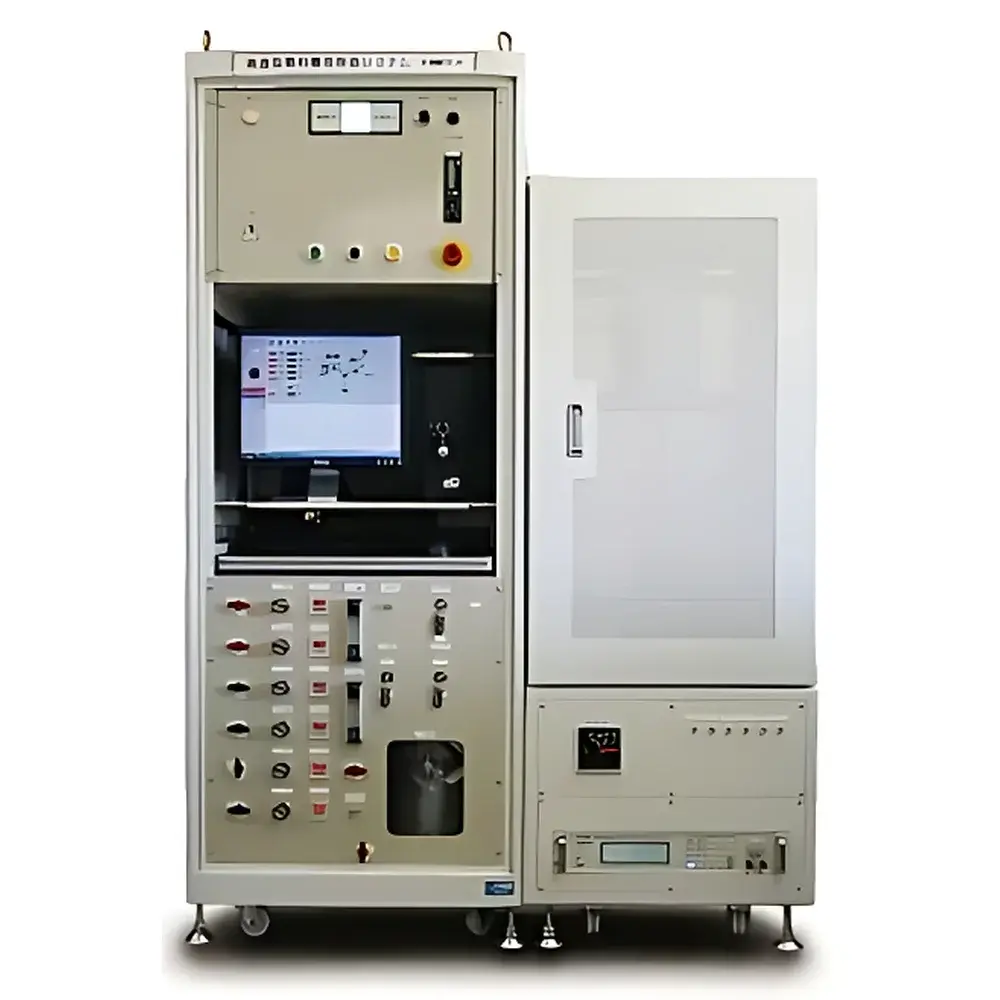
TOYO Corporation AutoSOFC2 Automated SOFC Testing System with Integrated Electrochemical Workstation
| Brand | TOYO Corporation (Japan) |
|---|---|
| Origin | Japan |
| Manufacturer Type | Authorized Distributor |
| Product Category | Imported Instrument |
| Model | AutoSOFC2 |
| Instrument Type | Electrochemical Workstation |
| Current Range | ±25 A |
| Current Accuracy | ±0.3% of full scale |
| Potential Accuracy | ±0.3% of full scale |
| Potentiostatic Range | ±10 V |
| EIS Frequency Range | 1 mHz – 10 kHz |
Overview
The TOYO Corporation AutoSOFC2 is a fully integrated, automated testing platform engineered for the rigorous electrochemical and thermo-mechanical evaluation of solid oxide fuel cells (SOFCs) and related ceramic-based electrochemical devices. Unlike conventional potentiostats or generic electrochemical workstations, the AutoSOFC2 combines high-current galvanostatic/potentiostatic control, precision gas delivery with active humidification, programmable high-temperature furnace management (up to 1400 °C), and multi-electrode impedance spectroscopy in a single synchronized architecture. Its core measurement principle relies on controlled current/voltage excitation combined with real-time acquisition of voltage response, polarization curves (I–V), ohmic resistance (via current-interrupt technique), and complex impedance spectra (EIS) under defined thermal and gas-phase conditions—enabling quantitative separation of activation, ohmic, and concentration overpotentials per ASTM D7286 and ISO 17225-7 guidelines.
Key Features
- Integrated system-level automation: Unified control of gas mixing (H₂/CO/CH₄/N₂/H₂O), humidification (dew point accuracy ±1 °C), furnace ramp/soak profiles, electrical loading, and data acquisition via proprietary TFT software.
- High-power electrochemical control: Dual-range electronic load (5 A / 25 A) supporting constant-current, constant-voltage, and constant-power modes; zero-voltage compatible with integrated 3.3 V auxiliary supply.
- Multi-point impedance capability: Simultaneous EIS acquisition at three terminal configurations—full cell, anode-reference, and cathode-reference—using optional Frequency Response Analyzer (FRA) module compliant with IEEE Std 118.
- ProboStat-compatible high-temperature sample holder: Enables structural and electrochemical testing up to 1400 °C; supports humidified gas inlet (dew point 40–80 °C) with optional humidification module.
- Traceable metrology: Current and potential accuracy certified to ±0.3% of full scale across operating ranges; all analog signal paths calibrated per ISO/IEC 17025 requirements.
Sample Compatibility & Compliance
The AutoSOFC2 accommodates planar and tubular SOFC single cells, anode-supported and electrolyte-supported architectures, and symmetrical cell configurations. It supports standard 10–25 mm diameter ceramic substrates and custom electrode geometries mounted on ProboStat-compatible fixtures. All gas-handling components meet ISO 8573-1 Class 2 purity standards for compressed air and inert gases. The system complies with IEC 62282-2 for fuel cell safety, EN 61000-6-3 for electromagnetic compatibility, and supports GLP/GMP audit trails when configured with 21 CFR Part 11-compliant software logging (optional add-on).
Software & Data Management
The TFT control software provides deterministic real-time scheduling of multi-step test protocols—including cyclic I–V sweeps, hold-and-measure sequences, accelerated stress tests (AST), and time-resolved EIS. Raw data are stored in HDF5 format with embedded metadata (timestamp, setpoints, environmental conditions, calibration IDs). Export options include CSV, MATLAB .mat, and MPT (BioLogic-compatible) formats. Audit trail functionality logs user actions, parameter changes, and instrument state transitions with SHA-256 hashing—enabling full traceability for regulatory submissions under FDA or EU MDR frameworks.
Applications
- SOFC performance mapping: Polarization curve generation under variable temperature (600–1000 °C), fuel composition (H₂, syngas, reformate), and humidity levels.
- Degradation mechanism analysis: Long-term durability testing with periodic EIS and current-interrupt IR monitoring to isolate interfacial delamination, chromium poisoning, or Ni coarsening kinetics.
- Electrocatalyst screening: Half-cell testing of novel cathode/anode materials using symmetrical cell configurations with reference electrode integration.
- Fuel flexibility assessment: Evaluation of carbon tolerance, sulfur poisoning recovery, and redox cycling stability using programmable gas switching sequences.
- System-level validation: Correlation of lab-scale cell data with stack-relevant boundary conditions (e.g., thermal gradients, gas cross-flow effects).
FAQ
What is the maximum operating temperature supported by the ProboStat fixture?
The ProboStat sample holder is rated for continuous operation up to 1400 °C in oxidizing or reducing atmospheres, with thermocouple feedback and PID-controlled furnace zones.
Does the AutoSOFC2 support dynamic gas composition switching during a test?
Yes—gas mixing is controlled via mass flow controllers (MFCs) with <100 ms response time; pre-programmed gas transition sequences can be embedded in TFT protocols.
Is the current-interrupt IR measurement performed automatically?
Yes—the 890ZV electronic load executes microsecond-scale current interruption synchronized with high-speed voltage sampling, calculating series resistance without user intervention.
Can EIS be measured simultaneously at anode, cathode, and full-cell terminals?
Yes—when equipped with the optional FRA module and triple-reference electrode cabling, the system acquires three independent impedance spectra within a single frequency sweep.
Is remote monitoring and control supported?
The TFT software includes secure WebSocket-based remote access (TLS 1.3 encrypted), enabling real-time dashboard viewing and protocol modification from authorized network endpoints.
Related Products





