
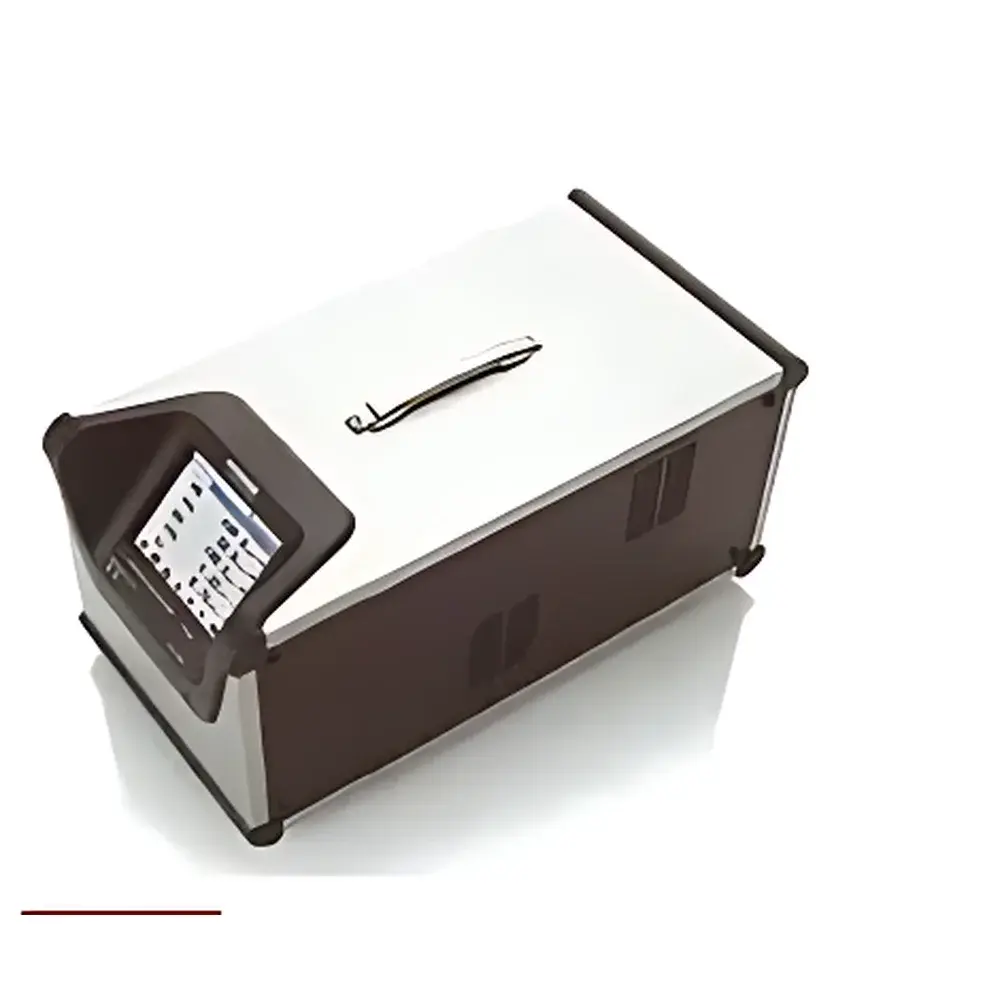
HORIBA PG-350 Portable Multi-Gas Analyzer
| Brand | HORIBA |
|---|---|
| Origin | Japan |
| Model | PG-350 |
| Instrument Type | Portable |
| Target Gases | NOx, SO₂, CO, CO₂, O₂ |
| Measurement Principle | Pulsed Flow Modulation Chemiluminescence (NOx), Pulsed Flow Modulation NDIR (SO₂, CO, CH₄), Broadband NDIR (CO₂), Galvanic Cell (O₂) |
| Range Options | NOx: 0–2500 ppm (7 ranges), SO₂: 0–3000 ppm (4 ranges), CO: 0–5000 ppm (5 ranges), CO₂: 0–30 vol% (3 ranges), O₂: 0–25 vol% (3 ranges) |
| Repeatability | ±1.0% FS |
| Drift | ±1.0% FS/day (SO₂: ±2.0% FS/day) |
| Linearity | ±2.0% FS |
| Response Time (T90) | ≤45 s (SO₂: ≤180 s) |
| Sample Flow Rate | ~0.5 L/min |
| Warm-up Time | 30 min |
| Operating Environment | 5–40 °C, ≤85% RH |
| Dimensions | 226 × 265 × 510 mm (W×H×D) |
| Weight | ~14 kg |
| Data Storage | SD card (user-configurable interval) |
| Outputs | 4–20 mA, Ethernet |
| Certifications | TÜV (EU), MCERTS (UK), GOST-R (Russia), ETV (US), CNAS/CMA (China), KOLAS (Korea), JIS/MIAC (Japan) |
Overview
The HORIBA PG-350 Portable Multi-Gas Analyzer is an engineered field-deployable solution for simultaneous, real-time quantification of up to five critical combustion and environmental gases—NOx, SO2, CO, CO2, and O2—with laboratory-grade metrological integrity. Built upon HORIBA’s proprietary pulsed flow modulation architecture, the instrument integrates multiple detection principles within a single compact platform: chemiluminescence detection for NOx, modulated non-dispersive infrared (NDIR) spectroscopy for SO2, CO, and CH4, broadband NDIR for CO2, and electrochemical galvanic cell sensing for O2. This multi-principle design ensures gas-specific selectivity, minimizes cross-sensitivity, and maintains traceable accuracy across dynamic industrial and regulatory measurement scenarios—including stack emissions verification, catalyst performance evaluation, and combustion optimization studies. The PG-350 operates at atmospheric pressure without sample dilution or pressurization, eliminating flow-dependent calibration artifacts and supporting direct hot/wet sampling when paired with optional conditioning modules.
Key Features
- Field-rugged chassis with shock-absorbing enclosure and vibration-damped internal optics—validated for transport and operation on mobile platforms including service vehicles and marine vessels.
- High-resolution 7-inch color capacitive touchscreen with intuitive icon-driven navigation, real-time trend plotting, and on-screen operational guidance—including step-by-step calibration prompts and fault diagnostics.
- Integrated electronic condensate management system with auto-drain and manual purge functions, enabling stable operation under high-humidity conditions (≤85% RH) without external chillers.
- Modular range configuration: users select from seven programmable NOx ranges (0–25 to 0–2500 ppm), four SO2 ranges (0–200 to 0–3000 ppm), five CO ranges (0–200 to 0–5000 ppm), three CO2 ranges (0–10 to 0–30 vol%), and three O2 ranges (0–5 to 0–25 vol%).
- Pre-warmed optical path and thermally stabilized detectors achieve full metrological readiness in ≤30 minutes—reducing downtime during sequential site surveys.
- Dual data output architecture: isolated 4–20 mA analog channels (per gas) plus IEEE 802.3-compliant Ethernet interface supporting Modbus TCP and HTTP-based data retrieval for integration into SCADA, DCS, or cloud-based EMS platforms.
Sample Compatibility & Compliance
The PG-350 accepts raw or conditioned flue gas streams with particulate loading ≤10 mg/m³ and dew point ≤40 °C. Optional heated sampling lines (up to 180 °C) and ceramic filter housings extend applicability to high-dust environments such as cement kilns and waste incinerators. All gas-specific measurements comply with ISO 12039 (CO2), ISO 7935 (CO), ISO 10849 (NOx), EN 14792 (SO2), and EPA Method 3A (O2). The analyzer meets MCERTS Performance Standards for portable reference analyzers (UK EA), TÜV Class 1 requirements (EN 15267-3), and has been independently verified per US EPA ETV Protocol for Continuous Emission Monitoring Systems. Full-system calibration—including sample probe, line, and analyzer—is traceable to NIST SRMs and supported by automated zero/span validation logs stored on removable SD cards.
Software & Data Management
Firmware v4.2 embeds GLP-compliant audit trail functionality: every calibration event, parameter change, or alarm condition is timestamped, user-ID tagged, and immutably recorded on the internal SD card. Data export supports CSV and XML formats with configurable sampling intervals (1 s to 1 h). Remote firmware updates and diagnostic access are enabled via secure HTTPS session over Ethernet; no proprietary software installation is required. The embedded web server provides live status monitoring—including detector health indicators, flow rate stability metrics, and condensate level warnings—accessible through standard browsers. All stored datasets include embedded metadata (location tag, operator ID, ambient T/RH, barometric pressure) to satisfy ISO/IEC 17025 documentation requirements.
Applications
- CEMS backup and periodic compliance verification per EU IED, US Clean Air Act §75, and China GB 13223–2011.
- In-situ combustion diagnostics for boiler tuning, burner optimization, and excess air ratio control.
- Catalyst aging studies in automotive exhaust labs and stationary power generation R&D facilities.
- Emissions characterization of biomass boilers, RDF-fired furnaces, and dual-fuel engines.
- Academic research in atmospheric chemistry, carbon capture process validation, and fuel reforming kinetics.
- Third-party verification services requiring portable, certified reference-grade instrumentation with full traceability documentation.
FAQ
Does the PG-350 support methane (CH4) measurement?
Yes—the PG-350 can be configured with an optional CH4 channel using pulsed-flow NDIR detection, with selectable ranges of 0–2000 ppm or 0–5000 ppm.
What is the minimum required sample flow rate for stable operation?
The analyzer maintains specified accuracy at nominal flow rates between 0.45 and 0.55 L/min; integrated mass flow control compensates for minor upstream fluctuations.
Can the PG-350 operate unattended for extended periods?
Yes—scheduled power cycling, automatic zero/span checks (configurable interval), and SD-card-based data logging enable autonomous deployment for up to 30 days without intervention.
Is the instrument suitable for measuring wet, corrosive flue gas?
When equipped with the optional heated sampling probe (up to 180 °C) and acid-resistant stainless-steel conditioning module, the PG-350 supports direct hot/wet measurement of SO2-rich streams with HCl concentrations up to 100 ppm.
How is calibration traceability documented?
Each factory calibration certificate includes uncertainty budgets per gas, referencing NIST-traceable standards; field calibrations generate machine-signed PDF reports with digital signatures compliant with FDA 21 CFR Part 11 Annex 11 requirements.
Related Products







