
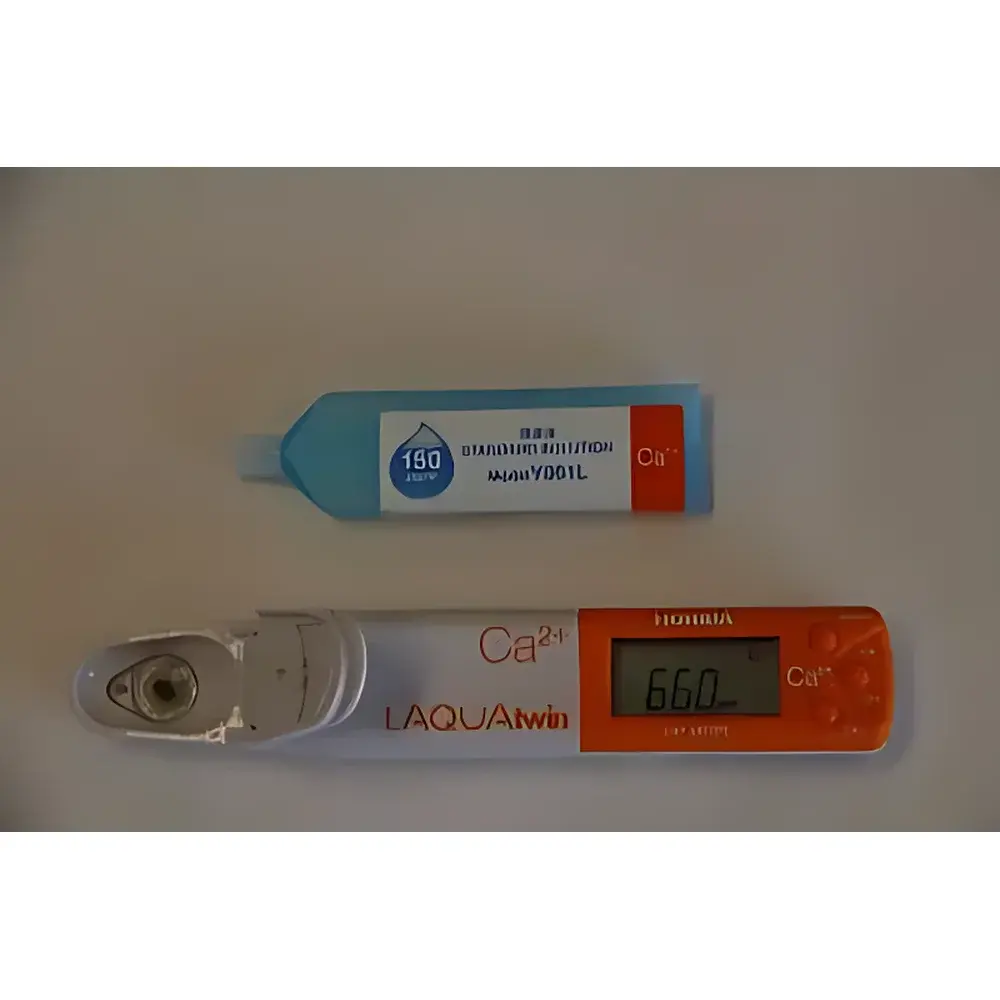
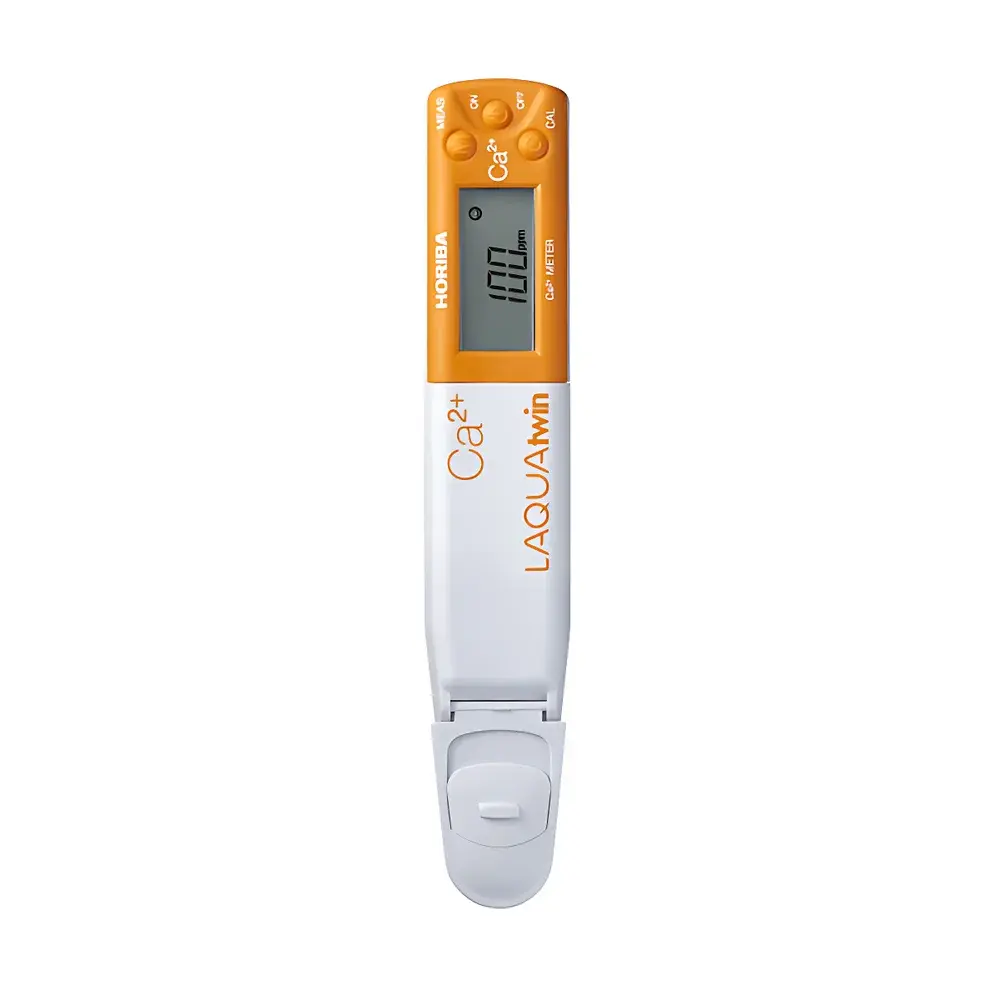
HORIBA B-751 Portable Calcium Ion Meter
| Brand | HORIBA |
|---|---|
| Origin | Japan |
| Model | B-751 |
| Measurement Principle | Ion-Selective Electrode (ISE) Method |
| Measuring Range | 40–4000 ppm (mg/L) Ca²⁺ (10⁻³–10⁻¹ mol/L) |
| Calibration | Two-Point Calibration |
| Accuracy | ±20% of reading |
| Sample Volume | 0.05 mL × 2 or ≥0.3 mL |
| Temperature Compensation | Automatic (2%/°C fixed coefficient) |
| Auto-Hold Function | Yes |
| Ingress Protection | IP67 |
| Operating Environment | 5–40°C, RH <85% (non-condensing) |
| Power Supply | Two CR2032 batteries |
| Dimensions (L×W×H) | 164 × 29 × 20 mm (excl. protrusions) |
| Weight | ~50 g (instrument only) |
Overview
The HORIBA B-751 is a compact, handheld calcium ion meter engineered for rapid, on-site quantification of free Ca²⁺ concentration in aqueous samples using solid-state ion-selective electrode (ISE) technology. Unlike optical or colorimetric methods, the B-751 relies on potentiometric detection—measuring the potential difference between a calcium-specific sensing membrane and a built-in reference electrode under Nernstian response conditions. This principle enables direct, real-time measurement without reagents or sample digestion, making it suitable for field-deployable water quality screening in environmental monitoring, aquaculture, irrigation management, and industrial process control. The instrument operates across a wide dynamic range (40–4000 mg/L Ca²⁺), covering concentrations typical of freshwater systems, brackish effluents, and moderately hard drinking water supplies. Its miniature form factor—measuring just 164 mm in length and weighing approximately 50 g—facilitates single-handed operation and integration into mobile laboratory workflows.
Key Features
- Ion-selective electrode (ISE) sensor with optimized Ca²⁺-selective membrane for stable Nernstian slope response (≈29.5 mV/decade at 25°C)
- Two-point calibration protocol supporting standard solutions traceable to NIST-certified reference materials
- Automatic temperature compensation (ATC) using a built-in thermistor; fixed 2%/°C correction coefficient aligned with ISO 7888 and ASTM D1125 guidelines for ion activity calculations
- Auto-hold function that freezes the stabilized reading upon signal convergence (±0.5 mV over 3 sec), reducing operator variability
- IP67-rated enclosure ensuring dust-tight integrity and submersion resistance up to 1 m for 30 minutes—validated per IEC 60529
- Low-power design powered by two replaceable CR2032 coin-cell batteries, providing >10,000 measurements per set under typical usage
- Compact ergonomic housing (164 × 29 × 20 mm) with tactile button layout optimized for gloved-hand operation in outdoor or industrial settings
Sample Compatibility & Compliance
The B-751 is validated for use with natural waters (surface, groundwater, wastewater effluent), treated drinking water, aquarium and hydroponic nutrient solutions, and low-TDS industrial rinse waters. It is not intended for high-ionic-strength matrices (>5000 µS/cm conductivity) or samples containing chelating agents (e.g., EDTA, citrate) or suspended solids >50 mg/L without prior filtration (0.45 µm). While the device itself does not carry CE marking for medical or food safety applications, its measurement methodology conforms to foundational principles outlined in ISO 10523 (pH), ISO 7888 (conductivity), and ASTM D511 (calcium in water) where applicable. Data output meets basic GLP documentation requirements when paired with manual logbook entries; however, it lacks electronic audit trail or 21 CFR Part 11 compliance features required for regulated pharmaceutical or clinical labs.
Software & Data Management
The B-751 operates as a standalone, firmware-based instrument with no Bluetooth, USB, or PC connectivity. All configuration, calibration, and measurement data reside exclusively on-device. Users record results manually or via external logging tools. Calibration history—including date/time stamp, standard concentrations used, and measured mV offsets—is retained in non-volatile memory for up to 10 calibration cycles. No proprietary software or drivers are required. For laboratories requiring digital data capture, integration is achieved through manual transcription or third-party OCR-enabled mobile apps compatible with standard PDF or CSV export protocols.
Applications
- Field assessment of water hardness in municipal distribution networks and rural well systems
- Routine monitoring of calcium levels in recirculating aquaculture systems (RAS) to maintain optimal osmoregulation
- Verification of calcium dosing in greenhouse fertigation reservoirs and soilless cultivation media
- Pre-compliance checks for calcium content in pretreated boiler feedwater or cooling tower makeup
- Educational demonstrations of ion activity, selectivity coefficients, and the Nernst equation in undergraduate analytical chemistry labs
- First-response screening during environmental incidents involving gypsum dissolution or cement leaching into surface runoff
FAQ
What sample volume is required for accurate measurement?
A minimum of 0.05 mL per measurement is specified, though reproducibility improves significantly with ≥0.3 mL—especially in low-conductivity samples (<100 µS/cm). Ensure full immersion of both the sensing membrane and reference junction.
Can the B-751 measure total calcium or only free Ca²⁺?
It measures only the activity of free, hydrated Ca²⁺ ions in solution—not total calcium bound in complexes or particulates. Chelated or precipitated forms require acid digestion prior to analysis.
Is calibration with certified standards mandatory?
Yes. Two-point calibration using traceable Ca²⁺ standards (e.g., 100 ppm and 1000 ppm in 0.01 M KNO₃ background) is required to establish slope and intercept per ISO 17025-recommended practice for ISE instruments.
How often should the electrode be cleaned or conditioned?
Rinse with deionized water after each use. Soak the sensing tip in 0.1 M CaCl₂ for 30 minutes weekly if used daily; store dry in protective cap. Replace the ISE module every 12–18 months under continuous field use.
Does the B-751 support measurement of other ions?
No. The B-751 is dedicated solely to calcium. HORIBA’s B-7xx series includes separate models for pH (B-711), conductivity/salinity (B-771), nitrate (B-722), potassium (B-731), and sodium (B-741–743); each employs a chemically distinct electrode architecture.
Related Products







